Running Claude Code and Codex Unattended on a Mac: An Autonomous Task Queue You Can Control from Your Phone

Untether uses a task queue, git worktree isolation, and persistent tmux sessions to let AI coding agents run unattended and autonomously.
Untether is an unattended AI coding agent system built to solve the pain point of having to sit at the terminal. Users queue tasks at once, and agents execute builds, tests, and merges sequentially in isolated git worktrees; failed tasks are automatically kicked back to keep the main branch clean. All sessions run in real tmux sessions on the Mac, so closing the browser or losing your phone's connection won't interrupt the work. From the phone, you can view the task queue, live terminals, and code changes, connecting through a private Tailscale network without exposing anything publicly. The project is built as a fork of the MIT-licensed VibeTunnel, with a Node/TypeScript server, a Rust terminal-capture component, and a Swift Mac app, and is not yet public.
Why You Need Unattended AI Coding Agents
Most AI coding agents don't need human intervention for 95% of their working time, yet developers still have to sit at the terminal just in case a task finishes or gets stuck. A developer on Reddit (project codenamed Untether) described this problem in a very relatable way: he runs Claude Code and Codex on his Mac all day, yet he's constantly tethered to the question of "do I need to glance at the terminal?" His solution was to combine a task queue, automated build-and-test, auto-merge, and phone-based remote control into a single system that lets agents run autonomously in a local environment.
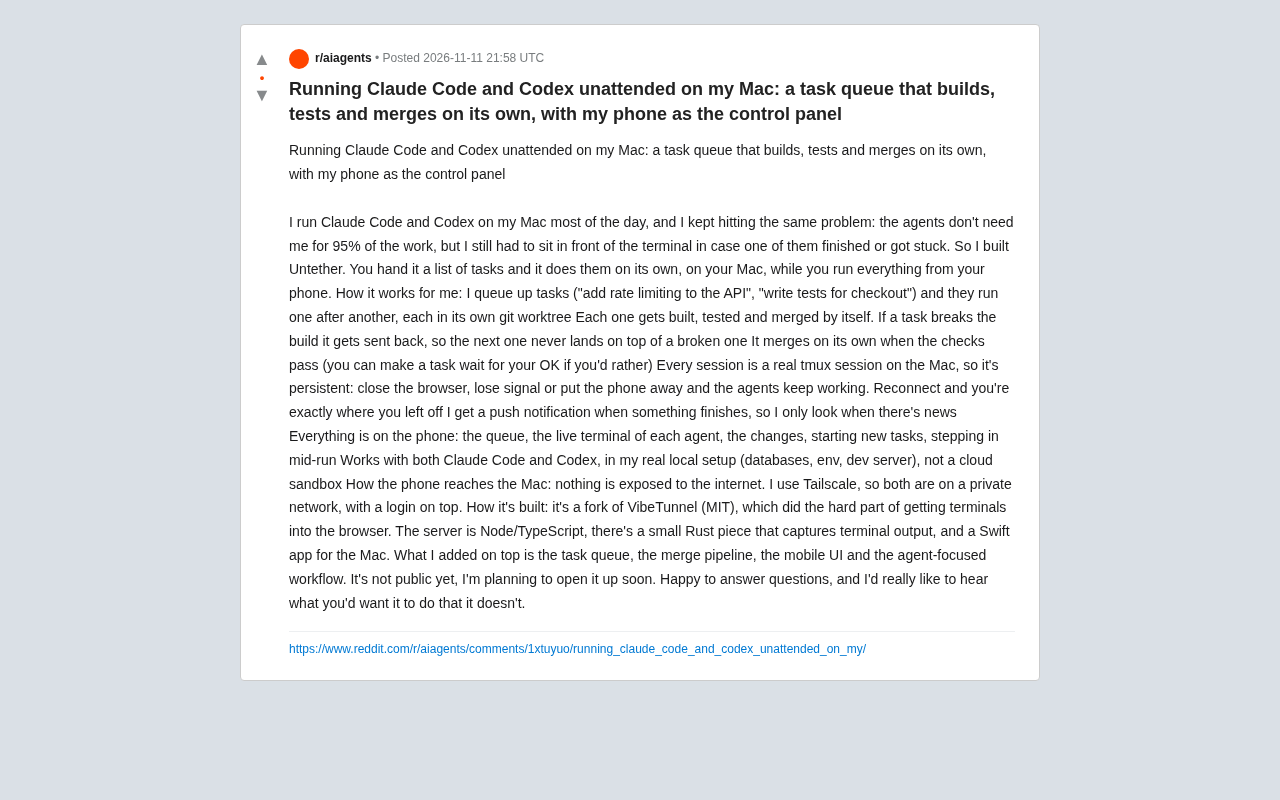
The core idea behind this approach isn't complicated: queue up a batch of tasks at once, let the agents execute them in sequence, and have each task complete its build, test, and merge in an isolated git worktree. If a task breaks the build, it gets automatically kicked back and won't contaminate subsequent tasks. Once checks pass, changes are auto-merged (or you can configure it to wait for manual approval). All sessions are real tmux sessions on the Mac, so they're persistent—closing the browser, losing signal, or putting your phone away won't interrupt the work, and the state is fully preserved when you reconnect.
How the Task Queue Runs Autonomously
The Loop from Queueing to Merge
According to the original post, users simply provide a task list—things like "add rate limiting to the API" or "write tests for the checkout flow"—and the system executes them one by one. Each task gets its own git worktree, which means tasks don't interfere with each other. Tasks that fail their build or tests are sent back, ensuring the next task doesn't start on top of already-broken code. After checks pass, the system auto-merges, or users can configure it to require manual approval.
This design solves a key pain point: when agents work in parallel, code conflicts and broken builds are common problems. Through worktree isolation and a "fail and kick back" mechanism, the queue keeps the main branch stable.
git worktree is a Git mechanism that allows checking out multiple working directories on the same repository at once, each on a different branch or commit. Unlike git clone, worktrees share the same .git object database, so creation and switching are cheap. In the AI agent context, giving each task its own worktree means agents can modify code in parallel without overwriting each other, and builds and tests run in isolated environments. Even if a task fails or produces dirty data, you just discard the corresponding worktree—the main branch and subsequent tasks are unaffected, which is the foundation that makes "fail and kick back" work.
Persistence and Push Notifications
Each session runs in a real tmux session on the Mac, not an ephemeral cloud sandbox. Closing the browser or losing your phone's connection won't stop the agent from continuing its work. When a task completes, the user receives a push notification, so they only need to check in when there's progress. This point matters—unattended doesn't mean completely hands-off; it means turning "constant screen-watching" into "event-driven" check-ins.
tmux is a terminal multiplexer that decouples the terminal session from the user's current connection: the session keeps running in the background, and after disconnecting SSH, closing the browser, or switching devices, the user can re-attach to restore the full state. The article emphasizes "real tmux sessions" rather than cloud sandboxes—the key point is that tmux runs on the developer's own machine, so agent processes can directly access local databases, environment variables, and dev servers while retaining disconnect-recoverable persistence, which is fundamentally different from ephemeral containers.
The Phone as Control Panel
Everything can be done from the phone: view the task queue, view each agent's live terminal, view code changes, start new tasks, and intervene mid-run. The system is compatible with both Claude Code and Codex and runs in the developer's real local environment (including databases, environment variables, and dev servers) rather than a cloud sandbox.
The connection between phone and Mac is handled by Tailscale, with both devices on a private network plus an additional layer of login authentication—nothing is exposed to the public internet. This design balances convenience and security: developers can achieve remote control without configuring port forwarding or a public IP.
Tailscale is a mesh VPN built on the WireGuard protocol that lets different devices form a private network without port forwarding or a public IP. Each device gets a stable private IP, traffic is end-to-end encrypted, and only devices within the same tailnet can reach each other. For remote-control scenarios like Untether, Tailscale puts the Mac and phone on the same virtual LAN, and with application-layer login authentication on top, it avoids exposing terminal services directly to the public internet, significantly reducing the attack surface.
Technical Architecture: Standing on the Shoulders of VibeTunnel
Untether is a fork of VibeTunnel (MIT license). VibeTunnel solved the hardest part: getting terminal output into the browser. The server side uses Node/TypeScript, with a small Rust component responsible for capturing terminal output, and a Swift app on the Mac side. The developer added the task queue, merge pipeline, mobile UI, and agent-oriented workflows on top of that foundation.
This architectural choice is worth noting: rather than building terminal streaming from scratch, it reuses a mature open-source project. For developers who want to build similar tools, this "reuse the foundation + build your own workflows" strategy can significantly reduce development costs. Untether isn't public yet, but the author plans to open-source it soon.
VibeTunnel is an open-source project whose goal is to present local terminal sessions through the browser, letting developers access the shell on their Mac from any device's browser. Its architecture typically includes a local component that captures PTY (pseudo-terminal) output, a server that handles forwarding and WebSocket communication, and a native macOS shell app. Streaming terminal output involves low-latency encoding and session management, which is the most technically difficult part of such tools—so Untether chose to reuse VibeTunnel directly rather than reinvent the wheel, focusing its effort on higher-level workflows like the task queue and merge pipeline.
Implications for AI Coding Workflows
This project reflects a trend: AI coding agents are getting more capable, but the "workflow infrastructure" around them is still primitive. Most developers currently manage agents manually in the terminal, lacking mechanisms for queueing, isolation, and auto-merge. Untether's attempt shows that when agents can autonomously handle large amounts of work, the real bottleneck shifts from "is the agent smart enough" to "how do you organize the agent's work."
Another signal worth watching is mobile control. When agents can run autonomously for long stretches, developers don't need to be tied to their desks. Using a phone to check progress, approve merges, or intervene in anomalies may become a standard interaction for AI coding tools. Of course, this model also introduces new trust issues: auto-merge means code enters the main branch without human review, so developers need to decide based on project risk whether to enable auto-approval.
At the end of the post, the author asked the community for input: what features would you want this tool to have that it currently lacks? This itself shows that the tooling around AI coding agents is still in an early exploratory phase, and best practices haven't yet formed.
One-line Summary
Untether uses a task queue, git worktree isolation, and persistent tmux sessions to let AI coding agents run autonomously and unattended.
Paragraph Summary
Untether is an unattended AI coding agent system built by a developer to address the pain point of "having to sit at the terminal." Users queue up tasks at once, and agents execute builds, tests, and merges sequentially in isolated git worktrees; failed tasks are automatically kicked back to avoid contaminating the main branch. All sessions run in real tmux sessions on the Mac, so closing the browser or losing your phone's connection won't interrupt the work. From the phone, you can view the task queue, live terminals, and code changes, connecting to the Mac through a private Tailscale network without exposing anything to the public internet. The project is built as a fork of the MIT-licensed VibeTunnel, with a Node/TypeScript server, a Rust terminal-capture component, and a Swift Mac app, and is not yet public.
Related articles

AI Could Overthrow Governments in Six Months? ARC Head Issues His Starkest Warning Yet
ARC head Paul Christiano warns AI capable of overthrowing governments may arrive in 6-12 months, with ~one-third odds of superintelligence within a year. He urges frontier labs to pause algorithmic efficiency gains and fix safety first, and reveals how the Hugging Face incident foreshadowed AI taking over evaluation.

How Do Spies Infiltrate Nvidia? A CIA Agent Reveals a Honeypot Operation
A former CIA agent reveals in a YouTube interview that intelligence agencies ran a honeypot seduction operation against Nvidia CEO Jensen Huang, exposing the hidden spy risks facing tech executives.

How NVIDIA Cosmos Helps Delivery Robots Rehearse Unexpected Situations in Advance
NVIDIA Cosmos World Foundation Model expands a small amount of real input into large-scale synthetic scenarios, enabling delivery robots to train for unexpected situations in simulation in advance. Cocoa Robotics uses it to cover unexpected events and combines Isaac Sim and Isaac Lab to evaluate perception, prediction, and path planning.