Running Opus 5.5 Locally: The Compute Barrier and AI's 'Mainframe Era'

Reddit debates the barrier to running Opus 5.5 locally: short-term VRAM, long-term chip architecture.
A Reddit post about "running Opus 5.5 locally" sparked a hundred-comment discussion, with consensus that it's nearly impossible at current hardware levels—requiring personal data center-scale investment, and open-source inference solutions are far less optimized than top labs. The real focus is how long the barrier will last: one side cites the history of computer miniaturization and Amodei's Law (compute demand halving every 8 months), believing it could run on a phone or single card within 5 to 10 years; the other questions physical limits with "Moore's Law is dead." Technical paths diverge between stacking GPUs (e.g., a 72-Blackwell rack) and ASIC/neuromorphic chips (e.g., Taalas). On cost, enterprises building their own clusters can save on token fees when engineer scale is large, but VRAM is a hard threshold—about 80% cannot be amortized through multiplexing.
What Does It Actually Take to Run Opus 5.5 Locally?
A Reddit post has sparked a lively discussion: someone shared a "local Opus 5.5" setup, and the community auto-generated a discussion summary after 100 comments. The conclusion is unsurprising—almost everyone agrees that with current hardware, running a model of this caliber locally would require a personal data center and a hefty budget.
Top-voted comments bluntly state that the hardware alone would "cost a fortune," and even with a full rack of equipment, open-source inference solutions are far less optimized than those from top labs, so real-world performance would be compromised. Some even argue the original post's estimates were conservative.
But the real focus of the discussion isn't "can we run it now"—it's "how long will this barrier last?"
The Core Divide: Temporary Problem or Long-Term Wall?
The consensus in the thread is clear: running Opus 5.5 locally isn't realistic today. But the community is almost evenly split on the question—one side sees it as a temporary engineering problem, the other worries that physical limits are closing in.
The "temporary" camp holds the majority. The most common argument is a historical analogy: computers once filled entire rooms, now they fit in your pocket. Many predict that within 5 to 10 years, today's frontier models will run on a phone or a single GPU.
The other camp invokes "Amodei's Law"—the compute required for a given level of intelligence roughly halves every 8 months. If this trend holds, the timeline for local deployment of frontier models would be faster than intuition suggests.
Skeptics counter with "Moore's Law is dead," arguing that transistors are nearing physical limits and things aren't so simple.
Amodei's Law is the community's nickname for observations attributed to Anthropic CEO Dario Amodei, stating that the compute needed to sustain a fixed level of intelligence roughly halves every 8 months—i.e., costs drop by about half every 8 months. This empirical rule is far more aggressive than Moore's Law (roughly doubling every 18-24 months). If it holds, a model requiring data-center-scale investment today might run on a single consumer GPU or even a phone in a few years. Note that this law describes the cost of "achieving equivalent capability," not the cost of "frontier capability"—the latter tends to rise with scale, and the two aren't contradictory. This is precisely the crux of the community debate: whether you can run today's Opus locally depends on which curve you're aiming at.
Moore's Law is dead refers to the traditional cadence of "transistor density doubling roughly every two years" clearly slowing at nodes below 5nm, with diminishing process gains and worsening leakage and thermal issues. Skeptics use this to argue that process advances alone can't squeeze data-center-scale compute into your pocket in the short term—architectural innovation is required.
The Hardware Path Debate: GPU, ASIC, or Neuromorphic Chips?
On the question of "how to achieve it," the community offered several different technical paths.
The most direct idea is stacking GPUs. One comment mentions that 72 Blackwell chips forming a rack roughly matches the scale Opus requires. But someone immediately counters: Opus's parameter count is very likely in the trillions, requiring massive VRAM; and massive VRAM inevitably comes with massive compute, meaning the entire rack wouldn't serve a single user's session but would run tokens for many users simultaneously through multiplexing, keeping compute saturated. This is precisely why cloud computing resource utilization is typically higher than personal devices—like a private car, which sits parked most of the time.
Another path bets on new architectures. One user points out that people assume LLMs must use GPUs, but if Claude really wanted to sell Opus 5.5, it might only need a single processor—neuromorphic computing is a real direction.
Taalas is repeatedly mentioned as a typical example, especially with interest in how this path will evolve after AMD's acquisition. One comment paints a future vision: once LLM capabilities plateau, people will buy and swap LLM chips like they swap graphics cards.
ASIC (Application-Specific Integrated Circuit) is a chip customized for a specific task, as opposed to general-purpose GPUs. In LLM inference scenarios, ASICs can "bake" model weights into silicon and customize data paths, achieving significantly better energy efficiency and unit cost than general-purpose GPUs—but at the cost of poor flexibility, high tape-out costs, and difficulty adapting to rapidly iterating models. Taalas, mentioned in the article, is a representative of this path, whose approach is to fix the model directly onto the chip to achieve extremely high inference efficiency.
Neuromorphic Computing mimics the spiking operation of biological neurons, characterized by event-driven, sparse activation, and theoretically far exceeds traditional von Neumann architectures in energy efficiency. But the current ecosystem is immature, with programming models quite different from mainstream frameworks, making it difficult to support general LLM inference in the short term. The comment section views it as a long-term vision of "swapping chips on demand once LLM capabilities plateau," reflecting an expectation for architectural diversity rather than a ready-made solution.
The Enterprise Ledger: Buy Machines or Buy Tokens?
An easily overlooked angle in the discussion is the difference in cost structure. One comment does the math: for any company with a large number of engineers, buying such a setup is far more economical than continuously paying token fees.
But another user's addition is key: even if this setup could support many users simultaneously, to load model weights—even to serve just one user—about 80% of the VRAM must physically exist. In other words, VRAM is a hard threshold that can't be amortized through multiplexing.
This also explains why "open-source solutions aren't optimized enough" becomes a recurring pain point—with the same hardware, top labs can extract more effective throughput.
Multiplexing and the VRAM hard threshold are key to understanding the cost structure. During inference, model weights must fully reside in VRAM to respond to requests; multiplexing refers to concurrently processing tokens for multiple users on the same set of weights, thereby amortizing unit costs. But as the article notes, the VRAM occupied by loading weights itself cannot be amortized—even to serve just one user, about 80% of VRAM must physically be present. Therefore, the economics of enterprises building their own clusters hold only when concurrency is high enough that the fixed VRAM cost allocated per token is low enough; if utilization is insufficient, self-hosting becomes more expensive than pay-as-you-go. This also explains why cloud providers' resource utilization is typically far higher than personal devices.
Editorial View: Short-Term Hardware, Long-Term Architecture
The value of this discussion isn't in reaching a "can it run" conclusion, but in clearly presenting two timescales of the AI compute problem.
In the short term, VRAM and optimization are hard constraints. Trillion-parameter models require matching VRAM, and the efficiency gap in open-source inference stacks further worsens the cost-effectiveness of local deployment. The economics of enterprises building their own clusters hold, but only if utilization is high enough.
In the long term, architectural innovation is the variable. Whether it's ASICs baking weights into silicon or neuromorphic computing bypassing traditional GPU paths, both point in the same direction: improvements in inference efficiency may come from changes in chip form rather than mere process advances. As for whether "compute demand halving every 8 months" or "Moore's Law is dead" is closer to reality, the community has no answer—which itself shows the question remains open.
As for the comments asking "are there Black Friday discounts" and "can it run Crysis," they add a bit of community-specific levity to this serious discussion.
One-line Summary
Reddit debates the barrier to running Opus 5.5 locally: short-term VRAM, long-term chip architecture.
Paragraph Summary
A Reddit post about "running Opus 5.5 locally" sparked a hundred-comment discussion, with consensus that it's nearly impossible at current hardware levels—requiring personal data center-scale investment, and open-source inference solutions are far less optimized than top labs. The real focus is how long the barrier will last: one side cites the history of computer miniaturization and Amodei's Law (compute demand halving every 8 months), believing it could run on a phone or single card within 5 to 10 years; the other questions physical limits with "Moore's Law is dead." Technical paths diverge between stacking GPUs (e.g., a 72-Blackwell rack) and ASIC/neuromorphic chips (e.g., Taalas). On cost, enterprises building their own clusters can save on token fees when engineer scale is large, but VRAM is a hard threshold—about 80% cannot be amortized through multiplexing.
Related articles
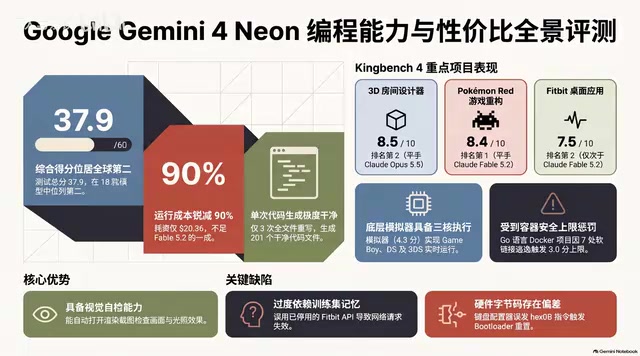
Gemini 4 Neon Hands-On: Value King or Confident Catastrophe?
Gemini 4 Neon review: 1M-token context, four thinking levels, 201 files in one KingBench4 pass at one-tenth Fable 5.2's cost—but it hallucinates fake data, leaves 7 symlink escapes, and bricks keyboards.

Google Gemini 4 Neon Hands-On: 6 3D Works That Impress and Fail
Hands-on with Google Gemini 4 Neon on a 3060 laptop: 6 3D works tested. Sunshower Fishing Harbor and mechanical keyboard impress; soft-body physics and faces fall short.

Gemini 4 Neo Web Novel Writing Test: Faint AI Flavor, Textured Dialogue
Bilibili creator's first-look review of Gemini 4 Neo for Chinese web novel writing: testing a Three Kingdoms transmigration opening with faint AI flavor, emotionally textured dialogue, and strong crisis building, plus comparison of 4A/4H/4C models and full workflow demos.