SafePay Ransomware Hits 600+ Critical Infrastructure Organizations: The Pitfall of Supply Chain Data Hosting
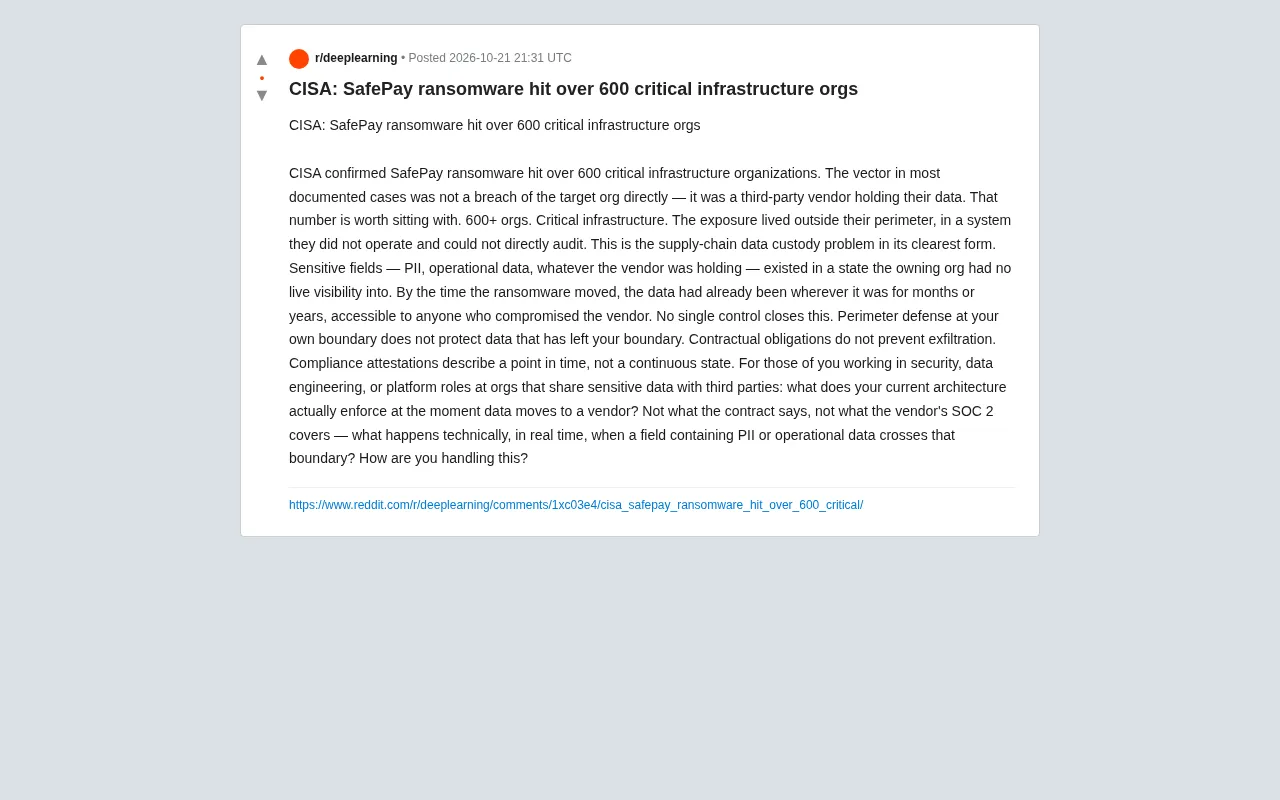
SafePay ransomware attacks 600+ critical infrastructure organizations via third-party vendors, exposing systemic risks of supply chain data hosting.
SafePay ransomware has attacked over 600 critical infrastructure organizations. CISA confirms most attacks penetrated through third-party vendors holding data rather than directly breaching the targets' own defenses. This exposes the systemic risks of supply chain data hosting: sensitive data flows long-term through external systems where owners lack real-time visibility. Traditional perimeter defense, contractual obligations, and compliance certifications collectively fail in supply chain scenarios, and attackers exploit precisely the technical blind spot between data owners and holders. The article recommends that security and data engineering practitioners re-examine data flow architecture from four dimensions—data minimization, real-time visibility, encryption and access control, and continuous verification—to drive a shift from "trust but verify" to "zero trust data flow," closing the gap through technical means rather than relying solely on contracts and certifications.
Event Core: 600+ Critical Infrastructure Organizations Hit by SafePay Ransomware
According to CISA (Cybersecurity and Infrastructure Security Agency) confirmation cited by the Reddit community, the SafePay ransomware has attacked over 600 critical infrastructure organizations. This number alone is shocking enough, but what deserves deeper scrutiny is the attack entry point—in most documented cases, attackers did not directly breach the target organizations' own defenses, but instead penetrated through third-party vendors that hold their data.
This means that the sensitive data of over 600 critical infrastructure organizations has long been flowing through external systems that they cannot directly audit or monitor in real time. When the ransomware finally detonates, the data may have been sitting with vendors for months or even years, accessible to anyone who breaches that vendor.
CISA (Cybersecurity and Infrastructure Security Agency) is a federal agency under the U.S. Department of Homeland Security, responsible for coordinating cybersecurity protection for critical infrastructure, publishing threat intelligence and security advisories, and providing technical support during major cyber incidents. CISA confirmation is generally regarded as a relatively high-credibility source, but its statements are often sanitized, and specific victim organization lists and attack details may not be fully disclosed. In this incident, CISA's confirmation means that SafePay's attacks have constituted a cross-industry, cross-regional systemic threat rather than isolated events.
Critical Infrastructure refers to industry assets of strategic importance to social operation and national security, covering energy, water, transportation, finance, healthcare, communications, and other sectors. Once such organizations suffer data breaches or system paralysis, the impact often extends beyond a single enterprise and may affect public services and upstream/downstream supply chains. Therefore, the severity of the 600+ figure lies not only in its scale but also in the industry attributes of the victims.
Ransomware is a type of malware that encrypts victims' data or systems and demands ransom in exchange for decryption keys. Modern ransomware attacks have evolved into "double extortion" or even "multiple extortion": attackers steal data before large-scale encryption, and if victims refuse to pay, they threaten to publicly disclose sensitive information. SafePay's modus operandi fits this trend—after penetrating through vendors, attackers may have maintained long-term persistence and stolen data, then chosen the timing to launch encryption-based extortion, putting victims under dual pressure of data breach and business disruption.
Systemic Risks of Supply Chain Data Hosting
This incident exposes the "supply chain data hosting problem" in its clearest form. Sensitive fields—personally identifiable information (PII), operational data, or anything else held by vendors—exist in a state where the data owner has no real-time visibility. For practitioners working in security, data engineering, or platform roles who need to share sensitive data with third parties, a sharp question emerges: at the moment data flows to a vendor, what does your architecture technically enforce?
Not what the contract says, not what the vendor's SOC 2 certification covers, but what technical actions occur in real time when fields containing PII or operational data cross the boundary.
Collective Failure of Traditional Controls
No single control measure can close this gap.
- Perimeter defense: Cannot protect data that has already left your perimeter.
- Contractual obligations: Cannot prevent data exfiltration.
- Compliance certifications: Describe a state at a point in time, not a continuous state.
These measures operate in isolation in supply chain scenarios and cannot form an effective synergy. Attackers exploit precisely this gap—the technical blind spot between data owners and data holders.
SOC 2 certification is an audit framework developed by the American Institute of Certified Public Accountants (AICPA) to evaluate service organizations' controls in security, availability, processing integrity, confidentiality, and privacy. SOC 2 reports are divided into Type I (control design at a point in time) and Type II (operating effectiveness of controls over a period), but regardless of type, it is essentially a sampling assessment of "control status within the audit window" and does not constitute continuous assurance of a vendor's real-time security posture. A vendor obtaining SOC 2 certification only indicates that it met established control standards during the audit period; it cannot rule out configuration drift, privilege abuse, or new vulnerabilities that emerge between audits. Therefore, treating SOC 2 as a sufficient condition for supply chain security is precisely the root cause of the compliance certification failure in this incident.
Implications for Security and Data Engineering Practitioners
For critical infrastructure organizations, this incident sounds an alarm: the architecture design of data sharing needs to shift from "trust but verify" to "zero trust data flow." Specifically, several technical questions need to be answered:
- Data minimization: Are the fields shared with vendors truly necessary? Can sensitivity be reduced through anonymization or tokenization?
- Real-time visibility: When data is accessed on the vendor side, can the owner receive real-time alerts or audit logs?
- Encryption and access control: Does data remain encrypted in the vendor environment, with keys controlled by the owner?
- Continuous verification: Beyond compliance certifications, are there technical means to continuously verify the vendor's security posture?
These questions have no standard answers, but the SafePay incident demonstrates that ignoring them will exact a heavy price. The plight of 600+ critical infrastructure organizations is a concentrated outbreak of supply chain data hosting risks and a challenge to the entire industry's architectural design thinking.
This article is based on CISA confirmation information cited by the Reddit community, combined with analysis of common supply chain security risk patterns. Specific attack details are subject to official disclosure.
Zero Trust is a security architecture concept whose core principle is "never trust, always verify"—access is not automatically granted because a request comes from the internal network or an authenticated partner; instead, every access request undergoes continuous identity verification, least-privilege authorization, and contextual evaluation. Extending zero trust to data flow scenarios means data owners cannot assume vendor environments are trustworthy, but should use encryption, tokenization, attribute-based access control (ABAC), and continuous auditing to ensure data remains constrained by technical policies after leaving the perimeter. This forms a fundamental departure from the traditional "perimeter defense + contractual trust" model and is the theoretical basis for the "zero trust data flow" proposed in this article.
One-line Summary
SafePay ransomware attacks 600+ critical infrastructure organizations through third-party vendors, exposing systemic risks of supply chain data hosting.
Paragraph Summary
SafePay ransomware has attacked over 600 critical infrastructure organizations. CISA confirms that most attacks penetrated through third-party vendors holding data rather than directly breaching the targets' own defenses. This exposes the systemic risks of supply chain data hosting: sensitive data flows long-term through external systems where owners lack real-time visibility. Traditional perimeter defense, contractual obligations, and compliance certifications collectively fail in supply chain scenarios, and attackers exploit precisely the technical blind spot between data owners and holders. The article recommends that security and data engineering practitioners re-examine data flow architecture from four dimensions—data minimization, real-time visibility, encryption and access control, and continuous verification—to drive a shift from "trust but verify" to "zero trust data flow," closing the gap through technical means rather than relying solely on contracts and certifications.
Related articles

RAG Interview Essentials: Breaking Down the Full Offline Indexing and Online Retrieval Pipeline
A complete breakdown of the RAG retrieval-augmented generation workflow: offline document loading, chunking, vectorization, and indexing; online query rewriting, vector retrieval, reranking, and generation, plus core interview points and system optimization directions.

AI Large Models for Absolute Beginners: Principles and API Calling in Practice
From AI's evolution to large model training principles and core concepts like Token, Temperature, and Top-P, this article explains system prompts, Function Call, RAG, and memory with hands-on examples and four API call scenarios—ideal for beginners.

Will GitHub Die? Open Source Maintainer Burnout and the Collaboration Crisis in the AI Era
Lex Fridman podcast discussion on open source maintainer burnout and GitHub's predicament: massive pull requests overwhelm core maintainers, and AI worsens code bloat. Using math journal peer review and Poincaré conjecture verification as analogies, the article analyzes why verification in knowledge production must be deliberately slow, and how open source communities can avoid the failure mode of maintainers exiting.