Salesforce Moves Toward Mandatory Agent Registration: What Changes Are Coming to AI Governance?

Salesforce will launch Agent identity features in November 2026, mandating registration and permission restrictions.
Salesforce plans to launch its agentic identity feature in November 2026, assigning registered AI Agents independent identities, credentials, and scoped permissions to solve the difficulty of tracing anonymous Agent operations. Agent registration will shift from optional to mandatory, but the deadline does not simply start from November: customers using Salesforce MCP servers must register within three months after the availability notice, and the actual preparation window may be shorter. CRM Vanguard recommends that enterprises immediately inventory existing Agents, designate accountable owners, review access permissions, and confirm applicable deadlines to address the governance challenges of mandatory registration at the lowest cost.
Salesforce is adding a key piece to the AI governance puzzle: issuing "ID cards" to AI Agents. According to an analysis published by CRM Vanguard on YouTube, Salesforce plans to launch its agentic identity feature in November 2026, at which point registered Agents will receive independent identity identifiers, credentials, and scoped permissions. More importantly, Agent registration will shift from optional to mandatory—but the compliance deadline does not simply start in November.

From "Anonymous Operations" to "Traceable Identity"
An increasing number of automated workflows in enterprises are driven by AI Agents, yet most Agents remain "nobodies" within systems. When unauthorized actions or data breaches occur, it is difficult to pinpoint which Agent performed the action and under what permissions. Salesforce's agentic identity aims to close this blind spot: each registered Agent receives a unique identity, credentials are bound to permissions, and operation logs can be precisely attributed.
CRM Vanguard emphasized in the video that the core value of this capability is "knowing which Agent is acting and what it is allowed to do." This effectively brings AI Agents into the same identity management framework as traditional user accounts, laying the groundwork for subsequent auditing, compliance, and the principle of least privilege.
agentic identity refers to assigning AI Agents that operate autonomously an identity identifier, credentials, and permission scope that are independent of human users, so that every invocation within the system can be identified, authorized, and audited. Unlike traditional API Keys or service accounts, agentic identity typically emphasizes three things: identity is bound to a specific Agent instance rather than shared; credentials have a short lifecycle and support automatic rotation; and permissions follow the principle of least privilege with limited scope. This concept falls under the broader category of Non-Human Identity (NHI) management and is an extension of zero-trust architecture into AI scenarios.
Mandatory Registration: Deadlines Depend on Customer Agreements
Agent registration will become a mandatory requirement, but the specific deadline is not one-size-fits-all. According to CRM Vanguard's analysis, for customers using Salesforce MCP servers, registration must be completed within three months after Salesforce issues an availability notice—not three months from November. This means the actual preparation window for enterprises may be shorter, and different customer contract terms may result in varying deadlines.

The video specifically warns that enterprises cannot treat November as the only starting point for the countdown. Once Salesforce issues an availability notice, the three-month window begins. For enterprises with multiple business units or complex contract structures, confirming "which deadline applies to us" is itself a governance task.

MCP (Model Context Protocol) is an open protocol that enables AI models or Agents to connect to external tools, data sources, and services in a standardized way. Salesforce provides MCP servers, meaning external AI Agents can access data and business capabilities in Salesforce through this protocol. Since MCP servers are a key entry point for Agent-Salesforce interaction, Salesforce will prioritize customers using MCP servers for mandatory registration and start the three-month compliance window after the availability notice. Understanding the role of MCP helps determine which Agents in an enterprise fall within the scope of mandatory registration.
What Should Enterprises Do Now?
CRM Vanguard offers clear action recommendations: start preparing now rather than waiting until the deadline approaches. Specifically, this includes four steps: inventory existing Agents, assign an accountable owner to each Agent, review their access permissions, and confirm the specific deadline applicable to your contract.
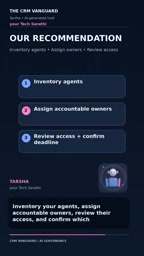
These four steps may seem simple, but they directly address common shortcomings in AI governance. Many enterprises lack a centralized inventory when deploying Agents; Agents are created by different teams in a decentralized manner, and permissions often inherit the broad authorizations of their creators. A mandatory registration system will expose these hidden problems, and advance inventorying can help enterprises avoid scrambling during the compliance window.
The Principle of Least Privilege requires that each entity receive only the minimum access permissions necessary to complete its tasks, and only for the necessary duration. In Agent scenarios, this principle is especially important: Agents are often created by different teams, and permissions easily inherit the broad authorizations of creators, leading to risks of privilege escalation. When reviewing Agent access permissions, each item's read/write scope, callable APIs, and data objects should be confirmed one by one, and long-unused authorizations should be removed. Combined with independent identities and credential rotation, the principle of least privilege can significantly reduce the blast radius when Agents are misused or malfunction.
Potential Impact on the AI Governance Landscape
Salesforce's move sends a signal: AI Agent identity management is moving from "best practice" to "platform mandate." Treating Agents as entities that require independent identities, credentials, and restricted permissions means enterprises need to establish lifecycle management processes similar to employee accounts—onboarding (registration), permission allocation, periodic reviews, and offboarding (deregistration).
For enterprises relying on the Salesforce ecosystem, the Agent registration system will force the standardization of internal governance processes. For the broader AI industry, this may also serve as a bellwether for other platforms to follow. CRM Vanguard expressed anticipation for Salesforce to release more details, and until then, proactively inventorying Agent assets and clarifying ownership is the lowest-cost way to respond.
One-line Summary
Salesforce will launch Agent identity features in November 2026, mandating registration and permission restrictions.
Paragraph Summary
Salesforce plans to launch its agentic identity feature in November 2026, assigning registered AI Agents independent identities, credentials, and scoped permissions, addressing the current difficulty of tracing anonymous Agent operations. Agent registration will shift from optional to mandatory, but the deadline does not simply start from November: customers using Salesforce MCP servers must complete registration within three months after the availability notice, meaning the actual preparation window may be shorter. CRM Vanguard recommends that enterprises immediately inventory existing Agents, designate accountable owners, review access permissions, and confirm applicable deadlines to address the governance challenges of mandatory registration at the lowest cost.
Related articles

LLM Application Development: A High-Paying Career Guide for Ordinary People
LLM application development offers fresh graduates up to 35K/month, with SP offers reaching 600K. This article explains the core skills, how to break in, and how ordinary people can seize AI opportunities through learning by doing.

Say Goodbye to AI Influencer Faces: A Complete Guide to Creating Visual Assets for AI Comic Dramas from Scratch
Bilibili creator shares a full workflow for zero-basics AI comic drama visual assets: use Doubao Work skills with script-first, visual references, and real-person texture to escape AI influencer faces, then lock character and scene consistency with asset sheet layouts, weapon detail images, scene nine-grids, and cinematic color palettes.

The AI Production Pipeline Behind Great Videos: From Research to Agent Validation
AI video production isn't just a model race. This article breaks down a transferable four-step pipeline: researching professional workflows, organizing a skill checklist, configuring agents, and experimental validation—and explains how general-purpose LLMs like DeepSeek can replace paid tools to run the entire process.