Sam Altman's Sister's Lawsuit Dismissed: Full Details of the Court's Ruling
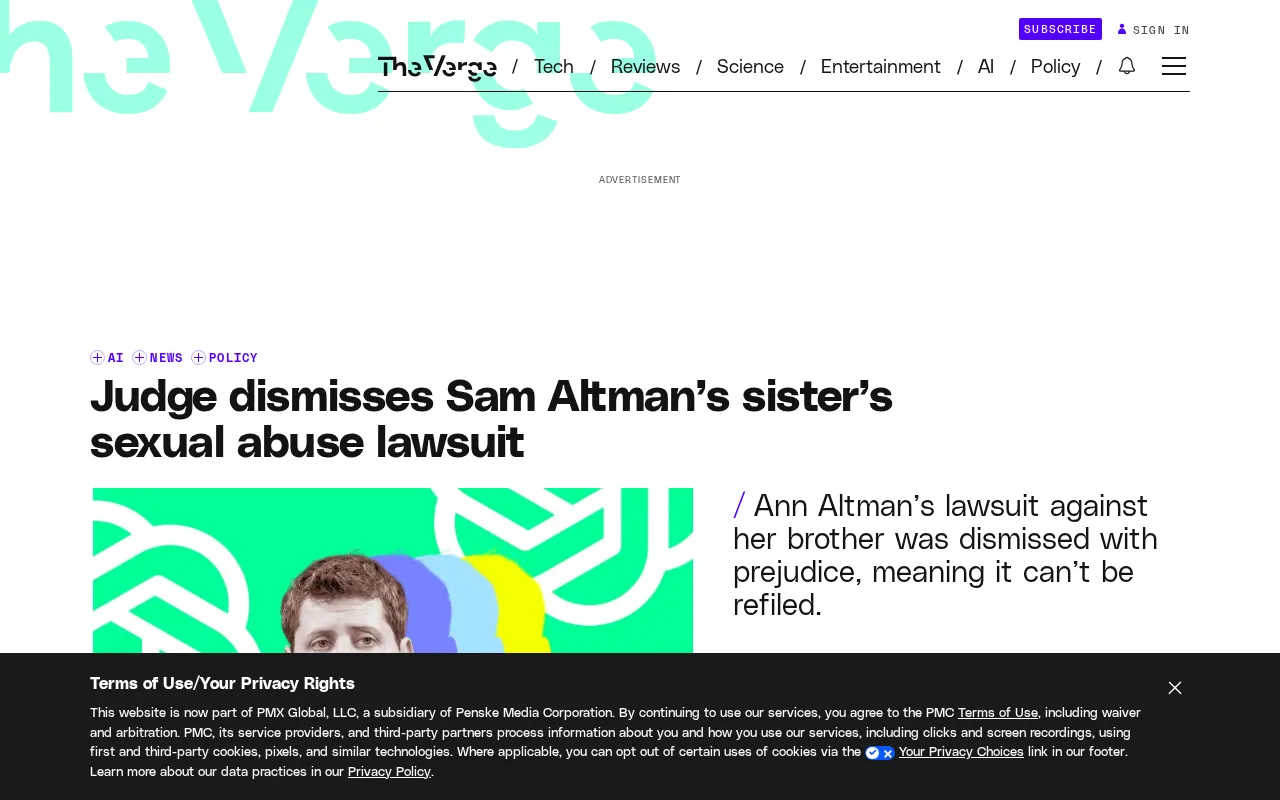
A federal judge dismissed Ann Altman's sexual abuse lawsuit against Sam Altman because she failed to attend an independent medical examination.
U.S. federal district judge Zachary Bluestone on Tuesday dismissed Ann Altman's sexual abuse lawsuit against her brother, OpenAI CEO Sam Altman. The ruling cited Ann's failure over the past year to comply with court procedure, specifically by not attending an independent medical examination, in violation of the Federal Rules of Civil Procedure. The court did not assess the substance of the allegations. The case has sparked discussion about the tension between procedural and substantive justice, privacy boundaries for public figures, and the moral responsibility of tech leaders. Although the lawsuit was dismissed, it may still affect Sam Altman's personal reputation and OpenAI's public image, and it remains uncertain whether Ann will appeal.
A U.S. federal district judge, Zachary Bluestone, on Tuesday dismissed the sexual abuse lawsuit that Ann Altman filed last year against her brother, OpenAI CEO Sam Altman. According to an earlier report by The Guardian, the judge noted that over the past year, Ann failed to attend an independent medical examination and also did not... (the original text is truncated here). This ruling brings a temporary close to this high-profile family lawsuit and has also sparked discussion about legal procedure and the privacy of public figures.
Background of the Lawsuit and Core Allegations
Ann Altman alleged in the lawsuit that her brother Sam Altman sexually abused her throughout her childhood. The lawsuit was filed last year and quickly became a focus of tech media attention because Sam Altman, as OpenAI's CEO, is one of the most influential figures in the field of artificial intelligence. Although the details of the lawsuit were not fully made public, they are said to involve allegations spanning many years. Legal experts point out that such cases usually require substantial evidence and medical evaluation to support them.
Key Reasons for the Court's Dismissal
In the ruling, Judge Zachary Bluestone explicitly stated that Ann Altman had failed to comply with court procedures over the past year, specifically by not attending an independent medical examination. This procedural defect became the direct reason for dismissing the lawsuit. Under the U.S. Federal Rules of Civil Procedure, a court may dismiss a case when the plaintiff fails to comply with pretrial procedures. Judge Bluestone's ruling did not delve into the substantive content of the allegations, but instead focused on procedural compliance.
The Tension Between Procedural Justice and Substantive Justice
The dismissal of this case highlights a common issue in legal procedure: even if the allegations themselves are serious, a lawsuit may be terminated if the plaintiff fails to follow the steps required by the court. An independent medical examination is usually used to assess the plaintiff's psychological or physical condition in order to determine the reasonableness of the allegations. Ann's absence may have stemmed from various reasons, but the court did not elaborate on them in the ruling. For the public following this case, the outcome may be confusing, but legal procedure requires both parties to follow the rules.
An Independent Medical Examination (IME) refers to a procedure during litigation in which a medical expert, appointed by the court or hired by the opposing party and independent of both sides, examines and evaluates the plaintiff's physical or mental condition. In civil cases involving personal injury or sexual abuse allegations, IMEs are often used to verify the authenticity and severity of the harm claimed by the plaintiff and its causal relationship to the alleged events. Plaintiffs are usually obligated to cooperate with such examinations; if they refuse without justified reason, the court may impose sanctions under Rule 35 or Rule 37 of the Federal Rules of Civil Procedure, including dismissal of the lawsuit. The results of an IME may become key evidence, but they also involve the plaintiff's right to privacy and bodily autonomy, so in practice a balance must be struck between discovering the truth and protecting the parties' rights.
The Federal Rules of Civil Procedure are the uniform rules governing the procedure for civil cases in federal district courts. Rule 41(b) provides that if the plaintiff fails to comply with these rules or a court order, the defendant may move to dismiss the action, unless the dismissal is based on lack of jurisdiction or improper venue. In addition, Rule 37 provides various sanctions for failure to comply with discovery orders, including dismissal of the action and exclusion of evidence. In deciding whether to dismiss a lawsuit because of procedural violations, courts usually consider factors such as the severity of the violation, whether it was intentional, the prejudice caused to the opposing party, and whether lesser sanctions would be sufficient. In this case, the plaintiff's long-term failure to attend an independent medical examination may have been regarded by the court as a major violation of pretrial procedure, thus constituting sufficient grounds for dismissal.
Impact on Sam Altman and OpenAI
Although the lawsuit was dismissed, the matter may still have aftereffects on Sam Altman's personal reputation and OpenAI's public image. As a leading figure in the AI industry, Altman is scrutinized under a magnifying glass in everything he does. OpenAI is currently in a critical period of commercialization and regulatory review, and any executive's personal legal dispute could distract attention from technological development. However, there is currently no evidence that this lawsuit affected OpenAI's day-to-day operations or strategic decisions.
The Privacy Boundaries of Public Figures
This case has also once again sparked discussion about the privacy of family members of public figures. Ann Altman's allegations triggered intense debate on social media, with supporters and skeptics each holding their own views. The court's dismissal ruling did not calm these debates and may instead have made supporters on both sides even more opposed. Against the backdrop of rapid AI development, the line between industry leaders' personal lives and professional achievements is becoming increasingly blurred.
Possible Next Legal Steps
It is currently unclear whether Ann Altman will appeal the dismissal ruling. Under legal procedure, she may file an appeal with a higher court within a certain period, but she would need to provide stronger grounds. If she appeals, the case could enter a longer judicial process. On the other hand, Sam Altman's legal team has not yet made public comments on the ruling. For observers following the case, this ruling may be only the beginning of a legal battle, not the end.
In the U.S. federal court system, appeals from final rulings of district courts are usually filed with the corresponding federal Circuit Court of Appeals. An appeal must be filed by submitting a Notice of Appeal within 30 days after the ruling is issued, but if the U.S. government is a party, the deadline may be extended to 60 days. The standard of appellate review varies by issue: questions of law are reviewed de novo, factual findings are reviewed for clear error, and procedural discretionary matters are reviewed for abuse of discretion. In this case, the dismissal was based on the plaintiff's failure to comply with pretrial procedure, which is an exercise of the court's discretion, so the appellate court may defer to the district court's judgment unless the plaintiff can prove an abuse of discretion. An appeal does not necessarily lead to a reexamination of the substantive issues of the case, but rather reviews whether the first-instance procedure was lawful.
Conclusion: The Interweaving of Law and Public Opinion
The dismissal of this lawsuit reminds us that legal rulings are often based on procedure rather than the facts themselves. For those following the AI industry, Sam Altman's public image will continue to oscillate between technological innovation and personal controversy. Regardless of the final outcome, this matter reflects the public's expectations and scrutiny of tech leaders' moral responsibility. As OpenAI continues to lead in the AI race, Altman's personal story will remain a focus of media and public attention.
One-line Summary
A federal judge dismissed Ann Altman's sexual abuse lawsuit against Sam Altman because the plaintiff failed to attend an independent medical examination.
Paragraph Summary
U.S. federal district judge Zachary Bluestone on Tuesday dismissed Ann Altman's sexual abuse lawsuit against her brother, OpenAI CEO Sam Altman. The ruling was based on Ann's failure over the past year to comply with court procedure, specifically by not attending an independent medical examination, in violation of the Federal Rules of Civil Procedure. The court did not judge the substantive content of the allegations. The case has sparked discussion about the tension between procedural justice and substantive justice, the privacy boundaries of public figures, and the moral responsibility of tech leaders. Although the lawsuit was dismissed, it may have aftereffects on Sam Altman's personal reputation and OpenAI's public image, and it remains uncertain whether Ann will appeal.
Related articles

WebMCP Security Guide: Three Hints That Make AI Agents Safer
The Chrome team demonstrates three security hints for WebMCP tools: readOnlyHint eliminates invalid confirmation dialogs, consequentialHint forces human confirmation for high-risk operations, and untrustedContentHint defends against indirect prompt injection—improving AI agent security with one or two lines of code.

Why Turbulence Is the Hardest Problem in Fluid Mechanics — and How AI Could Crack It
Why is turbulence the hardest problem in fluid mechanics? This article, based on a Lex Fridman podcast conversation, explores turbulence's multi-scale nature, comparisons with classical thermodynamics, and how AI might simplify turbulence description by discovering coordinate transformations — examining the intersection of vortex formation with mathematics and physics.

R.L. Stine Google Talk: How the Master of Horror Ignites Kids' Passion for Reading
At a Google talk, R.L. Stine shares his accidental pivot from comedy to horror, his principles for children's horror, how phones impact storytelling, and how Goosebumps motivates kids to read.