Samsung's Quarterly Operating Profit Expected to Surge 780%: The Memory Logic Behind the AI Boom

Samsung's 780% profit surge reveals how AI hardware demand is making memory the new center of the semiconductor industry.
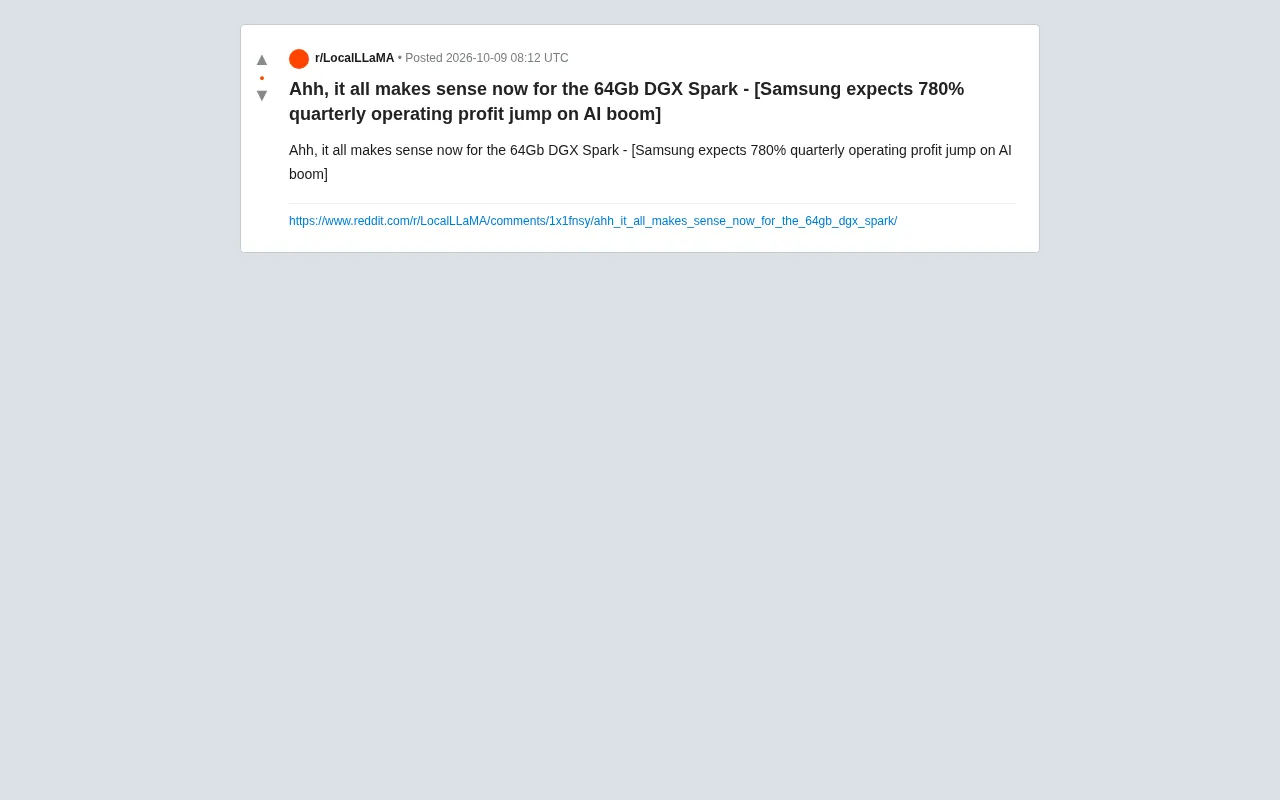
A Reddit thread juxtaposing Samsung's ~780% year-over-year operating profit forecast with the NVIDIA DGX Spark's 64GB unified memory spec illustrates a clear AI industry transmission chain: surging downstream demand for HBM and large-capacity system memory in AI workstations and servers flows upstream, landing squarely on the income statements of leading memory manufacturers. Once a cyclical also-ran, memory has been transformed by the AI wave — absorbing excess capacity while driving both volume and pricing for high-value HBM. The 780% figure is still a projection, and the causal link between any single product and macro-level profits is inferential, but AI's reshaping of semiconductor profit dynamics is no longer in doubt.
One Data Point, One Industry Signal
A discussion thread on Reddit recently connected Samsung's latest earnings expectations to the memory configuration of the NVIDIA DGX Spark. The core of the post: Samsung's operating profit is expected to surge approximately 780% year-over-year this quarter, with the AI wave sweeping the globe as the primary engine driving that growth.
For those following the AI hardware ecosystem, this might sound like yet another well-worn "AI dividend" story — but it reveals a deeper industry logic: the bottleneck in today's AI infrastructure is increasingly shifting from compute to memory.
Why Memory Manufacturers Are Capturing the Biggest Gains
In the hardware stack for AI training and inference, GPU computing power is important, but the supply of high-bandwidth memory (HBM) and large-capacity system memory is becoming the critical constraint on both performance and shipment volume. As one of the world's leading memory chip suppliers, Samsung's dramatic profit swings directly reflect the near-insatiable demand for high-end memory components in AI servers and AI workstations.
The 780% figure is striking precisely because the memory industry is a classically cyclical business — one that has previously suffered severe oversupply and price collapses. The explosion in AI demand has not only absorbed excess capacity but also driven both volume and price increases for high-value-added products like HBM. For Samsung, this represents a rapid reversal from a cyclical trough to an AI-driven peak.
What Is High-Bandwidth Memory (HBM)? HBM is a new memory architecture that vertically stacks multiple layers of DRAM dies using Through-Silicon Via (TSV) technology, packaging them directly alongside the GPU chip. Compared to conventional GDDR memory, HBM delivers several times — or even more than ten times — the bandwidth. The HBM3 used in NVIDIA's H100 exceeds 3.35 TB/s, while standard DDR5 system memory delivers only around 100 GB/s. This bandwidth gap is critical for large-model training and inference: model parameters routinely number in the tens of billions, and every forward pass requires reading massive amounts of weight data from memory into compute units — insufficient bandwidth leaves GPU compute sitting idle. HBM manufacturing is extraordinarily complex, with only three companies capable of mass production globally: Samsung, SK Hynix, and Micron, making supply inherently constrained. Combined with the fact that AI servers consume far more HBM per unit than traditional servers, the supply-demand imbalance layered on top of high value-add allows memory manufacturers to enjoy profit margins well above industry averages.
How DGX Spark's 64GB Configuration Fits Into the Picture
The phrase in the original post title — "Ahh, it all makes sense now" — points directly to the NVIDIA DGX Spark's 64GB memory configuration. The poster's implication: when you place the memory specs of a developer-facing AI workstation alongside the profit surge of a memory manufacturer, the entire supply-and-demand chain snaps into focus.
Every AI device equipped with large-capacity unified memory represents a real, concrete purchase of memory chips. When a company like NVIDIA rolls out products targeting local AI development at scale — with relatively generous memory configurations — upstream memory suppliers naturally become reliable beneficiaries. In other words, DGX Spark's memory spec is not just a product parameter; it is a snapshot of the health of the entire AI hardware supply chain.
What Is the NVIDIA DGX Spark? The NVIDIA DGX Spark is a desktop-class AI workstation aimed at individual developers and small teams. It is powered by the GB10 Grace Blackwell Superchip and features a Unified Memory Architecture — meaning the CPU and GPU share a single physical memory pool, rather than maintaining separate VRAM and system memory as in traditional designs. The 64GB of unified memory means the entire device can load and run inference on a nearly complete 70B-parameter-class open-source large language model directly in memory, without sharding or quantization degradation. This spec is high-end for a personal workstation, with memory consumption far exceeding a comparably priced traditional workstation. The spread of unified memory architecture is systematically raising "per-device memory consumption" across the board — from PCs to smartphones — which is why AI's pull on memory demand extends well beyond the data center, reaching all the way from the cloud down to edge and on-device deployments.
Tracing the Full AI Hardware Chain From a Single Product
The value of this discussion lies in how it connects an isolated product specification to a macro-level financial figure, revealing the transmission mechanism at work across the AI industry:
- Upstream: Memory manufacturers like Samsung and SK Hynix supply HBM and system memory
- Midstream: Companies like NVIDIA integrate GPUs and memory into AI servers and workstations
- Downstream: Developers and enterprises purchase these devices for AI training and inference
When downstream demand is strong, that force propagates up the chain, ultimately showing up on the income statements of upstream manufacturers. Samsung's 780% profit expectation is, in essence, a concentrated release of the entire AI hardware demand chain at the earnings level.
A Note of Caution
It is worth noting that the source material here comes from a single Reddit discussion thread, and its core is an associative interpretation of two data points — not a thoroughly verified piece of investigative reporting. The 780% figure is an expectation, not a confirmed financial result, and the specific basis for the figure (year-over-year vs. quarter-over-quarter, whether one-time items are included) should be confirmed against Samsung's official disclosures.
Moreover, drawing a direct causal line from DGX Spark's 64GB configuration to Samsung's profit surge is more of an intuitive inference from the community than a rigorous argument. Memory manufacturer profit growth is driven by the entire AI server market; the contribution of any single product is limited. Readers should treat this as a useful entry point for observing supply-and-demand dynamics in AI hardware — not as a strict causal claim.
Closing Thoughts
Regardless of the exact numbers, it is undeniable that the AI boom is reshaping the profit landscape of the semiconductor industry. Memory, once a cyclical "supporting player," is steadily moving toward the center of AI infrastructure. For those working in AI hardware, the earnings reports of upstream memory manufacturers may well be one of the most important leading indicators for gauging the temperature of the entire industry.
Related articles

LLM Application Development: A High-Paying Career Guide for Ordinary People
LLM application development offers fresh graduates up to 35K/month, with SP offers reaching 600K. This article explains the core skills, how to break in, and how ordinary people can seize AI opportunities through learning by doing.

Say Goodbye to AI Influencer Faces: A Complete Guide to Creating Visual Assets for AI Comic Dramas from Scratch
Bilibili creator shares a full workflow for zero-basics AI comic drama visual assets: use Doubao Work skills with script-first, visual references, and real-person texture to escape AI influencer faces, then lock character and scene consistency with asset sheet layouts, weapon detail images, scene nine-grids, and cinematic color palettes.

The AI Production Pipeline Behind Great Videos: From Research to Agent Validation
AI video production isn't just a model race. This article breaks down a transferable four-step pipeline: researching professional workflows, organizing a skill checklist, configuring agents, and experimental validation—and explains how general-purpose LLMs like DeepSeek can replace paid tools to run the entire process.