Semantic Caching Explained: Reusing the Same Answer for Similar Questions
Semantic caching reuses results for similar queries using embeddings and thresholds, with both benefits and misjudgment risks.
Semantic caching addresses the low hit rate of traditional exact-match caching: instead of comparing whether strings are identical, it uses embeddings to compute semantic distance between queries and reuses cached results when the distance falls below a threshold. This mechanism depends on a high-quality embedding model and an appropriate threshold, both of which require repeated tuning for the actual business. The article uses negation as an example to illustrate the main risk — "I don't want to know the capital of France" and "I want to know the capital of France" are literally similar but semantically opposite, and a loose threshold could return the wrong answer. Semantic caching is therefore better suited to scenarios with high query repetition and answers insensitive to phrasing; in practice, a tiered strategy with exact matching first and semantic matching as a fallback is advisable, along with keeping hit records for auditing.
What Problem Does Semantic Caching Solve?
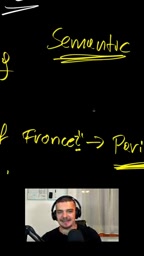
Traditional caching logic is straightforward: the same key returns the same value. If a user first asks "What is the capital of France," the cache stores this query and its answer (Paris), and the next time the string is exactly identical, it hits the cache directly. The problem is that real users almost never phrase questions in exactly the same way.
"What is the capital of France," "I'd like to know the capital of France," and "The capital of France, I'd like to learn about it" are completely different at the literal level. An exact-match cache cannot hit any of them, which drives the cache hit rate very low. Semantic caching is designed to solve exactly this pain point: instead of comparing whether strings are identical, it compares whether the query's "meaning" is close enough.
The core idea comes down to one sentence — semantic caching no longer caches exactly identical prompts, but reuses cached results for prompts that are "similar enough." The key term here is "similar enough," which is determined by a threshold rather than by string equality.
How Embeddings Determine "Similar Meaning"
The technical pillar of semantic caching is embeddings. Embeddings convert text into vector representations — high-dimensional coordinates made up of a series of numbers. Sentences with similar meanings end up close to each other in vector space.
So the three phrasings above, despite being literally different, are likely to land in adjacent regions of vector space. After receiving a new query, the system first computes its embedding, then searches the cache for the nearest existing query. If the distance is below the configured threshold, the two are deemed equivalent, the cached result is returned directly, and one model call is saved.
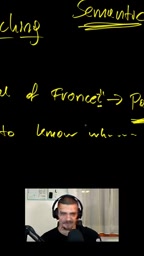
Whether this mechanism works depends on two conditions. First, the embedding model itself must be good enough to accurately map semantic relationships onto vector distances. Second, the threshold must be tuned appropriately — too loose and unrelated queries get judged as similar; too tight and it effectively reverts to exact matching. The original video author explicitly states that, provided both the model and threshold are in place, all three phrasings should correctly retrieve the answer "Paris."
Interestingly, an embedding model is not a component you simply "install and forget." Different models vary in their sensitivity to subtle semantic differences, and the same model may perform differently on different business corpora. The threshold is likewise not a fixed constant — it needs to be repeatedly tested against the actual query distribution.
Embedding models (such as OpenAI's text-embedding-3, the open-source BGE, Sentence-BERT, etc.) are typically trained on large-scale text pairs or contrastive learning objectives, bringing semantically similar sentences closer together in vector space. A common practice is to use cosine similarity to measure the angle between two vectors, typically ranging from -1 to 1, with values closer to 1 indicating greater similarity. Semantic caching systems generally set a similarity threshold (e.g., 0.9), and a new query is considered a hit only when its similarity to a cache entry exceeds that threshold. Notably, vector retrieval is usually accelerated with approximate nearest neighbor (ANN) indexes (such as FAISS, HNSW), since brute-force comparison across millions of cache entries would be too costly. These engineering details jointly determine the response speed and hit quality of semantic caching.
Why Threshold Tuning Is Difficult
The fragility of semantic caching is most obvious with negations.
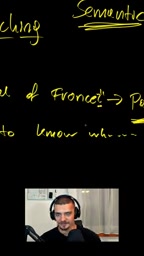
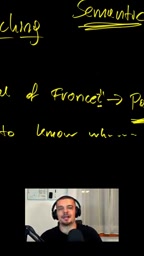
Suppose a user asks, "I don't want to know the capital of France." This sentence differs from "I want to know the capital of France" by only a few words, but the semantic direction is completely opposite. If the embedding model is not sensitive enough and the threshold is too loose, this sentence may land very close to the original query in vector space, and the system eagerly returns "Paris" to a user who explicitly said they don't want to know.
The original video calls such queries "silly queries," but it is precisely this seemingly absurd example that illustrates how small words and small phrasing differences can cause semantic reversal. The author thus emphasizes that such edge cases require repeated parameter tuning and testing, rather than being covered by a set of default configurations.
This also means semantic caching is not an optimization you can enable blindly. It requires someone to continuously monitor cache hit records, identify misjudged query pairs, and adjust the threshold or switch models accordingly. Negations, qualifiers, and rhetorical questions are all sensitive structures that need special attention.
The reason negations are easily misjudged relates to how embedding models are trained. Many models mainly capture topic-level similarity during contrastive learning, while polarity differences like "want" versus "don't want" appear only in individual words and have limited influence on the overall vector direction. Moreover, negations often lack a stable, linearly separable direction in vector space, making it difficult to fully distinguish affirmative from negative expressions using distance thresholds alone. One mitigation approach is to layer rule-based filtering on top of semantic matching — for example, detecting whether the query contains a negation word and forcing a miss if the new query and the cache entry differ in negation polarity. Another approach is to choose a model more sensitive to fine-grained semantics or to fine-tune on business corpora. Both point to the same conclusion: threshold tuning is not an isolated step but must work in tandem with model selection and rule constraints.
The Applicable Boundaries of Semantic Caching
From a mechanistic standpoint, semantic caching delivers benefits in both cost and latency: a cache hit means skipping one model inference, resulting in faster responses and lower call costs. But it obtains these benefits through "approximation," which inherently introduces accuracy risk.
It is therefore better suited to scenarios where answers are insensitive to phrasing details and repeated questions are plentiful — domains like general knowledge Q&A and FAQ consultation, where query distributions are concentrated and answers are relatively stable. Conversely, if the business is full of negations, conditional qualifiers, or questions highly dependent on context, the cost of semantic caching misjudgments rises significantly, and the threshold needs to be set more conservatively.
A pragmatic approach is to treat semantic caching as one layer in a tiered strategy: exact matching first, semantic matching as a fallback, while keeping traceable records of semantic hits for later auditing of misjudgments. This captures the benefit of reusing similar queries without leaving errors impossible to investigate.
The concept of semantic caching is not complex — cache "meaning" rather than "strings," compute similarity with embeddings, and use a threshold to decide whether to reuse. The real engineering effort hides in threshold tuning and edge-case handling, which is why it looks simple but requires patience in practice.
One-line Summary
Semantic caching reuses results for similar queries using embeddings and thresholds, with both benefits and misjudgment risks.
Paragraph Summary
Semantic caching addresses the low hit rate of traditional exact-match caching: instead of comparing whether strings are identical, it uses embeddings to compute semantic distance between queries and reuses cached results when the distance falls below a threshold. This mechanism depends on a high-quality embedding model and an appropriate threshold, both of which require repeated tuning for the actual business. The article uses negation as an example to illustrate the main risk — "I don't want to know the capital of France" and "I want to know the capital of France" are literally similar but semantically opposite, and a loose threshold could return the wrong answer. Semantic caching is therefore better suited to scenarios with high query repetition and answers insensitive to phrasing; in practice, a tiered strategy with exact matching first and semantic matching as a fallback is advisable, along with keeping hit records for auditing.
Related articles

Nvidia CEO Removal Saga: Trump Intervenes Over the Weekend, Jensen Huang Reinstated Monday
Vergecast podcast reveals Nvidia CEO drama: earnings call said he wouldn't return and a new CEO was being sought; Trump intervened over the weekend, with J.D. Vance brokering a security guarantee to the board; Jensen Huang reinstated at 9 a.m. Monday.

How Did Trump Personally Turn Nvidia into the "Twelfth Board Member"?
A YouTube political commentary offers a sharp view: behind Nvidia's market cap milestone, Trump's deep involvement earns him the title of "twelfth board member." The article breaks down the commentator's logic on stock market achievements, the break from small-government tradition, and power display.

ASPECT: Getting AI Agents to Truly Learn Your Communication Style
ASPECT uses a 92-item communication style inventory to compress personal communication history into an auditable communication DNA profile, with raw data staying on-device and preferred in 42.5% of blind-test scenarios.