Seven from MIT Named 2026 AI2050 Fellows to Advance Beneficial AI Research

Seven from MIT named 2026 Schmidt Sciences AI2050 Fellows to support beneficial AI research.
Schmidt Sciences announced the 2026 AI2050 Fellows, including five MIT faculty members and two alumni. The fellowship funds researchers dedicated to ensuring AI develops beneficially for humanity, helping them explore long-term impacts and potential risks and promoting responsible technology development. The article introduces the AI2050 program's positioning and MIT's recipient composition, noting that specific research directions have not been detailed but are expected to span multiple subfields from technological breakthroughs to policy and ethics. It argues that the multiple selections further consolidate MIT's role in AI ethics, safety, and governance and represent a strategic investment in beneficial AI research; as AI evolves rapidly, MIT scholars' participation will bring academic depth and diverse perspectives to this global issue.
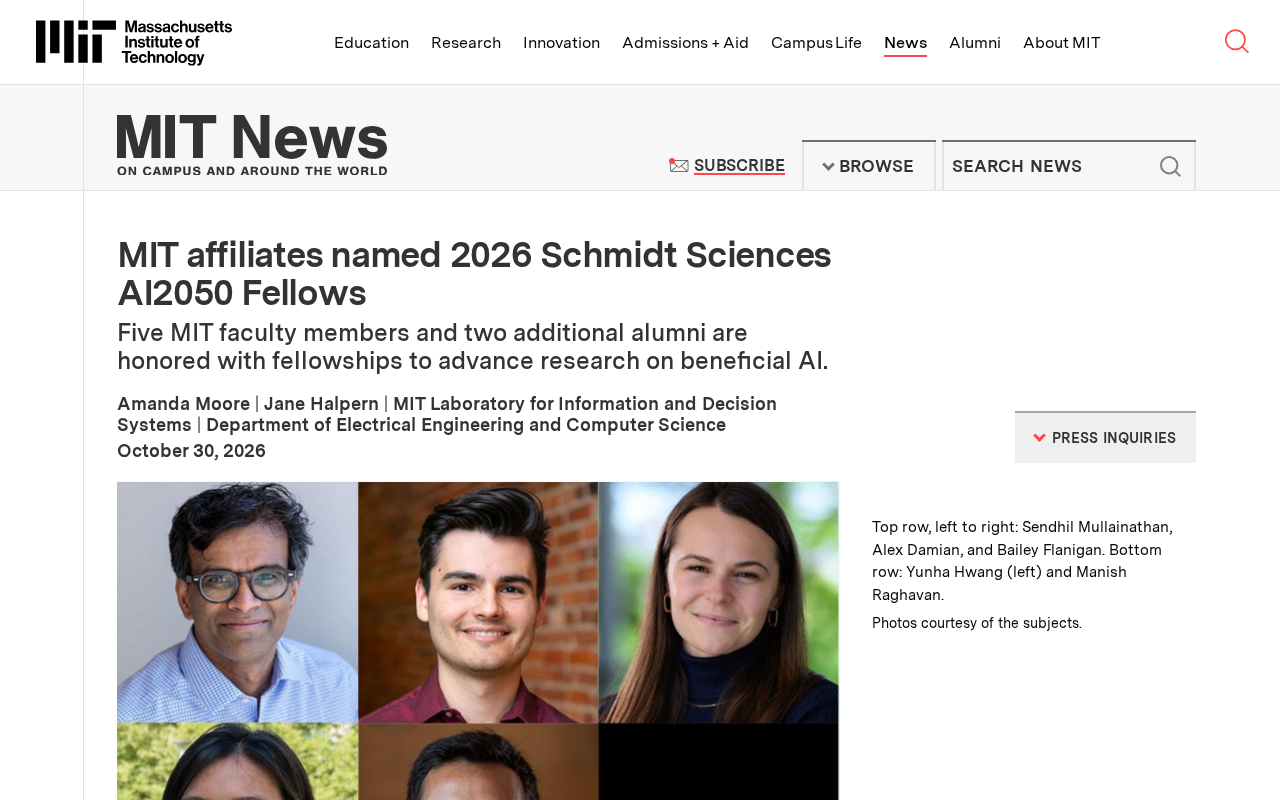
Schmidt Sciences recently announced the 2026 cohort of AI2050 Fellows, with five MIT faculty members and two alumni among the recipients. They will receive funding to advance research in the field of beneficial AI.
AI2050 Fellowship: For Beneficial AI
AI2050 is a program under Schmidt Sciences aimed at supporting researchers dedicated to ensuring that artificial intelligence develops in ways that benefit humanity. The fellowship provides recipients with resources to explore the long-term impacts and potential risks of AI, and to promote the responsible development of related technologies.
Seven individuals from MIT received this honor, reflecting the institute's continued commitment to cutting-edge AI research and analysis of its social impact.
"Beneficial AI" is a core concept in the AI ethics and governance field in recent years, emphasizing that the development and deployment of AI systems should be oriented toward enhancing human well-being and reducing social risks, rather than purely pursuing capability improvements or commercial monetization. This concept heavily overlaps with "responsible AI" and "trustworthy AI," but places greater emphasis on a long-term perspective: it focuses not only on current issues such as bias, privacy, and safety, but also on the existential risks that far-future technologies like artificial general intelligence may bring. Around beneficial AI, academia has gradually developed multiple research pathways including technical alignment, interpretability, robustness evaluation, policy regulation, and public participation. The AI2050 program uses this framework as its guiding principle, funding interdisciplinary research in an attempt to set value anchors for AI's development direction amid rapid technological evolution.
Schmidt Sciences is a philanthropic scientific research organization funded by former Google CEO Eric Schmidt and his wife Wendy Schmidt. Formerly known as Schmidt Futures, it has long supported interdisciplinary, high-risk high-reward scientific research and is known for funding early-career researchers. AI2050 is one of its signature programs, with its name derived from the long-term goal of "ensuring AI benefits humanity by 2050." The fellowship typically selects scholars globally who show potential in AI safety, ethics, governance, and intersections with basic science, providing multi-year funding and a cross-institutional collaboration network. Recipients are called "AI2050 Fellows." Compared to traditional research grants, it places greater emphasis on the social impact of research and cross-disciplinary dialogue, and is therefore often regarded as an important talent pipeline mechanism in the AI governance field.
Composition of Recipients
According to information released by MIT, the recipients include five MIT faculty members and two alumni. Although specific research directions have not yet been detailed in the summary, it is anticipated that their work will cover multiple subfields of AI, from technological breakthroughs to policy and ethics, echoing the AI2050 program's broad definition of "beneficial AI."
MIT's Engagement in AI Governance
MIT has been active in AI ethics, safety, and governance in recent years. The selection of multiple scholars for the AI2050 Fellowship further consolidates the institute's role in shaping the future direction of AI. By supporting independent researchers, Schmidt Sciences hopes to stimulate interdisciplinary collaboration to address the complex challenges posed by AI.
Significance and Outlook
The AI2050 Fellowship is not only a recognition of individual research but also a strategic investment in the direction of beneficial AI research. As AI technology evolves rapidly, how to ensure its development aligns with human interests has become a global issue. The participation of MIT scholars will bring academic depth and diverse perspectives to this topic.
(Note: The above content is based on a brief announcement released by MIT; specific research project details await further official disclosure.)
Related articles

AI Comic Drama with WorkBuddy from Scratch: A Step-by-Step Skill Pack Installation Guide
Learn how to create AI comic dramas with WorkBuddy from scratch. This guide covers installation, Skill pack import and invocation, plus a script generation demo with manual revision tips to get you through the first step from script to storyboard.

WorkBuddy Agent Runs the Entire GEO Database Mining Pipeline with a Single Prompt
WorkBuddy agent automates GEO database mining: from data search and curation to batch correction, differential analysis, co-expression networks, feature gene screening, and immune infiltration—a single prompt generates a complete bioinformatics report, greatly lowering the barrier to bioinformatics analysis.

PC Memory Wasted? Hacker News Debates Centralized Data Centers
Hacker News users argue that personal computer memory is wasted and should be centralized in data centers, sparking debate on centralized vs. distributed computing resource allocation. This article analyzes the logic behind the claim, the costs of centralization, and new tensions in memory resource allocation in the AI era.