Signs of a GPU Price Crash? The Double Squeeze of Small Models and Excess Compute
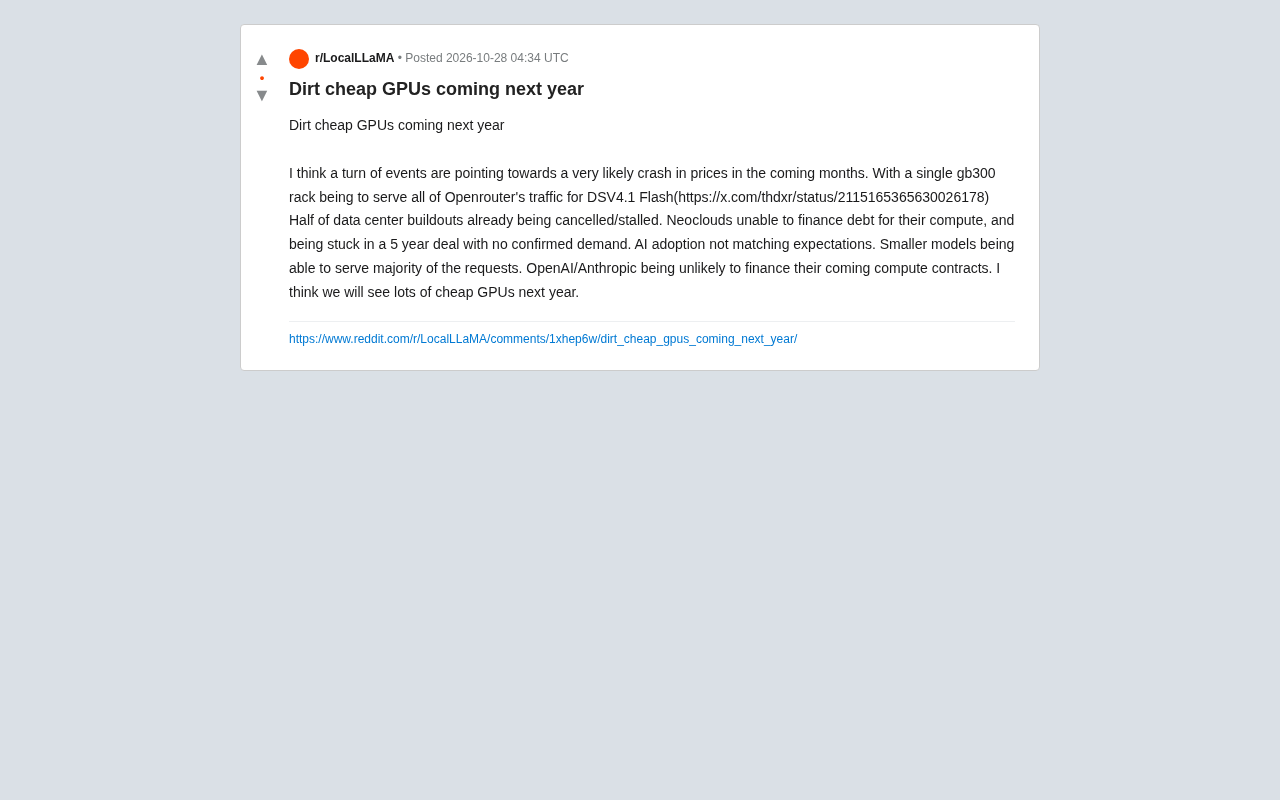
Rising inference efficiency and weaker-than-expected demand may drive a notable GPU price decline next year
The article reviews a Reddit discussion about a potential sharp drop in GPU prices. Three threads form the core logic: a leap in inference efficiency—reportedly a single GB300 rack can handle all of OpenRouter's DSV4.1 Flash traffic, reducing the need for large-scale compute expansion; slowing data center construction—about half of projects canceled or stalled, with debt-financed Neoclouds facing cash flow pressure and possible second-hand GPU sell-offs; and AI adoption slower than expected, with small models covering most requests and demand shifting from maximum compute to good enough. Financing uncertainty for leading AI companies' future compute contracts is another variable. The article sees a possible cost-reduction window for small teams but notes the judgment depends on multiple premises and requires tracking financing, construction, and efficiency data.
A recent discussion on Reddit has drawn considerable attention: one user predicts that GPU prices could see a significant decline in the coming months, even describing next year's second-hand and newly built compute markets as "dirt cheap." This judgment is not unfounded—it is strung together from several interrelated threads: rising inference efficiency of small models, slowing data center construction, and the gap between AI adoption speed and expectations.
Inference Efficiency Leap: A Single Rack Handling an Entire Platform's Traffic
The most striking argument in the discussion comes from a post on X: allegedly, a single GB300 rack is enough to handle all of OpenRouter's DSV4.1 Flash traffic. If true, this means that inference workloads that previously required large-scale clusters could now be compressed into an extremely small hardware footprint.
The leap in inference efficiency directly changes the calculus of compute demand. When models can achieve the same throughput on fewer GPUs, the economics of building new data centers start to look bad. The demand curve has not risen as expected, while supply continues to expand by inertia—price pressure naturally follows.
GB300 is a rack-scale AI computing system (GB300 NVL72) that NVIDIA launched on the Blackwell architecture, integrating 72 GPUs and 36 Grace CPUs per rack, interconnected via high-speed NVLink. Unlike traditional GPUs priced per card, GB300 is delivered as a complete rack and targets large-scale training and high-throughput inference scenarios. Its inference performance gains come not only from process and architecture iteration but also from FP4 low-precision inference, greater HBM bandwidth, and improved intra-rack interconnect bandwidth. Understanding this helps assess the claim that "one rack handles all traffic": it measures the number of concurrent requests a unit of hardware can support, not the absolute speed of a single inference.
Data Center Construction Hits the Brakes, Neocloud Debt Risks Loom
The original post mentions that half of data center construction projects have been canceled or stalled. Whether this ratio is precise is debatable, but the directional signal deserves attention: builders are beginning to reassess their return on investment.
More noteworthy is the situation of emerging compute rental providers like Neoclouds. They often rely on debt financing to purchase GPUs and then lease compute under long-term contracts. If there are no confirmed orders on the demand side, five-year contracts become a burden hanging overhead. Once cash flow falls short, the likelihood of second-hand GPUs being dumped onto the market rises—and that is the direct driver of falling prices.
Neocloud refers to a class of cloud service providers that have emerged in recent years with GPU compute rental as their core business, including companies like CoreWeave, Lambda, and Crusoe. Unlike hyperscale cloud providers such as AWS and Azure, Neoclouds typically do not build a complete data center ecosystem themselves but focus on rapid deployment and rental of GPU clusters, serving mainly AI startups and model training teams. Their business model relies heavily on debt or asset-backed financing to purchase GPUs, then locks in revenue through multi-year contracts. This structure offers obvious leverage when demand is strong, but once order growth slows, fixed debt service pressure quickly turns into cash flow risk—this is the mechanism by which second-hand GPUs could flood the market, as discussed.
AI Adoption Falls Short, Small Models Absorb Most Requests
The original post also highlights a key trend: actual AI adoption speed has not matched earlier optimistic expectations, and small models are already able to serve most requests.
These two factors together create a double squeeze on demand for high-end GPUs. On one hand, enterprise customers' willingness to pay and deployment pace are slower than expected; on the other hand, even where inference demand exists, small models are sufficient for most scenarios without stacking the most top-tier compute. The demand structure is shifting from "pursuing maximum compute" to "good enough is enough," which fundamentally weakens pricing power.
Small models typically refer to models with parameter counts in the billions, compressed through distillation or quantization, such as various open-source and closed-source models in the 7B to 30B range. Compared with frontier large models, they have clear advantages in inference cost, latency, and deployment门槛, and their performance is already sufficient for many practical tasks (classification, summarization, customer service Q&A, code completion). The phrase "small models absorb most requests" reflects the distribution of inference workloads: high-frequency, low-complexity requests account for the vast majority, and only a few tasks require top-tier compute. This structural change means compute demand no longer grows in sync with model parameter counts, thereby weakening marginal demand for the highest-end GPUs.
Financing Uncertainty for Big Tech Contracts
The discussion also mentions that leading companies like OpenAI and Anthropic may struggle to finance their upcoming compute contracts as planned. This is a single-source judgment that should be treated with caution, but it points to a real problem: capital expenditure for compute expansion relies heavily on continuous financing. Once the financing environment tightens or revenue growth falls short of expectations, the pace of fulfilling signed contracts may slow, affecting order visibility across the entire supply chain.
What This Means for Practitioners
If the above logic holds, the GPU market next year could see several changes: increased supply of second-hand cards, pressure on rental prices, and more conservative decisions on new data center construction. For small and medium teams and independent developers, this could be an opportunity window to lower compute costs and experiment with large model applications at a lower barrier to entry.
But it should also be noted that this judgment rests on the premise that multiple links hold simultaneously. Whether the improvement in inference efficiency continues to spread, whether the proportion of stalled data center construction is real, and how the financing pace of leading companies evolves all remain variables. Treating "possible price declines" as a certain purchasing opportunity still carries risk.
Overall, the original Reddit post offers an analytical thread worth tracking, not a conclusion. The supply and demand in the compute market are being recalibrated, and financing dynamics, construction progress, and inference efficiency data in the coming quarters will say more about the direction than any single forecast.
The price formation mechanism of the second-hand GPU market deserves separate understanding. As capital goods, GPUs' second-hand prices are affected by three factors: depreciation speed, generational replacement, and supply concentration. When large compute rental providers sell equipment in bulk due to contract defaults or cash flow strain, the supply curve shifts right in the short term, and prices often overshoot; but second-hand cards also face issues such as voided warranties, driver support cycles, and落后 energy efficiency, with a limited buyer base and far lower liquidity than new cards. Therefore, "dirt cheap" describes a selling window at a specific point in time rather than a sustainable market equilibrium price. Buyers need to evaluate the true total cost of ownership based on the duration of their workload and operational capabilities.
One-line Summary
Rising inference efficiency and demand falling short of expectations may lead to a significant decline in GPU prices next year
Paragraph Summary
The article reviews a Reddit discussion about a possible sharp decline in GPU prices. Its core logic consists of three threads: first, a leap in inference efficiency—allegedly a single GB300 rack can handle all of OpenRouter's DSV4.1 Flash traffic, weakening the need for large-scale compute expansion; second, slowing data center construction—about half of projects have been canceled or stalled, and debt-financed Neoclouds face cash flow pressure and may be forced to sell off second-hand GPUs; third, AI adoption slower than expected—small models can already cover most requests, and the demand structure is shifting from pursuing maximum compute to good enough. In addition, financing uncertainty for follow-on compute contracts of leading AI companies is also a variable. The article suggests this could be an opportunity window for small and medium teams to reduce costs, but the judgment depends on multiple premises holding simultaneously, and financing, construction, and efficiency data still need to be tracked.
Related articles

Gemini 4 Carbon Tops AI Benchmark, 72% Cheaper Than Leader
Google DeepMind releases Gemini 4 Carbon, topping the Archital Analysis Intelligence Index B5 with 59 points and Arena text leaderboard with 1528. Median task cost is only $80, 72% lower than leader Cloud Office 1.5.

Gemini 4 Carbon Hands-On: The Strongest AI Model? Compared with Claude Opus 5.5
Google's Gemini 4 Carbon tops the Artificial Analysis leaderboard with 71% on CW Bench and leads Vending Bench. Hands-on comparison with Claude Opus 5.5: stunning front-end design but slightly behind in web development, with a clear price advantage.

Gemini 4 Carbon Tops Global Rankings as AI Productivity and Open-Source Ecosystems Surge
Google DeepMind's Gemini 4 Carbon tops global benchmarks, built for complex agents and system security. ByteDance launches Doubao Work integrated with Feishu, Anthropic's AI autonomously breaches 5 system-level attack chains, and ModelBest and Fudan open-source on-device multimodal and image generation models.