SLAM Mapping and Navigation Tutorial: A Complete Learning Path from Theory to Practice

A from-principles-to-practice SLAM learning path that opens with a navigation overview and connects to the Fourteen Lectures on Visual SLAM and slam_toolbox/Cartographer.
The article introduces a SLAM algorithm teaching system labeled "the most complete and detailed," organized to first build an overall understanding of navigation systems before diving into specific algorithms and tools. The first major section—the navigation overview—covers concepts and roles, navigation architecture, installation commands, and practical prerequisites, emphasizing that the architecture, while complex, can be decomposed into perception, mapping, localization, planning, and control modules, and that installation requires only two commands. Subsequent content connects the theoretical foundations of the Fourteen Lectures on Visual SLAM with the engineering practice of slam_toolbox and Cartographer. The article concludes with learning advice: don't skip the theory, work in a clean environment to avoid dependency conflicts, and alternate between theory and practice.
SLAM (Simultaneous Localization and Mapping) is the core technology behind autonomous robot navigation, and a key threshold that many developers must cross on the journey from theory to real-world practice. On Bilibili, there is a series of SLAM algorithm tutorials labeled "the most complete and detailed," covering the Fourteen Lectures on Visual SLAM, slam_toolbox, and Cartographer, aiming to provide learners with a complete path from principles to hands-on practice.
Navigation Overview: Clarify Concepts Before Getting Hands-On
Any technical learning requires building a framework first. The first major section of this tutorial series focuses on the navigation overview, primarily theoretical knowledge that helps learners build an overall understanding of navigation systems.
The Concept and Role of Navigation
The tutorial begins by introducing the basic concept of navigation and its role in robotic systems. This may seem fundamental, but it determines the depth of understanding of architectures and tools that follows. Navigation is not just "moving from point A to point B"—it involves the coordination of perception, decision-making, control, and multiple other layers.
SLAM (Simultaneous Localization and Mapping) addresses the core challenge of a robot in an unknown environment where it "neither knows where it is nor has a map": the robot must simultaneously estimate its own pose from sensor observations while incrementally building a map of the environment as it moves. These two tasks are inherently interdependent—precise localization requires a map as a reference, while building a map requires knowing the sensor's pose—so early approaches were often modeled as a high-dimensional joint probability estimation problem. Mainstream technical routes divide into LiDAR SLAM (such as Cartographer and slam_toolbox, based on LiDAR ranging) and visual SLAM (based on camera images, such as the ORB-SLAM series). The former is stable and mature in indoor structured environments, while the latter has low hardware costs but is sensitive to lighting and texture. Understanding the relationship between SLAM and navigation is crucial: SLAM is responsible for "where am I and what's around me," while navigation builds on this to accomplish path planning and control execution.
Navigation Architecture: Complex but Decomposable
The first subsection focuses on navigation architecture. The architecture diagrams in the tutorial show that the overall navigation architecture is relatively complex, containing multiple modules and layers. For beginners, this complexity can easily create a sense of intimidation, but once decomposed, the main logical thread becomes clear: perceive the environment, build a map, localize oneself, plan a path, and execute control. The significance of understanding the architecture lies in the fact that when later learning slam_toolbox or Cartographer, learners can clearly identify where each tool fits within the system.
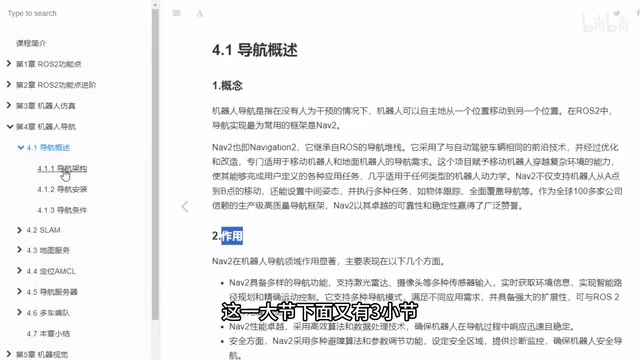
Installation Commands: Simple and Direct
The second subsection introduces the navigation installation commands. The tutorial emphasizes that this part is relatively simple—just two commands that learners can directly copy, paste, and press Enter to execute. This "low-barrier" design reduces the frustration of environment configuration and allows learners to quickly move into the practical phase.
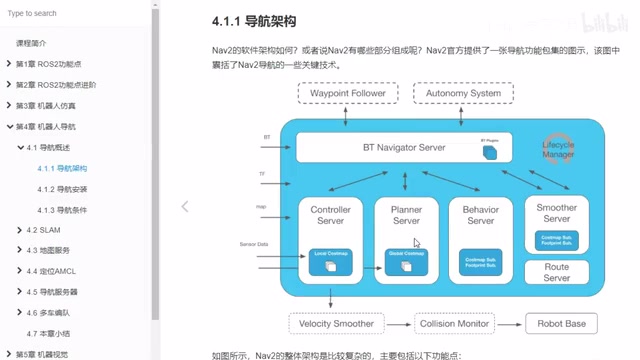
Navigation Prerequisites: Fundamentals and Practical Environment
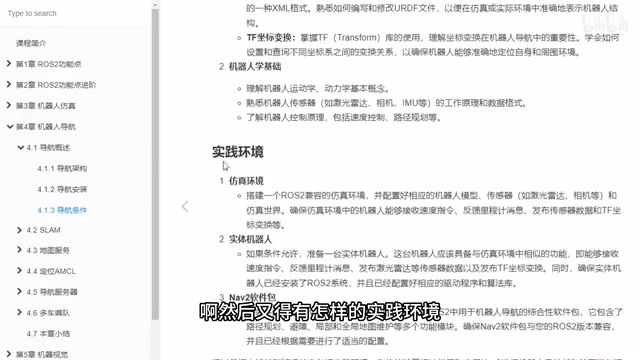
The third subsection discusses the prerequisites for implementing ROS 2 navigation. The tutorial addresses two dimensions: first, the foundational knowledge required; second, the practical environment requirements. This means learners cannot simply watch videos—they also need certain prerequisite knowledge (such as ROS fundamentals and coordinate system concepts) and a runnable software and hardware environment. The tutorial provides detailed coverage of both aspects, helping learners self-assess whether they meet the prerequisites before starting.
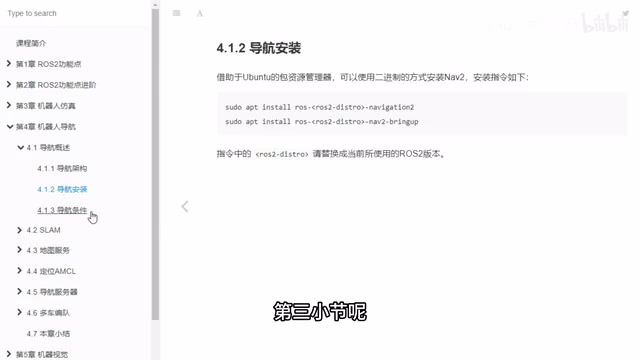
Connecting the Navigation Overview to SLAM Practice
This tutorial series places the navigation overview as the first major section, with the Fourteen Lectures on Visual SLAM, slam_toolbox, and Cartographer to follow. This arrangement has its rationale: first let learners understand the full picture of the navigation system, then dive into specific SLAM algorithms and tools, avoiding the problem of "seeing the trees but not the forest."
The Fourteen Lectures on Visual SLAM is a classic theoretical textbook focusing on mathematical foundations and algorithm principles, while slam_toolbox and Cartographer are commonly used mapping and localization tools in the ROS ecosystem, focusing on engineering practice. The tutorial attempts to combine both, enabling learners to use tools to complete actual mapping and navigation tasks on the basis of understanding the principles.
ROS 2 (Robot Operating System 2) is not an operating system in the traditional sense, but rather a distributed communication middleware and toolset for robotics applications. It implements publish/subscribe, service, and action communication between nodes based on DDS (Data Distribution Service), naturally supports multi-process and multi-machine collaboration, and improves upon the deficiencies of ROS 1 in real-time performance and security. In navigation and SLAM scenarios, sensors such as LiDAR, odometry, and IMU typically each publish topics as independent nodes, while slam_toolbox, Cartographer, and Nav2 subscribe to these topics to obtain data and output maps and poses. slam_toolbox is a 2D LiDAR mapping tool based on graph-based SLAM, suitable for online mapping and map persistence in small-to-medium scenarios; Cartographer employs a strategy combining submaps with loop closure detection, excelling in large-scale scenarios and multi-sensor fusion. Mastering the core ROS 2 concepts of nodes, topics, and TF coordinate transforms is a prerequisite for understanding navigation architecture diagrams and successfully running these tools.
Learning Advice: Alternate Between Theory and Practice
For those who want to follow this tutorial series, there are a few things worth noting. Although the navigation overview section is primarily theoretical, don't skip it, because the concepts in the architecture will be repeatedly referenced when using the tools later. Although the installation commands are simple, it's recommended to operate in a clean environment to avoid dependency conflicts. The prerequisites section should be carefully reviewed—if foundational knowledge is lacking, learners can first supplement their understanding of ROS 2 and coordinate systems.
The tutorial's title emphasizes "from principles to practice," which means learners need to maintain two mindsets: don't be intimidated by theory, and don't be impatient with practice. SLAM itself is a highly interdisciplinary field involving probability theory, linear algebra, computer vision, and robotics, and it's difficult to master in a short time. However, by following the path of "navigation overview—visual SLAM theory—tool practice," learners can establish a sustainable learning rhythm.
The value of this tutorial lies in providing a structured learning framework, but the ultimate results depend on whether learners actually run the code, debug parameters, and observe mapping results. The installation commands and prerequisite checks mentioned in the tutorial are precisely the starting point for hands-on practice.
The Fourteen Lectures on Visual SLAM was written by Gao Xiang and others and is the most widely circulated introductory textbook in the field of visual SLAM in China. The "fourteen lectures" in the title correspond to fourteen progressive chapters. Its content starts from 3D rigid body motion in space, Lie groups and Lie algebras, and camera models, gradually delving into nonlinear optimization, feature point methods, optical flow methods, direct methods, back-end optimization, loop closure detection, and mapping—covering almost the complete technology stack of modern visual SLAM. A major feature of the book is that it emphasizes both theory and code, with accompanying example programs based on libraries such as Eigen, Sophus, Ceres, and g2o, allowing readers to implement pose estimation and optimization processes hands-on. For beginners, the mathematics in the first half (especially Lie algebras and nonlinear optimization) is the main barrier, and it's recommended to repeatedly work through derivations alongside publicly available course videos; the second half should be read in conjunction with open-source projects like ORB-SLAM to understand the correspondence between engineering implementations and textbook formulas.
One-line Summary
A from-principles-to-practice SLAM learning path that opens with a navigation overview and connects to the Fourteen Lectures on Visual SLAM and slam_toolbox/Cartographer.
Paragraph Summary
This article introduces a SLAM algorithm teaching system labeled "the most complete and detailed," whose organizing logic is to first build an overall understanding of navigation systems, then dive into specific algorithms and tools. The first major section—the navigation overview—covers four aspects: concepts and roles, navigation architecture, installation commands, and practical prerequisites. It emphasizes that although the architecture is complex, it can be decomposed into modules for perception, mapping, localization, planning, and control, and that installation requires only two commands, lowering the entry barrier. The article notes that subsequent content will connect the theoretical foundations of the Fourteen Lectures on Visual SLAM with the engineering practice of slam_toolbox and Cartographer, balancing principles and implementation. Finally, it offers learning advice: don't skip the theoretical parts, operate in a clean environment to avoid dependency conflicts, and maintain a rhythm of alternating between theory and practice.
Related articles
Getting Started with ROS2 Robot Development: Core Concepts and Environment Setup
This article introduces the core concepts and environment setup of ROS2 robot development, explains why ROS2 unifies module communication and facilitates collaborative work, and outlines the Turtlesim simulation experiment to help beginners get started quickly.

LangChain Beginner's Guide: Core Concepts and Hands-On Tools
What is LangChain? This guide covers its core positioning—Agent = Model + Harness—and the three key problems it solves: training time limits, external data connections, and multi-turn conversation context.

FDE Forward Deployed Engineer: The New Species of AI Implementation and Two Schools of Practice
An analysis of FDE (Forward Deployment Engineer), the new species of AI implementation, covering Palantir's ontology-driven and AI Walking scenario-driven schools, Agent development and fine-tuning/distillation tech stacks, common enterprise pitfalls, and learning paths for entering the field.