LangChain Beginner's Guide: Core Concepts and Hands-On Tools

LangChain is an agent harness framework: Agent = Model + Harness.
Based on a hands-on course, this article outlines LangChain's positioning, core value, and beginner path. It introduces the mental model Agent = Model + Harness Framework, with LangChain as a general-purpose scaffold akin to Spring in Java. It solves three main problems: breaking training time limits to access the internet, connecting external data and internal systems (RAG, vector databases), and managing multi-turn conversation context. It also warns against equating chat products like DeepSeek and ChatGPT with bare API models—the latter's missing capabilities are exactly what LangChain provides.
Title
LangChain Beginner's Guide: Core Concepts and Hands-On Tools
Meta Description
What is LangChain? This article outlines LangChain's core positioning—an agent equals a model plus a harness framework—and breaks down the three major problems it solves: breaking through training time limits, connecting external data, and managing multi-turn conversation context, along with a quick-start path and common pitfalls to watch out for.
Article Content
LangChain has become the de facto entry-level framework for LLM application development. If you already have a Python foundation and want to quickly build agents, connect external data, or implement multi-turn conversations, it's almost impossible to avoid as your first stop. This article, based on a hands-on course, outlines LangChain's positioning, core features, typical scenarios, and provides a quick-start path.
What Is LangChain: Agent = Model + Harness Framework
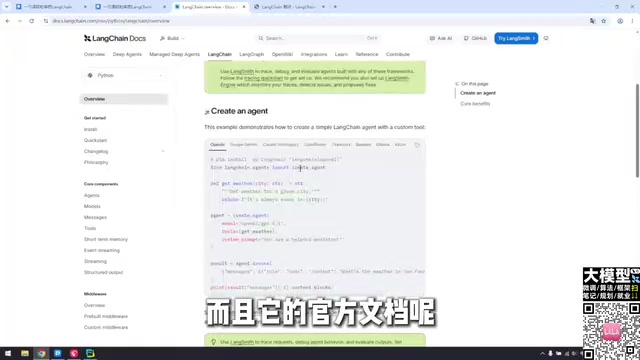
The course opens with a clear formula: Agent = Model + Harness Framework. The model refers to LLMs like DeepSeekAd, Claude, and GPT, while the harness framework is the LangChain ecosystem. The official documentation states it even more directly in English—An Agent is a model plus a Harness (scaffolding), and LangChain is essentially a Harness solution.
According to the instructor of this course on Bilibili, OpenAI and DeepSeek have all launched similar approaches with roughly the same direction—some competing on price margins, others building their own ecosystems—while LangChain takes a more general-purpose route. Its official documentation is comprehensive, with complete starter demos and code examples, so it's recommended to start directly with LangChain when getting into LLM applications.
LangChain is an open-source framework for developing LLM-powered applications. Think of it like Spring in Java development—Spring helps you quickly drive web applications, and LangChain helps you quickly drive models. But it's not just a wrapper around model API calls; tool calling and context management may sound simple, but there's a lot going on behind them, and the LangChain ecosystem has already integrated everything for you, so you don't need to build complex architecture from scratch.
Understanding "agent" requires distinguishing it from a simple API call. A bare model can only generate output text based on input text and cannot take initiative; an agent adds a layer of loop control on top of the model: the model first decides whether it needs to call a tool (search, calculator, database query, code execution, etc.), the framework parses the model's calling intent, actually executes the tool, feeds the result back to the model, and the model decides the next step—repeating until the task is complete. This "think—act—observe" loop is the responsibility of the Harness (scaffolding). The term Harness comes from the testing and engineering domain, referring to a shell that wraps the object under test and provides runtime support; here it refers to the orchestration layer built around the model, responsible for prompt assembly, tool registration and scheduling, output parsing, error retry, and state management. Because of this, the same model paired with different Harnesses can perform very differently.
The Three Core Problems LangChain Solves
The course summarizes LangChain's core value into three dimensions. There are more than these three, but these best demonstrate its irreplaceability.
Breaking Through Model Training Time Limits
LLMs are not omniscient—they only know things before their training cutoff. For example, if the model was trained in June, it won't know about things that happened in August. The model itself has no ability to directly call tools or access the internet, but it knows "what it doesn't know" yet cannot look it up itself. The LangChain ecosystem provides tools for accessing the internet, helping the model complete queries.
There's an easily confused point here: when you send a message in the DeepSeek chat box, you're not directly interacting with a bare model—that product itself is already in a form similar to a knowledge base or agent, with built-in internet access capabilities. A pure model has no ability to access the internet.
Connecting External Data and Internal Systems
Building RAG and knowledge bases requires going to vector databases and doing traceability, and the model itself still lacks this capability. LangChain can help you access your company's internal databases and bring external data into the model's workflow.
RAG (Retrieval-Augmented Generation) is currently the most common engineering paradigm for LLM deployment: when a user asks a question, the system first retrieves relevant fragments from external knowledge bases (documents, databases, web pages, etc.), then stitches these fragments as context into the prompt, letting the model answer based on real materials. It bypasses two inherent challenges—model training data has a cutoff date and cannot cover internal enterprise private information. Implementing RAG typically requires document splitting, vectorization (Embedding), storing in vector databases, similarity retrieval, reranking, and other steps. Vector databases store dense vectors of text and support approximate nearest neighbor search; "traceability" means attaching citation sources when returning answers, making it easy for users to verify and reducing hallucination risks. LangChain's value lies in abstracting this entire pipeline into composable components (document loaders, text splitters, vector stores, retrievers), so developers only need to assemble them as needed rather than implementing every layer of protocols and interface adapters themselves.
Managing Multi-Turn Conversation Context State
Normally, a model is one question one answer—when you ask again, it answers entirely based on the current question without referencing previous statements. Multi-turn contextual communication works well, but bare models have no memory capability. LangChain provides context management mechanisms. Of course, you could do it yourself, but LangChain makes these things much easier to handle.

LLM APIs themselves are "stateless": each request is an independent inference, and the server doesn't remember what you said last time. So-called multi-turn conversations are essentially the client stuffing historical messages (the back-and-forth between user and assistant) into the context window and resending them with each request. This brings two practical constraints: first, the context window length is limited—the longer the history, the more tokens consumed, the higher the cost, the slower the response, and overly long contexts may dilute key information; second, beyond the window, truncation or summarization compression is necessary. LangChain's Memory component is exactly a wrapper around this process, providing various strategies such as keeping by turn count, trimming by token count, and rolling summarization of history, and can be combined with session storage backends to achieve cross-request state persistence. Understanding that "memory is implemented by resending history" is essential to reasonably designing the balance between cost and effectiveness in multi-turn conversations.
Quick-Start Path and Learning Advice
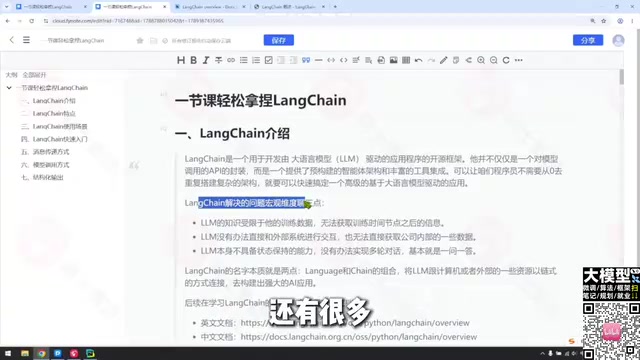
The hands-on portion of the course covers message passing methods, model invocation methods, structured output, tool calling, and short-term context memory. The starter code is very easy, and the official documentation provides complete examples.
The learning path suggested by the instructor is: first go through the official documentation, get the basic small features running, then practice through code. English documentation is the clearest; if your English is limited, you can use translation software or read the Chinese documentation directly.
It's worth noting that LangChain has many details, and one lesson can only cover basic features. Advanced topics like tool calling and memory mechanisms require follow-up deep dives. For developers new to LLM applications, it's recommended to first establish the mental model of "model + harness framework," understand LangChain's position in the agent architecture, and then start writing code—this will be more rewarding than directly copying demos.
Common Pitfalls to Watch Out For
Don't equate model products with bare models. The DeepSeek and ChatGPT you use in the chat box are already packaged agent products with built-in internet access, knowledge bases, and other capabilities. But bare models called through APIs need frameworks like LangChain to fill in these capabilities. Understanding this difference is essential to figuring out when you need LangChain and when using existing products is enough.
One-line Summary
LangChain is an agent harness framework, with the formula: Agent = Model + Harness.
Paragraph Summary
Based on a hands-on course, this article systematically outlines LangChain's positioning, core value, and beginner path. The author first presents the mental model: Agent = Model + Harness Framework, where LangChain is such a general-purpose scaffold, analogous to Spring in the Java ecosystem. It mainly solves three types of problems: breaking through model training time limits to access the internet, connecting external data and internal systems (such as RAG and vector databases), and managing multi-turn conversation context state. The article particularly highlights a common misconception—chat products like DeepSeek and ChatGPT are already packaged agents, not equivalent to bare models called through APIs, and the capabilities missing from the latter are exactly what LangChain fills in. The beginner advice is to first go through the official documentation, get basic demos running, then dive deeper into tool calling and memory mechanisms.
Related articles
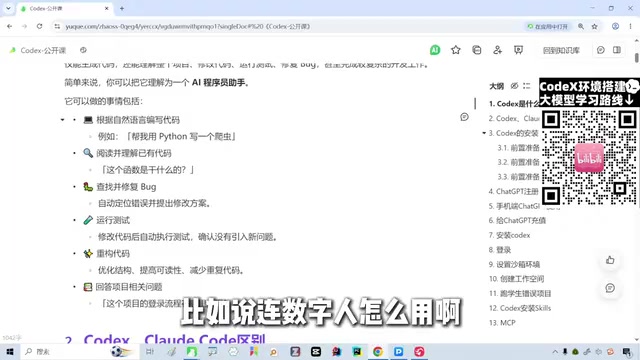
Codex in Practice: From Environment Setup to Skills and MCP Calls
Codex is OpenAI's AI coding assistant. This guide covers its positioning, how it compares to Claude Code, model configuration pitfalls, and practical Skills and MCP usage for beginners.
Getting Started with ROS2 Robot Development: Core Concepts and Environment Setup
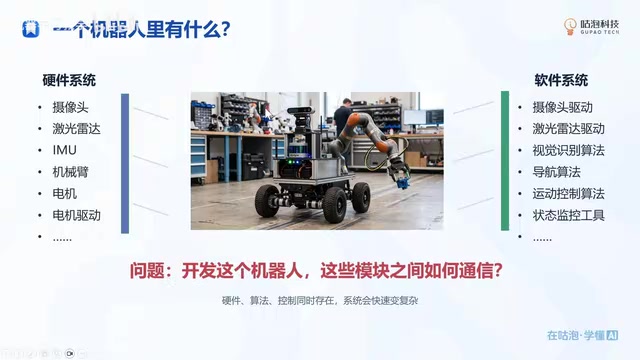
This article introduces the core concepts and environment setup of ROS2 robot development, explains why ROS2 unifies module communication and facilitates collaborative work, and outlines the Turtlesim simulation experiment to help beginners get started quickly.

SLAM Mapping and Navigation Tutorial: A Complete Learning Path from Theory to Practice
This Bilibili SLAM mapping and navigation tutorial starts with a navigation overview, covering architecture, installation commands, and practical prerequisites, then connects to the Fourteen Lectures on Visual SLAM, slam_toolbox, and Cartographer—a complete learning path from theory to practice.