Small School, Retracted Paper: One AI Student's Struggle and Breakthrough

How a small-school student breaks through the AI internship dilemma with a cloud RAG and a federated learning paper.
Using the self-account of an undergraduate at a non-top-tier US university, the article analyzes the structural predicament small-school students face in AI/ML: international student status and school ranking create a double disadvantage in resume screening, insufficient research funding may force an accepted paper to be withdrawn, and the long lag between effort and reward brings psychological drain. It argues that the student's cloud RAG application and IEEE BigData federated learning paper actually form an effective "engineering capability + research potential" signal that simply isn't reaching recruiters, and proposes three breakthrough paths: building verifiable public assets, seeking non-traditional entry points, and turning the retraction crisis into another form of participation.
When the "Small School" Label Meets the AI Wave
In AI/ML, the halo of prestigious universities and the resource threshold seem to be rising ever higher. A self-account by an American undergraduate on Reddit strikes a chord with many students at non-top-tier institutions: he comes from a school that doesn't even rank in the top 1000 nationally, is double-majoring in Computer Science and Mathematics, and is about to enter his junior year — yet he has already produced tangible results in cutting-edge areas like RAG applications and federated learning.
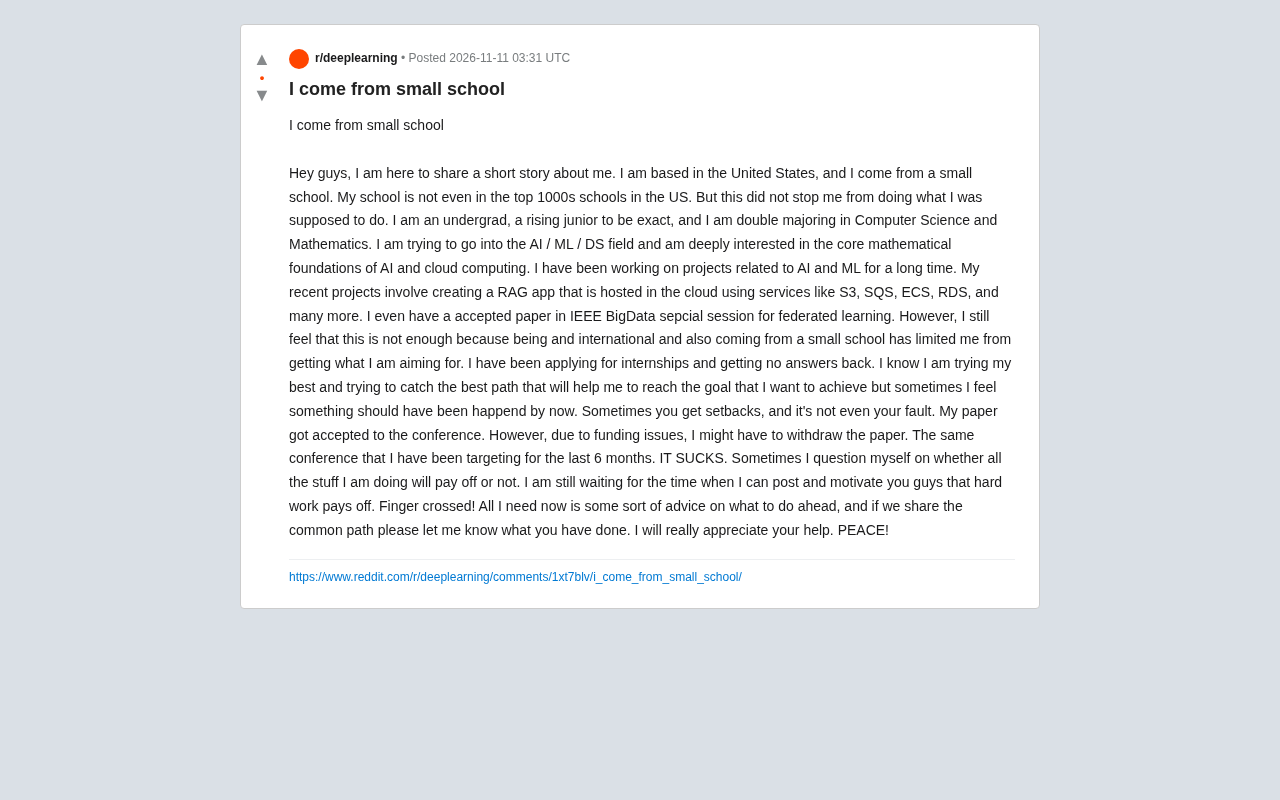
His experience presents a fractured reality: on one hand, the RAG application he led is already deployed in the cloud, using a suite of AWS services including S3, SQS, ECS, and RDS; on the other hand, most of his internship applications have vanished into the void, and he rarely even receives a rejection letter. This gap — "I've done a lot, but no one sees it" — is a shared predicament for many AI students at non-prestigious schools.
The Triple Barriers Facing Small-School Students
Identity and School: Two Invisible Filters
The student mentions two key constraints: international student status and a small-school background. In internship recruiting, these two factors often work in tandem. Many tech companies' internship positions carry additional visa cost considerations for international students, while school ranking is often used as a quick label in resume pre-screening. Even though he already has an accepted paper at the IEEE BigData federated learning special session, this signal can still be overshadowed by the school's name in the recruiting system.
RAG (Retrieval-Augmented Generation) is one of the mainstream architectures for current large language model applications: it first retrieves document fragments relevant to the question from an external knowledge base, then feeds these fragments as context into the generative model, enabling the model to give grounded, traceable answers. Compared with directly fine-tuning a model, RAG's advantages lie in hot-updatable knowledge, lower cost, and fewer hallucinations, making it the preferred solution for enterprises deploying LLMs. A complete RAG application typically includes document chunking and vectorization, vector database retrieval, prompt orchestration, generation and post-processing — and engineering-wise also involves embedding model selection and the trade-off between recall and latency. The fact that this student could independently complete a cloud-deployed RAG application at the undergraduate stage shows that what he mastered is not just algorithmic concepts but the complete engineering chain of data pipelines, service orchestration, and online operations — exactly what many candidates who only know how to call APIs lack.
Resource Gap: From the Lab to Conference Travel
A more concrete blow comes from the paper retraction. His paper was accepted by the conference, but due to funding issues he may have to withdraw it — that was a conference he had been targeting for six months. Research funding at small schools is typically limited, and the travel support an advisor can provide is far less than at large research universities. This means students not only lack the brand endorsement of a prestigious school but may also be forced to be absent from key aspects of participating in the academic community.
Federated Learning is a distributed machine learning paradigm: multiple parties, under the premise that local data does not leave their domain, each train models and upload only gradients or model parameters, which a central server aggregates and updates — thereby utilizing dispersed data while protecting privacy. It is often used in data-sensitive scenarios that are difficult to centralize, such as healthcare, finance, and mobile keyboard prediction. The core challenges of federated learning include non-IID (Non-Independent and Identically Distributed) party data, high communication overhead, and convergence guarantees for aggregation algorithms. IEEE BigData is a relatively large international conference in the data science field, and its federated learning special session has strict peer review; a paper being accepted means the research problem and methods have been recognized by peers in the field. For an undergraduate, this is a high-value research signal and an important basis for judging research potential.
Psychological Drain: The Time Lag Between Effort and Reward
He wrote in his post: "Sometimes you encounter setbacks, and it's not even your fault." This attribution is clear-eyed, but clarity cannot eliminate self-doubt. He is still waiting for a moment that proves "hard work pays off," and the waiting itself is draining.
The Achievements Are Actually More Substantial Than They Seem
From an external perspective, this student's accumulation is not thin. A cloud-deployed RAG application involves the complete chain of storage, message queues, container orchestration, and relational databases — already beyond the scope of most undergraduate course projects. A federated learning paper accepted by the IEEE BigData special session shows that his research problem and methods have been recognized by peer review. Together, these two constitute a combined signal of "engineering capability + research potential."
The problem is that these signals have not been effectively conveyed to recruiters. The mistake small-school students often make is burying their achievements in the tech stack list on their resume instead of weaving them together through project narrative. What recruiters see is not "what problem he solved" but a pile of service names.
Possible Directions for Breakthrough
Turn Projects into Verifiable Public Assets
If a RAG application stays only in a resume description, its persuasiveness is limited. Open-sourcing it, clearly writing up architectural decisions and pitfalls encountered, or turning it into an accessible demo can let recruiters see actual capability within minutes. Even if a federated learning paper is withdrawn, a preprint can still be made public, and the code and experimental setup can be organized into a technical blog. The advantage of public assets is that they bypass the direct screening by school label.
A preprint refers to a version of an academic paper that has not undergone formal peer review but has been made public on platforms such as arXiv or SSRN. In computer science, arXiv preprints have become a mainstream way to release results, and many top conference papers are posted as preprints before submission. The value of a preprint lies in: it carries a timestamp that can establish priority; it can be cited and retrieved by others; and it completely bypasses the cost and process thresholds of journals or conferences. For students forced to withdraw a paper due to funding issues, organizing the paper into an arXiv preprint with a code link can preserve the visibility of the results without losing the core contribution. Note that some conferences have specific policies on preprints, and you should confirm whether they are permitted before submission.
Actively Seek "Non-Traditional Entry Points"
Big tech internship screening processes are unfriendly to small-school students, but entry points at research labs, open-source communities, and early-stage startups rely more on actual capability. Submitting quality PRs to open-source AI projects and participating in community discussions often builds more genuine connections than mass-applying with resumes. This student's cloud service experience is scarce in open-source communities — what many projects lack is precisely practitioners of deployment and operations.
Turn the Retraction Crisis into Another Form of Participation
If funding truly cannot be resolved, you can contact the conference to ask about the possibility of remote participation, or see whether there are student scholarships or volunteer slots that can cover the registration fee. Even if the paper is ultimately withdrawn, you can organize its content into an arXiv preprint and briefly introduce the core contribution on social media. Participation in the academic community is not limited to on-site presentations.
Consensus and Divergence Across Multiple Perspectives
In Reddit and related AI communities, similar experiences are not uncommon. The consensus across multiple discussion threads is that a small-school background does carry disadvantages in resume screening, but once you enter the technical interview stage, the weight of project depth and problem-solving ability rises significantly. The divergence lies in coping strategies — some advocate "bypassing the resume gate with open-source work," while others believe one should prioritize securing research internships and use recommendation letters and output to compensate for school brand. The two paths are not mutually exclusive; the key is to choose the main direction based on your own time window.
This student's experience also points to a more structural issue: resource concentration in AI is accelerating, and small-school students need to realize earlier that they cannot rely solely on the pipelines provided by their schools. Proactively building a public evidence chain may be the most controllable step in the current environment.
He ends his post with "fingers crossed," waiting for a moment that can inspire others. From an observer's perspective, he is already doing the right things — the returns just haven't arrived yet. For those walking the same road, this candor itself has value.
One-line Summary
An analysis of how a small-school student breaks through the AI internship dilemma with a cloud RAG and a federated learning paper.
Paragraph Summary
Taking the self-account of an undergraduate at a non-top-tier American university as its entry point, the article analyzes the structural predicament small-school students face in AI/ML: international student status and school ranking form a double disadvantage in resume pre-screening, insufficient research funding may force an accepted paper to be withdrawn, and the long time lag between effort and reward brings psychological drain. The author points out that this student's cloud RAG application and IEEE BigData federated learning paper actually constitute an effective signal of "engineering capability + research potential"; the problem is that these signals have not been effectively conveyed to recruiters. The article accordingly proposes three breakthrough paths: turning projects into verifiable public assets such as open-source code, demos, or preprints; seeking non-traditional entry points through open-source communities, research labs, and early-stage startups; and resolving the retraction crisis through remote participation, student scholarships, or preprint publication. Finally, it notes that in the context of AI resource concentration, proactively building a public evidence chain is the most controllable step for small-school students.
Related articles

Don't Let Permission Pop-ups Scare Users Away: On-Demand Requests Are the Right Approach for AI Plugins
AI plugins that show a permission wall at install time can scare users away. Based on a technical sharing video, this article analyzes the friction caused by requesting all permissions upfront and introduces on-demand permission requests that ask only when needed, improving the user experience and trust of AI tools.

Perplexity Decider Free for a Week, Plus Compute Grants and Credit Matching
Perplexity Decider V1.3 and Flash V1.3 are free on OpenRouter for a week, plus Infirst.net offers up to $10K compute grants for open-source AI projects and Cognition provides $15K Devin credits with 1:1 matching for startups.

Motorcycle Infiltration: Russia's Drone War of Attrition in Ukraine
An analysis of Russia's motorcycle infiltration tactics in Ukraine: using speed to cross drone kill zones, accepting high casualties to find gaps in Ukrainian defenses, and exploring drone suppression and two Ukrainian response paths.