Spacesheep: Turning AI Agent Work into Collaborative Interactive Spaces

Spacesheep turns agent output into collaborative interactive spaces, bridging the gap between AI work and team understanding.
Spacesheep is a YC F26-backed Product Hunt new release ranked #4 with 126 votes and 12 comments. It transforms AI agent work into interactive documents, real-time dashboards, prototypes, or runnable apps, with sharing by person, team, or public. Targeting both developers and product/ops teams, its value lies in solving the "last mile" between AI output and team understanding—though maturity still needs verification.
Today, as AI agents take on more and more tasks, an awkward gap still exists: the results produced by agents often end up scattered across chat logs, terminal output, or temporary files, making it hard for team members to understand, discuss, or even modify them the way they would read a document. Spacesheep, a new product ranked #4 on Product Hunt, attempts to bridge this gap with the concept of a "Space"—turning any agent's work into interactive documents, real-time dashboards, product prototypes, or applications, and enabling team members to collaborate around them.
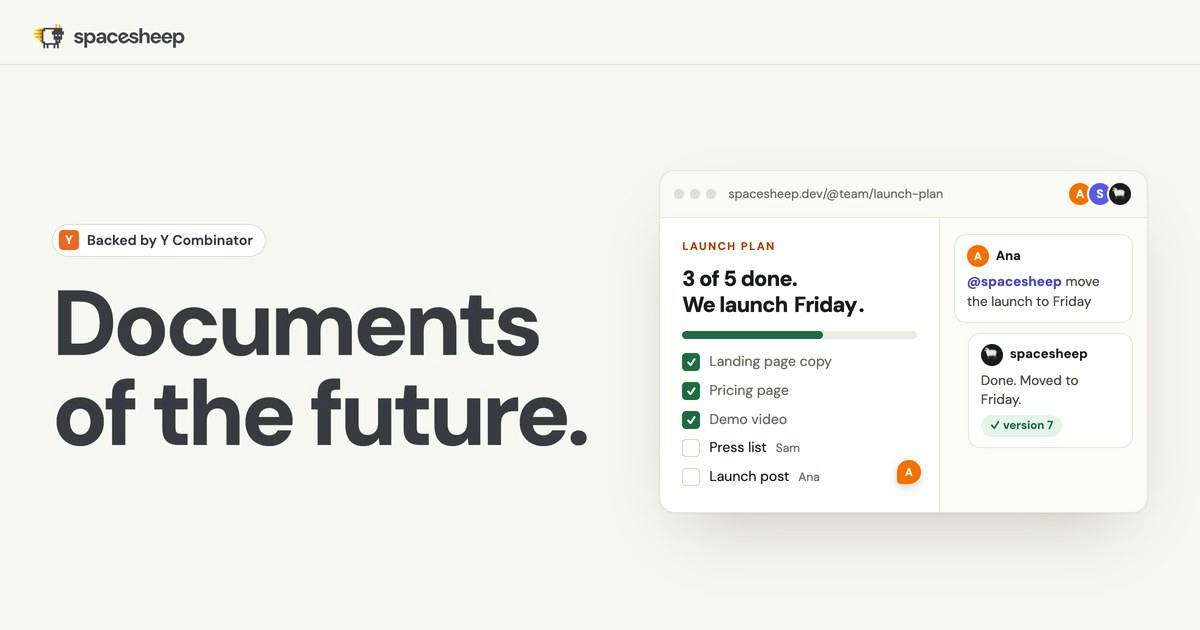
From Output to Space: Transforming the Form of AI Work Results
Spacesheep's positioning can be summed up in one sentence: make agent output a readable, interactive, shareable object. According to its Product Hunt page description, it can turn an agent's work into a "space"—which can manifest as an interactive document, a real-time dashboard, a design mockup, or a runnable application. This essentially redefines the endpoint of "AI output": no longer a block of text that needs to be manually moved around, but a collaborative unit with built-in context that can be continuously updated.
This approach hits a pain point in current agent applications. When developers use agents to write code, perform analysis, or generate reports, the results often need manual organization before they can be shown to non-technical colleagues; Spacesheep automates the conversion step, giving the output a form that is directly team-facing.
"AI Agent" refers to an AI system capable of autonomously planning, invoking tools, and executing multi-step tasks to accomplish goals, as distinct from single-turn question-answering chatbots. Its typical workflows include writing code, performing data analysis, and generating reports, but the output often exists as text streams or temporary files, lacking structured context. Spacesheep targets exactly the "deliverability" step of agent output—packaging raw output into objects with state, interactivity, and continuous updates, rather than one-off text blocks.
Permissions and Collaboration: Spaces Are Designed for Teams
Another emphasis of Spacesheep is sharing granularity. Users can choose the sharing scope as needed: specific people, the entire team, or public. This design implies the product's focus on collaborative scenarios—a space is not just a display window but a collaboration vehicle where team members can work together.
Looking at product categories, Spacesheep is listed under productivity, developer tools, and artificial intelligence, indicating that its target users include both developers who need to quickly produce prototypes and dashboards, and product and operations teams that rely on document collaboration. This cross-role positioning is consistent with its narrative of "letting teams understand AI work."
YC Background and Market Signals
Spacesheep is tagged with the YC F26 batch, and the founding team includes Rohan Chaubey. On Product Hunt, it received 126 votes and 12 comments, ranking #4. For a tool focused on "collaborativizing AI output," this early feedback shows the concept has some appeal, but the number of comments also indicates it is still in an early stage of market validation.
It is worth noting that Spacesheep is not building another agent framework, but rather the "last mile" between agents and teams. As agent capabilities themselves become increasingly commoditized, how to help organizations digest the output may become the key to differentiated competition.
YC (Y Combinator) is the world's most famous startup accelerator, running winter and summer batches each year (e.g., W for Winter, S for Summer, followed by the year). Selected teams receive seed funding, mentorship, and a Demo Day presentation opportunity. YC backing is usually seen as an early signal of team quality and market potential, and an important endorsement for products gaining attention in communities like Product Hunt. The F26 batch tag means the team is in an earlier acceleration stage, the product is not yet fully mature, but it has passed YC's screening process.
Initial Observations
Spacesheep's vision is clear: upgrade AI work results from "one-off output" to "collaborative spaces." Its success will depend on two things—whether the converted spaces are truly interactive and real-time enough, and whether the collaboration experience is smoother than simply dropping a document link. Currently, public information is limited, and the product's actual maturity still needs further verification, but its angle is worth watching.
One-line Summary
Spacesheep turns agent output into collaborative interactive spaces, bridging the gap between AI work and team understanding.
Paragraph Summary
Spacesheep is a Product Hunt new release backed by YC F26, ranked #4 with 126 votes and 12 comments. Its core is to transform AI agent work results into interactive documents, real-time dashboards, product prototypes, or runnable applications, and support sharing at three granularities: specific people, team, or public. The product targets both developers and product/operations teams, spanning productivity, developer tools, and AI categories. The article argues that its value lies in solving the "last mile" between AI output and team understanding, but actual maturity still needs verification, and success depends on whether the spaces are interactive and real-time enough and whether the collaboration experience is smooth.
Related articles

DeepSeek Harness: A Beginner's Installation and Testing Guide
A DeepSeek Harness tutorial for test engineers: set up Node.js, launch with one NPX command, configure official and third-party models, and explore web search, file I/O, and trace-view agent observability.
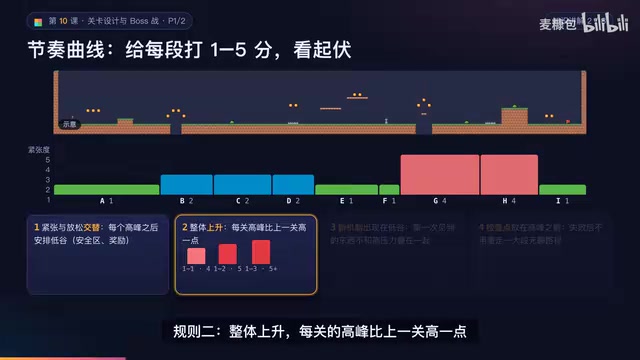
AI Game Development in Practice: Designing Levels with the Four-Step Method and Pacing Curves
AI game development lesson 10: design levels with the four-step method (teach, practice, combine, test) and a 1-5 pacing curve, plus sightline guidance and safety zones—implement Animatable Body 2D moving platforms and generate ASCII sketches for 1-2 Underground Cavern and 1-3 Guard Hall.

AI Game Development in Practice: Two-Phase Boss State Machines and Death Heatmap Tuning
AI game development lesson 10: implement a two-phase Boss with a state machine, guarantee fairness with color signals and a 0.4-second warning floor, locate difficulty cliffs with a death heatmap, and apply lightest-to-heaviest fixes one at a time, with an acceptance checklist and common pitfalls.