SpaceX Starfall: Making Microgravity Access Affordable and Routine

SpaceX launches Starfall to make microgravity access affordable and routine, but details remain scarce.
SpaceX published the Starfall project on its official website, claiming to provide affordable, routine microgravity access services, which sparked heated discussion in the Hacker News community. The analysis suggests the project may rely on Starship's reusability to lower marginal costs, but key parameters such as capacity, pricing, and mission duration have not been disclosed. Demand for microgravity experiments is real, but the customer base is narrow, and scalable operations remain unproven. Community reactions are polarized: supporters value SpaceX's execution ability, while skeptics point to insufficient transparency. Overall, Starfall has a clear direction, but implementation details remain unresolved.
SpaceX recently published a new project called "Starfall" on its official website, claiming it will provide "affordable, routine access to microgravity." The news quickly sparked discussion on Hacker News, where the post received 265 points and 200 comments. Although the official page contains limited information, Starfall's positioning deserves in-depth analysis when considered alongside SpaceX's existing technology layout and industry context.
What Is Starfall: From "Expensive Experiment" to "Everyday Tool"
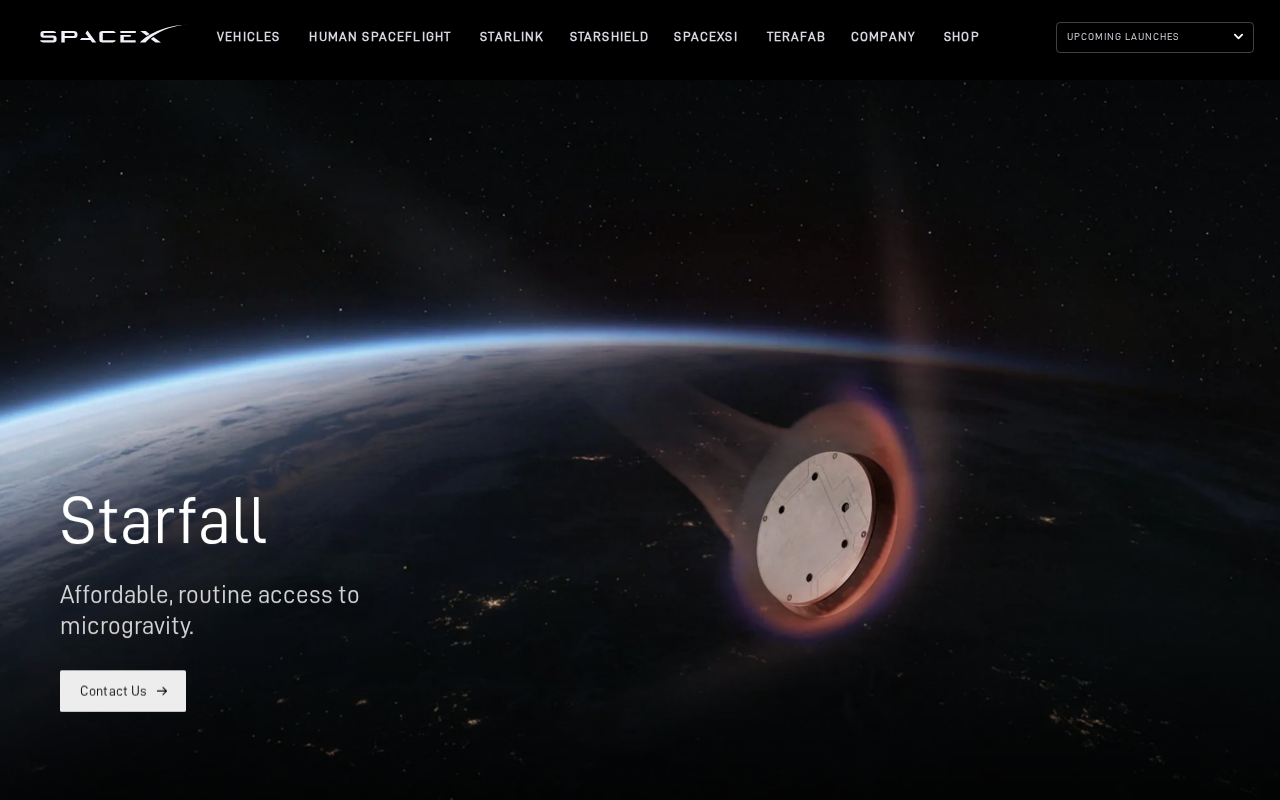
According to the description on SpaceX's official page, Starfall's core goal is to lower the barrier to accessing microgravity environments, transforming it from an expensive experiment exclusive to a few institutions into an affordable, repeatable routine service. The original text sets the tone with the words "affordable" and "routine," implying that this is not a one-off technology demonstration but a commercial product aimed at continuous operations.
The discussion on Hacker News (200 comments) reflects the community's polarized reaction: some see this as an important step in space commercialization, while others question what "affordable" actually means in the absence of specific pricing and capacity details. This divergence itself shows that the cost structure of microgravity access remains an industry pain point.
Technical Foundation: Starship and Reusability
Starfall's "affordable" promise cannot be separated from SpaceX's own launch vehicles. One of Starship's design goals is to dramatically reduce the cost per unit mass to orbit, and reusability is key to that. If Starfall relies on Starship's capacity and reuse capability, then there is indeed room for the marginal cost of microgravity missions to decline—this is also the logic most frequently mentioned in community discussions.
However, the official page does not disclose which launch vehicle Starfall will use, mission duration, payload limits, or other parameters. Some users in the Hacker News comments pointed out that the lack of these details makes the word "routine" seem premature. This information gap is the main obstacle to judging the project's feasibility at present.
The relationship between microgravity and launch costs: A microgravity environment refers to space conditions in which an object is in free fall and effective gravity is extremely low, usually achieved through suborbital flights (a few minutes), orbital flights (sustained microgravity), or parabolic flights. The cost of achieving microgravity access depends heavily on launch vehicle costs, reusability, and mission duration. As a fully reusable system, Starship aims to reduce the cost per kilogram to orbit far below that of Falcon 9, thereby making long-duration orbital microgravity experiments economically viable. This is also the technical premise behind Starfall's claim of being "affordable."
The Microgravity Market: Demand Is Real, but Scale Remains Unproven
Microgravity environments have clear research value in fields such as materials science, biopharmaceuticals, and fluid physics. The International Space Station has long served as a platform for such experiments, but its high access costs and long scheduling times have limited commercial customer participation. If Starfall can truly provide routine services, in theory it could activate a batch of demand that had previously been shut out by cost.
The question is whether the scale of demand is sufficient to support "routine"-level operational frequency. Some comments on Hacker News argue that the customer base for microgravity experiments remains relatively narrow, making it difficult to form a high-frequency flight business loop in the short term. This view contrasts with the official narrative and also suggests that Starfall's commercialization pace still needs to be observed.
The commercialization limitations of the International Space Station (ISS): As a microgravity research platform, the ISS has extremely high access costs (tens of thousands of dollars per kilogram for cargo, and even more for crewed missions), and experiment scheduling requires coordination among multinational agencies, making it difficult for commercial customers to obtain flexible, high-frequency flight opportunities. In addition, the ISS is planned to be retired around 2030, creating a market window for commercial space stations and microgravity service platforms. If Starfall can establish routine service capability before the ISS retirement, it is expected to take on part of the transferred demand, but it will also face competition from other commercial space stations such as Axiom and Orbital Reef.
Community Perspective: Expectations and Skepticism Coexist
Among the 200 comments on Hacker News, supporters value SpaceX's past execution—from the routine reuse of Falcon 9 to the large-scale deployment of Starlink, the company has repeatedly turned "impossible" into "routine." Skeptics focus on information transparency: a project claiming to be "affordable" has not disclosed its pricing logic or mission specifications, making it difficult to assess its true competitiveness.
This discussion atmosphere is related to SpaceX's consistent communication strategy: first release a vision, then gradually disclose details. Starfall is currently at the vision stage, and the community's reaction is more about judging the direction than testing the product.
Conclusion: Clear Direction, Details Pending
Starfall points to a market that has long existed but has not been fully commercialized—microgravity access. SpaceX's brand and technical accumulation provide credibility backing, but whether "affordable" and "routine" can be realized depends on capacity plans, pricing strategies, and customer demand validation that have not yet been made public. For readers following space commercialization, this is a project worth continued tracking rather than a finished product about which conclusions can be drawn immediately.
One-line Summary
SpaceX launches the Starfall project, aiming to make microgravity access affordable and routine, but details are still lacking.
Paragraph Summary
SpaceX published the Starfall project on its official website, claiming it will provide affordable, routine microgravity access services, sparking heated discussion in the Hacker News community. The article's analysis suggests that the project may rely on Starship's reusability to lower marginal costs, but the company has not disclosed key parameters such as capacity, pricing, or mission duration. Demand for microgravity experiments is real, but the customer base is relatively narrow, and scalable operations remain to be verified. Community reactions are polarized: supporters value SpaceX's execution ability, while skeptics point to insufficient information transparency. Overall, Starfall has a clear direction, but implementation details remain unresolved.
Related articles
 Tech Frontiers
Google Omni 1.2 Flash: 15-Second AI Video at Just $0.07 per Second
Google DeepMind releases Gemini Omni 1.2 Flash: 15-second video, 720p at $0.07/sec (30% cheaper), multi-turn editing without regeneration, draft upscaling to 4K.
 Tech Frontiers
No AI Ghostwriting: Writer's Quarter Reinvents Novel Writing with a Visual Workbench
The Writer's Quarter is an AI-free novel writing and planning tool that unifies character building, story planning, and manuscript writing in one visual workbench. This article analyzes its positioning, target users, and differentiated value amid the rise of AI writing tools.
 Tech Frontiers
Fleeep: A Unified Inspiration Collection Notes App for Creatives
Fleeep is a notes app for creatives that unifies screenshots, bookmarks, saved posts, and inspiration into one calm, cross-device, offline-capable space. This article analyzes its positioning, differentiation, and target users.