SpaceX Starship Successful Recovery: A Milestone Where Science Fiction Becomes Reality

Starship's booster was successfully captured by mechanical arms, marking a key step forward in reusable rocket technology.
After launch, SpaceX's Starship booster was precisely captured by the launch tower's mechanical arms, sparking enthusiastic reactions on social media with many exclaiming "science fiction becomes reality." This successful recovery validates the fundamental feasibility of rocket reuse economics. Its technical challenges lie in precise guidance, attitude control, and coordination with the mechanical arms, demanding extremely high real-time communication and autonomous decision-making. From an industry perspective, reusable technology promises to restructure launch cost structures and mission cadence, laying the foundation for deep-space missions to the Moon and Mars. However, one success does not mean the technology is fully mature—full reusability of Starship still requires more flight validation, including rapid reuse and orbital refueling.
From Science Fiction to Reality: The Stunning Moment of Starship Recovery
When SpaceX's Starship booster was precisely captured by the mechanical arms after launch, many watching the livestream shared the same feeling: this looks like a scene straight out of a science fiction movie. As one congratulatory tweet from Twitter put it: "Congrats @SpaceX for that starship catch, still feels like science fiction! Watching it live was incredible. Upwards!" This excitement spread rapidly across social media, not only because of the technical difficulty itself, but because it marks a key step forward in reusable rocket technology.
Starship recovery is not simply a "chopsticks catching a rocket" spectacle—it is a fundamental validation of the economics of rocket reuse. Traditional rockets' boosters typically fall into the ocean or become space debris after launch, whereas Starship's in-place capture promises to significantly reduce launch costs. This success means SpaceX has crossed another threshold on the path to a fully reusable launch system—one that many once considered impossible.

Technical Challenges: Why This Recovery Was So Difficult
To have a booster dozens of meters tall precisely align with the mechanical arms on the launch tower during its return requires solving a series of engineering challenges. First, the booster must precisely control its attitude and speed during reentry, ensuring it approaches the capture mechanism at the right angle and position. Second, the timing and force of the mechanical arms' closure must perfectly match the booster's dynamic characteristics—even a slight deviation could cause collision or structural damage.
Moreover, the entire recovery process demands extremely high real-time communication and autonomous decision-making capabilities. The rocket needs to complete multiple attitude adjustments in a very short time, and the coordination between ground control systems and onboard computers must be seamless. This success demonstrates that SpaceX has accumulated considerable maturity in guidance, navigation and control, material tolerance, and rapid reuse procedures.
Guidance, Navigation and Control (GNC) is one of the core technologies of rocket recovery. It fuses multi-source sensor data from inertial measurement, GPS, LiDAR, and more, using algorithms such as Kalman filtering to estimate the rocket's position, velocity, and attitude in real time. During the Starship booster's return, the GNC system must compute optimal control commands within milliseconds, driving the grid fins and engine thrust vectoring to guide the tens-of-tons vehicle precisely toward the launch tower after high-speed reentry. Unlike traditional expendable rockets, recovery missions require GNC to be extremely robust, capable of handling aerodynamic disturbances, engine thrust fluctuations, and other uncertainties—a key capability SpaceX has built through years of iteration.
Impact on the Space Industry: Restructuring Costs and Cadence
The most direct impact of Starship's successful recovery is the change in launch cost structure. Although specific figures have not been disclosed, reusable technology inherently has the potential to lower per-launch costs. When boosters can be reused multiple times, manufacturers no longer need to produce entirely new hardware for each mission, allowing resources to be concentrated on higher-frequency launches and more complex deep-space missions.
From an industry cadence perspective, this recovery also provides technical validation for future lunar and Mars missions. Starship's design goals include not only low-Earth-orbit transport but also crewed lunar landings and Mars colonization. Successful recovery means that subsequent steps such as orbital refueling and long-duration spaceflight have a more reliable foundation. The competitive landscape of the space industry may also shift as a result, with other nations and commercial companies potentially accelerating their development of reusable technology.
The economics of reusable rockets are not simply equivalent to "hardware reuse means cost savings." After each recovery, the booster must undergo inspection, maintenance, and refurbishment—processes whose cost and time also affect per-launch prices. Through rapid reuse process design, SpaceX aims to compress the refurbishment cycle to days or even hours, thereby truly achieving high-frequency launches. Additionally, recovery technology is changing insurance and supply chain models: rocket reuse reduces the risk exposure of individual missions but also places higher demands on reliability verification. From an industry perspective, reusability is driving launch services to transform from "custom manufacturing" to "airline-style operations."
Community Reaction and Future Outlook
Reactions on social media show that this recovery has sparked widespread public enthusiasm for space exploration. The word "Upwards!" in that tweet is both a congratulation to SpaceX and an aspiration for humanity's space endeavors to keep reaching higher. Many non-expert viewers felt for the first time that scenes once found only in science fiction are becoming reality.
Of course, one success does not mean the technology is fully mature. Full reusability of Starship still requires more flight validation, including rapid reuse of both booster and ship, orbital refueling, and other key steps. But this recovery has undoubtedly injected a shot of confidence into the entire industry and filled people with anticipation for Starship entering routine operations in the coming years.
Orbital refueling is a key enabling technology for Starship's deep-space missions. Because Starship carries limited propellant when launching from the ground, flying to the Moon or Mars requires docking with another Starship (serving as a "tanker") in low Earth orbit and transferring cryogenic propellants. This involves a series of challenges including long-term storage of liquid hydrogen/liquid oxygen in microgravity, fluid transfer, and thermal management. Only after orbital refueling technology matures can Starship carry enough payload to perform crewed lunar landings or Mars cargo missions—which is why it is regarded as a milestone equally important as recovery in Starship's full reusability roadmap.
Conclusion
SpaceX Starship's successful recovery is an important node in the history of human spaceflight. It proves that bold visions and precision engineering can be combined, and makes "science fiction becoming reality" more than just an exclamation. As technology continues to iterate, whether Starship can truly achieve low-cost, high-frequency space transportation will determine how fast and how far humanity's journey of cosmic exploration can go.
One-line Summary
Starship's booster was successfully captured by mechanical arms, marking a key step forward in reusable rocket technology.
Paragraph Summary
After launch, SpaceX's Starship booster was precisely captured by the launch tower's mechanical arms, sparking enthusiastic reactions on social media with many exclaiming "science fiction becomes reality." This successful recovery validates the fundamental feasibility of rocket reuse economics. Its technical challenges lie in precise guidance, attitude control, and coordination with the mechanical arms, demanding extremely high real-time communication and autonomous decision-making. From an industry perspective, reusable technology promises to restructure launch cost structures and mission cadence, laying the foundation for deep-space missions to the Moon and Mars. However, one success does not mean the technology is fully mature—full reusability of Starship still requires more flight validation, including rapid reuse and orbital refueling.
Related articles
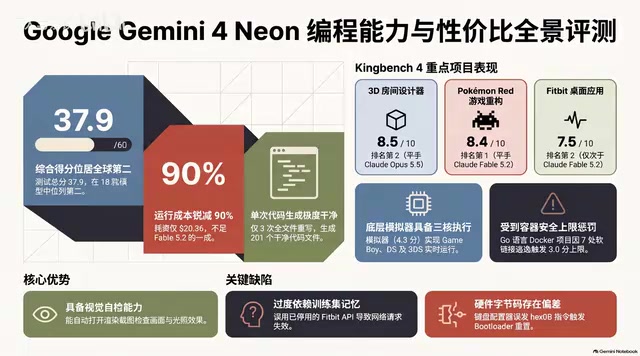
Gemini 4 Neon Hands-On: Value King or Confident Catastrophe?
Gemini 4 Neon review: 1M-token context, four thinking levels, 201 files in one KingBench4 pass at one-tenth Fable 5.2's cost—but it hallucinates fake data, leaves 7 symlink escapes, and bricks keyboards.

Google Gemini 4 Neon Hands-On: 6 3D Works That Impress and Fail
Hands-on with Google Gemini 4 Neon on a 3060 laptop: 6 3D works tested. Sunshower Fishing Harbor and mechanical keyboard impress; soft-body physics and faces fall short.

Gemini 4 Neo Web Novel Writing Test: Faint AI Flavor, Textured Dialogue
Bilibili creator's first-look review of Gemini 4 Neo for Chinese web novel writing: testing a Three Kingdoms transmigration opening with faint AI flavor, emotionally textured dialogue, and strong crisis building, plus comparison of 4A/4H/4C models and full workflow demos.