Speechmark: A Fully Offline Mac Meeting Transcription Tool That Keeps All Data on Your Device

Speechmark is a Mac app that records, transcribes, and summarizes meetings entirely offline.
Speechmark is a privacy-first macOS meeting transcription app that handles recording, transcription, and summarization entirely on-device — no cloud uploads, no bots, no account required. It extracts key decisions and action items with speaker attribution, supports MCP protocol integration with Claude Code, and uses a one-time purchase model instead of subscriptions.
The Privacy Dilemma of Meeting Transcription Tools
As remote collaboration becomes the norm, AI-powered meeting transcription tools have proliferated. However, most mainstream solutions rely on cloud processing — they require a "bot" to join your meeting, ask you to create an account, and upload meeting audio and transcripts to external servers for processing. While convenient, this approach introduces significant privacy risks: sensitive business discussions, internal decisions, and client information could all end up stored and analyzed on third-party servers.
For teams handling confidential information, legal or healthcare professionals, or anyone who values data sovereignty, this "cloud-first" model is far from ideal. Speechmark, which recently launched on Product Hunt, targets exactly this pain point with a "fully local" meeting transcription experience.
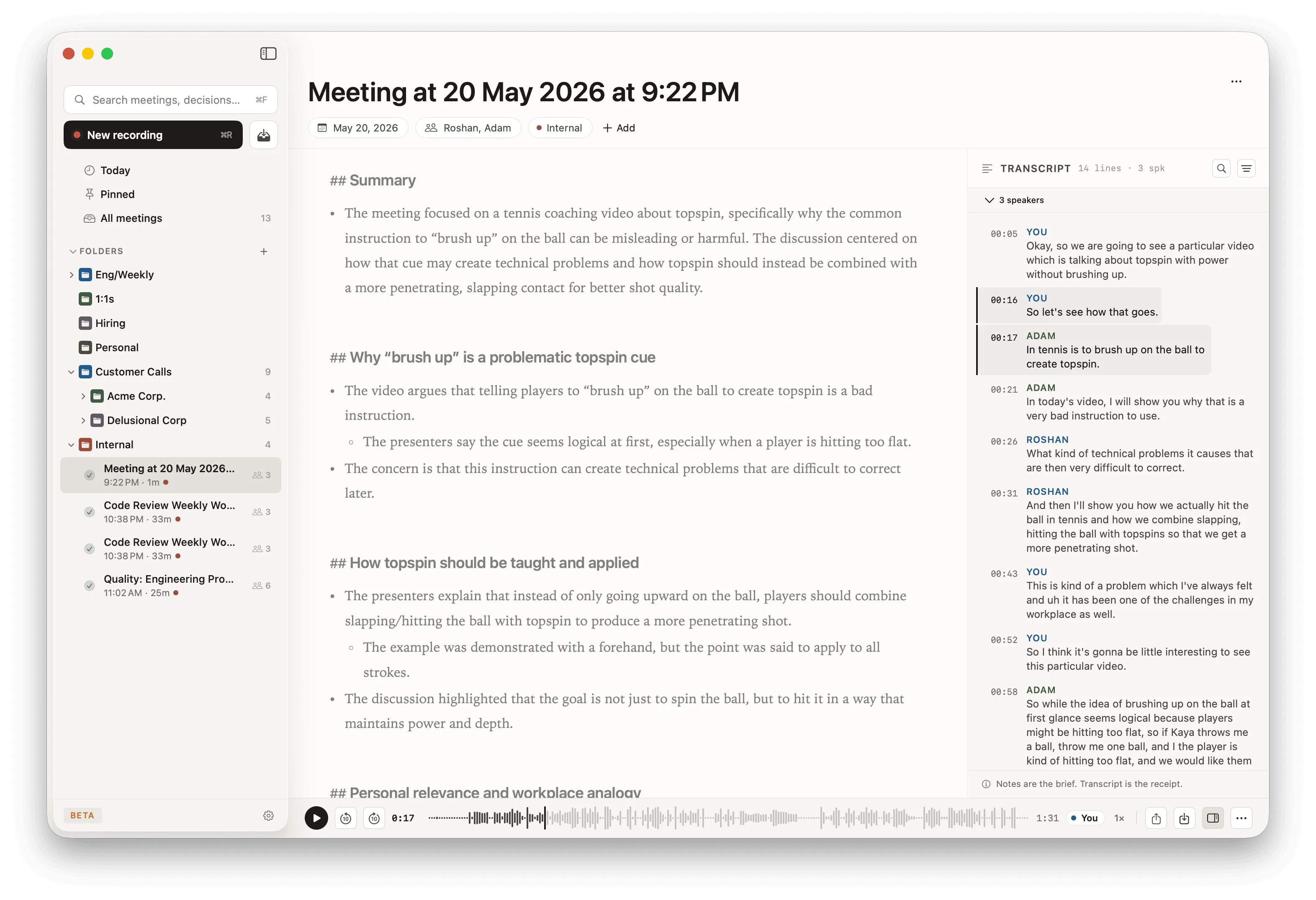
What Is Speechmark: A Fully Local Meeting Transcription App for Mac
Speechmark is a meeting transcription application built exclusively for macOS. Its core value proposition is crystal clear: recording, transcription, and summarization all happen entirely on your Mac — no data ever leaves your device. According to its Product Hunt listing, the app can automatically extract key decisions, action items, and generate full speaker-attributed transcripts.
Developer Nitin Hayaran highlighted three key differentiators at launch:
- No bot joins your call: Unlike many cloud-based meeting tools that require a visible "participant" to capture audio, Speechmark captures sound directly at the system level.
- No account signup required: It eliminates the need for account creation and identity binding — it works right out of the box.
- One-time purchase: It uses a pay-once model instead of subscriptions, which is refreshingly rare in today's subscription-saturated SaaS landscape.
On launch day, the product received 78 upvotes and 11 comments on Product Hunt, ranking 14th and categorized under Mac, Notes, and Meetings.
The Technical Foundation Behind Local Offline Processing
Speechmark's ability to run entirely offline is powered by the rapid advancement of on-device AI capabilities in recent years. Thanks to the powerful Neural Engine in Apple Silicon chips and the lightweight optimization of open-source speech recognition models like Whisper, tasks like speech transcription and text summarization — which once required cloud computing power — are now entirely feasible on local devices.
Dual Benefits: Privacy Compliance and Data Sovereignty
The greatest advantage of local processing is data sovereignty. From recording to transcription to summarization, meeting content never passes through any external server, which means:
- Sensitive conversations face zero risk of being uploaded or intercepted;
- It naturally complies with regulations like GDPR and HIPAA that impose strict data localization requirements;
- It works perfectly even in offline environments, unaffected by network conditions.
For law firms, healthcare institutions, financial teams, and other industries with stringent confidentiality requirements, this design fundamentally eliminates the data breach concerns that come with cloud-based tools.
MCP Protocol Integration with Claude Code
One noteworthy feature of Speechmark is its support for MCP (Model Context Protocol), enabling seamless integration with Claude Code. MCP is an open protocol developed by Anthropic that allows AI assistants to securely access external data sources and tools.
This means developers can let Claude directly read and process meeting transcripts generated by Speechmark. For example, after a technical review meeting, you could have Claude Code automatically generate task lists from the local transcript, draft meeting minutes, or even turn technical decisions discussed in the meeting directly into code. This combination of "local meeting data + AI coding assistant" opens up a highly promising automated workflow path for technical teams.
Core Strengths and Potential Limitations of Speechmark
From a product positioning perspective, Speechmark's competitive advantages are clear and focused: privacy, one-time purchase, and non-intrusive operation. These three points directly address the weak spots of mainstream cloud-based meeting transcription tools.
That said, any local-first solution comes with inherent trade-offs worth noting:
- Platform limitation: Currently macOS-only, and local AI inference has certain hardware requirements — older machines may experience slower transcription speeds and lower summarization quality.
- Model capability ceiling: On-device models are constrained by local computing power, so transcription accuracy and summarization quality may fall short of cloud-based large models in some complex scenarios.
- Limited collaboration features: While purely local storage ensures privacy, it may fall short in scenarios requiring real-time team sharing and multi-device synchronization.
These aren't unique to Speechmark — they're common trade-offs that all local AI applications must navigate.
Conclusion: A Privacy-First Alternative for Meeting Transcription
Speechmark represents a product philosophy that's gaining increasing attention: now that on-device AI capabilities are sufficiently powerful, keep data processing on the user's device and earn trust through privacy and data sovereignty. As Apple Silicon chips and open-source models continue to improve, privacy-first local meeting transcription tools like this are poised to cover an ever-wider range of use cases.
For Mac users who prioritize data security, are tired of subscription models, and want to seamlessly integrate meeting content into AI workflows, Speechmark offers a compelling new option worth trying. It may not replace full-featured cloud giants, but for a specific audience, the simple promise of "your data never leaves your device" carries enormous weight all on its own.
Related articles

RAG Interview Essentials: Breaking Down the Full Offline Indexing and Online Retrieval Pipeline
A complete breakdown of the RAG retrieval-augmented generation workflow: offline document loading, chunking, vectorization, and indexing; online query rewriting, vector retrieval, reranking, and generation, plus core interview points and system optimization directions.

AI Large Models for Absolute Beginners: Principles and API Calling in Practice
From AI's evolution to large model training principles and core concepts like Token, Temperature, and Top-P, this article explains system prompts, Function Call, RAG, and memory with hands-on examples and four API call scenarios—ideal for beginners.

Will GitHub Die? Open Source Maintainer Burnout and the Collaboration Crisis in the AI Era
Lex Fridman podcast discussion on open source maintainer burnout and GitHub's predicament: massive pull requests overwhelm core maintainers, and AI worsens code bloat. Using math journal peer review and Poincaré conjecture verification as analogies, the article analyzes why verification in knowledge production must be deliberately slow, and how open source communities can avoid the failure mode of maintainers exiting.