STAIR: A New Direction for Structured Information Retrieval?
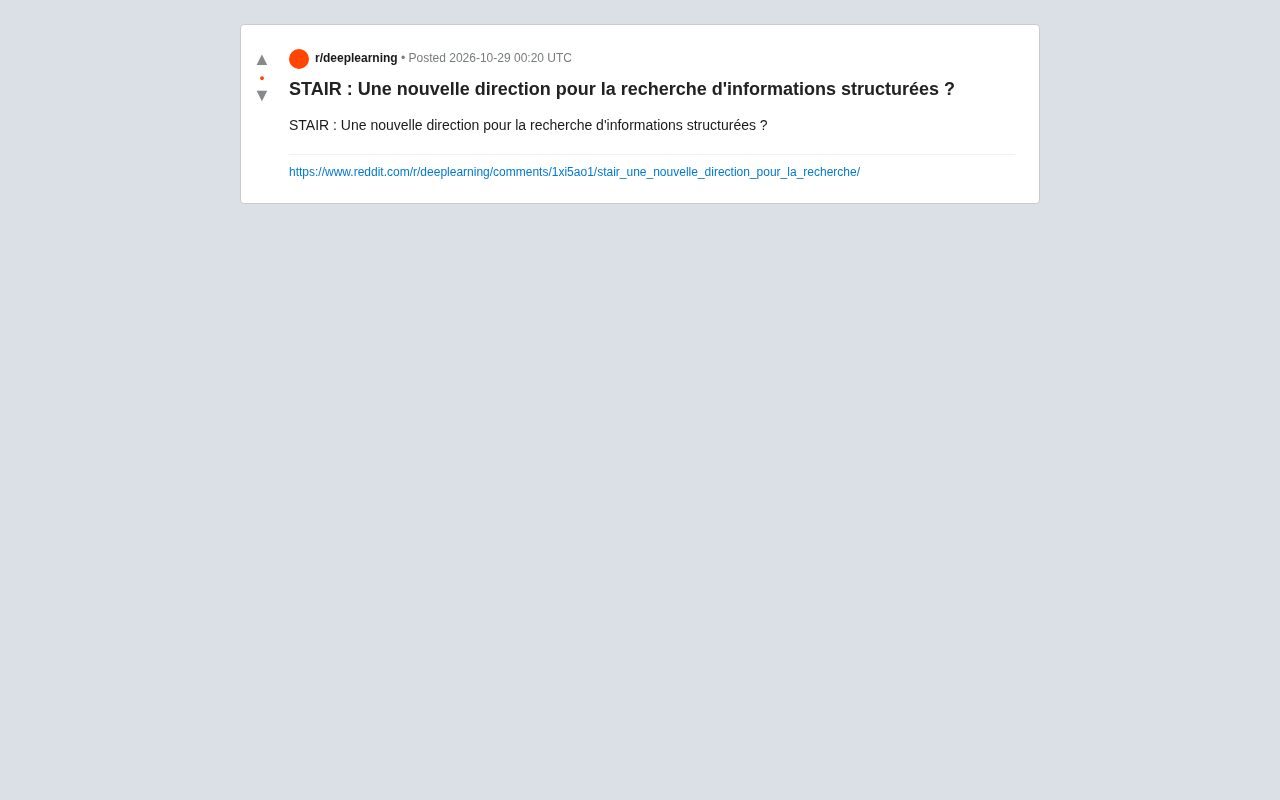
Reddit discussion positions STAIR as a new direction for structured information retrieval, prompting a re-examination of structural understanding in the era of large models.
Starting from a Reddit community discussion about STAIR, this article explores the predicament and turning point of structured information retrieval. Structured retrieval requires precisely mapping natural language queries onto information sources with explicit schemas such as data tables and knowledge graphs; traditional rule-based matching and supervised learning methods lack generalization in open, heterogeneous environments. STAIR is positioned by the community as a potential paradigm-shifting new direction, though the original material does not disclose its specific technical details. The article notes that structured retrieval becomes even more critical in the era of large models, as RAG requires external structured knowledge for verification and constraint, while current RAG practices remain weak in supporting tables and databases. The community holds both optimistic and cautious attitudes toward STAIR, with the lack of evaluation benchmarks being a major point of contention. The article concludes by alerting developers to the trend of retrieval system competitiveness shifting from text matching to structural understanding.
The Predicament and Turning Point of Structured Information Retrieval
Behind search engines and recommendation systems, Structured Information Retrieval has always been a key technology supporting the acquisition of precise answers. Unlike traditional full-text retrieval, structured retrieval requires understanding information sources with explicit schemas—such as data tables, knowledge graphs, and JSON documents—and mapping users' natural language queries onto these structures. However, for a long time, the methodological evolution in this field has been relatively slow: rule-based schema matching, query rewriting that relies on handcrafted features, and supervised learning requiring large amounts of labeled data have constituted the mainstream technical paths. These methods perform reasonably well in closed domains, but their generalization ability often falls short when faced with open, heterogeneous, and dynamically changing data sources.
A recent Reddit discussion thread titled "STAIR : Une nouvelle direction pour la recherche d'informations structurées ?" (STAIR: A New Direction for Structured Information Retrieval?) has prompted researchers and engineers to re-examine this issue. Although the thread title is in French, the core of the discussion points to a new approach that could potentially reshape the structured retrieval paradigm—STAIR.
What Is STAIR: A Signal Worth Noticing
Judging from the thread title and the context of community discussion, STAIR is positioned as "a new direction for structured information retrieval." It should be noted that the original material does not disclose STAIR's specific technical details, paper source, or complete architecture. But inferring from the naming and discussion direction, it likely represents a methodological framework that combines retrieval with structured reasoning. In current AI research, the combination of "structured" and "retrieval" typically involves several dimensions:
- Structured query understanding: Parsing natural language queries into executable schema constraints or graph queries;
- Structured data representation: Building unified embedding representations for tables, graphs, and other data to be retrieved;
- Structured retrieval process: Introducing schema alignment, path reasoning, or constraint satisfaction mechanisms into the retrieval process.
The Reddit community's attention to this topic is itself a signal: structured information retrieval is returning to the research spotlight from "a corner forgotten by large models." As large language models make remarkable progress on unstructured text, how to enable models to reliably operate on structured data has become an unavoidable challenge.
Retrieval-Augmented Generation (RAG) is a technical paradigm that combines external knowledge retrieval with large language model generation. Its basic workflow is: after a user submits a query, the system first retrieves relevant fragments from external knowledge bases (such as document repositories, databases, and knowledge graphs), then injects these fragments as context into the large model's prompt, and the model generates an answer based on the retrieved evidence. The core value of RAG lies in mitigating the knowledge staleness and hallucination problems of large models, making generated content traceable and verifiable. Current mainstream RAG implementations mostly use vector databases for dense retrieval of unstructured text, while support for structured data sources such as tables and relational databases is relatively weak—this is precisely the gap that structured information retrieval attempts to fill.
Why Structured Retrieval Matters More in the Era of Large Models
The proliferation of large language models has not diminished the value of structured retrieval; rather, it has made it more critical. The reason is that model-generated content needs to be verified and constrained by external structured knowledge—this is precisely the core logic of Retrieval-Augmented Generation (RAG). But current RAG practices mostly focus on vector retrieval of unstructured text, and support for structured retrieval of tables, databases, and knowledge graphs remains weak.
According to the implicit consensus in community discussions, the difficulty of structured retrieval lies not in "finding it" but in "aligning it": when a user asks "Which subsidiaries had a revenue growth rate exceeding 20% last year?", the system needs to understand the temporal anchoring of "last year," the calculation methodology of "revenue growth rate," the hierarchical relationships of "subsidiaries," and precisely map these semantic elements onto database columns, tables, and foreign keys. This semantic-to-schema mapping is precisely the most fragile link in traditional methods.
If the direction represented by STAIR is indeed committed to solving this mapping problem, then its value will not be limited to academic research but will directly impact enterprise search, intelligent reporting, data analysis assistants, and other practical application scenarios.
Semantic Parsing refers to converting natural language statements into machine-executable logical forms, such as SQL queries, SPARQL graph queries, or program code. In structured information retrieval, semantic parsing bears the critical responsibility of mapping user intent to database schemas. Unlike traditional keyword matching, semantic parsing needs to handle implicit semantics such as temporal anchoring, calculation methodology, and hierarchical relationships, and precisely align them to specific tables, columns, and foreign key constraints. This process is highly dependent on schema understanding and compositional generalization ability, and is also the link where supervised learning methods are most prone to failure—because the combinations of query forms and database schemas in open domains are nearly infinite, making it difficult for labeled data to cover them all.
Divergence and Expectations in Community Discussions
The discussion around STAIR is not uniformly optimistic. From the interactions on the Reddit thread, there are two typical attitudes in the community. One view holds that the structured retrieval field has long lacked an end-to-end learnable method, and STAIR's emergence may fill this gap; the other view is more cautious, pointing out that many "new directions" ultimately remain constrained by the scarcity of labeled data and schema heterogeneity, and their actual effectiveness remains to be verified.
This divergence is itself healthy. Benchmark construction for structured information retrieval has consistently lagged behind unstructured retrieval, and the lack of recognized cross-domain evaluation sets makes comparing new methods difficult. If STAIR can come with reproducible experimental setups and public evaluation results, it will more easily gain the community's trust.
Benchmark in information retrieval research refers to a standardized set of datasets, query collections, and evaluation metrics used for horizontal comparison of different methods' performance. The unstructured retrieval field has widely recognized benchmarks such as MS MARCO and BEIR, while structured retrieval has long lacked a unified cross-domain evaluation set: existing datasets are often limited to specific database schemas or single domains, making it difficult to compare new methods under fair conditions. The absence of benchmarks not only affects method credibility but also hinders the community from forming a consensus on "what constitutes genuine progress." Therefore, if a new method can come with reproducible experimental setups and public evaluation results, it will significantly lower the barrier to community adoption.
Implications for Developers and Researchers
For developers focused on AI application deployment, the significance of STAIR lies not in immediately adopting a particular technology, but in signaling a trend: the competitiveness of retrieval systems is shifting from "text matching quality" to "structural understanding capability." Whether building enterprise knowledge bases, intelligent customer service, or data analysis tools, the ability to enable systems to understand data schemas and execute structured queries will increasingly become key to product differentiation.
For researchers, this discussion also reminds us that the intersection of structured information retrieval with semantic parsing, graph neural networks, program synthesis, and other directions still contains vast unexplored space. Large language models provide new tools but have not automatically solved the core challenge of structuring—how to build a reliable, interpretable bridge between semantics and schemas.
Whether STAIR will become that "new direction" remains undetermined. But the Reddit community's attention to it indicates that structured information retrieval is once again becoming a topic worthy of investment. For practitioners in this field, staying informed, evaluating cautiously, and experimenting actively may be the most pragmatic attitude at present.
Related articles

Ollama Local Deployment Guide: Run Open-Source LLMs with Zero Experience
Ollama local deployment tutorial: what Ollama is, why choose it, how to download, install, and run open-source LLMs, and use its API for custom development. Beginner-friendly.

n8n: The 187K-Star Open-Source Automation Powerhouse That Turns Repetitive Work into Workflows
n8n is a 187K-star open-source visual workflow automation engine with 400+ nodes, Webhook/schedule/polling triggers, self-hosting for data security, and AI Agent support. Here's a guide to its core concepts, use cases, and pitfalls.

Self-Hosting n8n in Practice: Docker + PostgreSQL + Caddy Deployment Guide
A step-by-step guide to deploying a self-hosted n8n instance with Docker Compose, PostgreSQL, and Caddy automatic HTTPS, including env var pitfalls, Feishu alerting, and backup/upgrade/rollback tips.