Stop Using Giant Questions: Break Down Problems and Ask Follow-Ups for Better Results
Break giant queries into multi-turn follow-ups for more focused AI answers with precise sources.
Based on a Reddit user's experience, cramming multiple sub-questions into one giant prompt often leads to shallow AI answers that half-answer each part, with diluted information and imprecise sources. Breaking a big question into small follow-ups and drilling down conversationally keeps each answer focused and sources tied to narrow sub-questions, while allowing dynamic adjustment based on intermediate answers. The article offers an actionable workflow: start with the smallest core question and build each follow-up on the previous answer, illustrated with an A/B/C comparison example. Giant queries remain reasonable only for panoramic overviews or tightly interrelated sub-questions—ultimately depending on whether you treat AI as a search engine or a conversational partner.
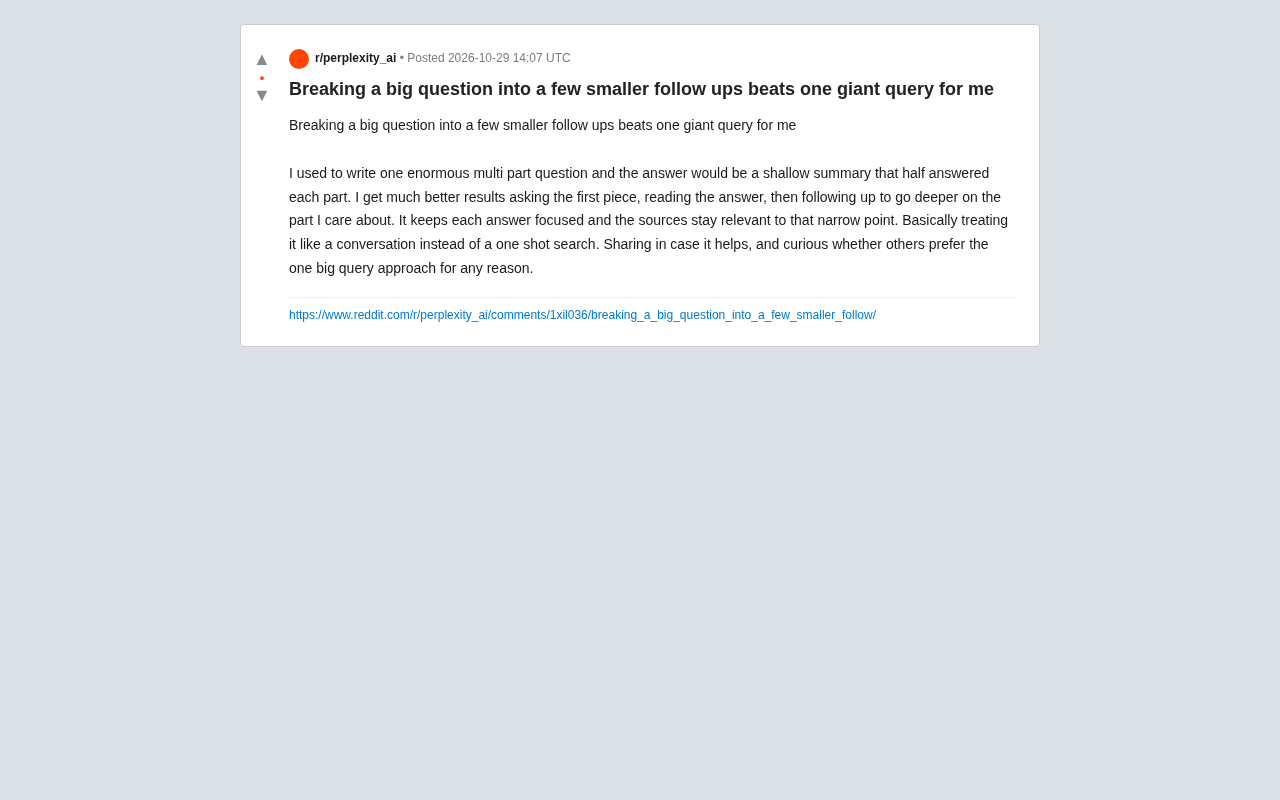
Many people habitually compress complex questions into a lengthy prompt containing multiple sub-questions, expecting AI to deliver a comprehensive answer all at once. But a user's experience shared on Reddit points out that this kind of "giant query" often yields only superficial summaries—each part gets answered a little, but none in depth. Conversely, breaking a big question into several small follow-ups and drilling down step by step like a conversation can actually yield more focused answers with more relevant sources.
The Trap of Giant Queries: Why "Asking Everything at Once" Works Poorly
When you cram multiple questions into a single query, the AI needs to cover all aspects in a single response, and the result is usually surface-level treatment of each point. As the user describes: "I once wrote a huge multi-part question and got a shallow summary that only half-answered each part." In this mode, the model tends toward completeness rather than depth, information density gets diluted, and cited sources are hard to map precisely to any specific sub-question.
A deeper problem is that giant queries deprive users of the chance to adjust direction based on intermediate answers. You can't point out after the first response, "expand on this part" or "that source is irrelevant"—you can only accept an averaged result.
The Advantages of Breaking into Follow-Ups: Focus, Iteration, Relevant Sources
The core benefit of splitting into small questions is keeping each answer focused. The user mentions asking about the first piece, reading the answer, then following up on the part they care about, so that "each answer stays focused, and sources always relate to that narrow point." This essentially turns search behavior into conversational behavior—you're not submitting a one-shot query but engaging in multi-turn exchange.
This iterative approach also lets you dynamically adjust the next question based on the previous answer. If a direction lacks information, you can immediately pivot and probe from another angle; if a source is unreliable, you can ask for a different one. In contrast, a giant query is a closed, single-shot game.
In the field of information retrieval, this iterative process of "query–feedback–re-query" is known as relevance feedback. Traditional search engines introduced this mechanism long ago: users annotate first-round results (relevant or not), and the system adjusts subsequent retrieval strategies accordingly. In AI conversations, this mechanism is naturally internalized—each model response can be seen as a tentative understanding of user intent, and the user's follow-up is a correction signal to that understanding. Unlike search engines, AI can understand feedback in natural language (such as "expand on this part") without requiring users to master Boolean operators or filter syntax, lowering the barrier to iteration. This also explains why breaking into follow-ups often yields more precise sources: each round of interaction narrows the semantic search space, so the model doesn't have to distribute attention across multiple sub-questions.
Asking Like a Conversation: An Actionable Workflow
How to do it specifically? Start with a minimal question, asking only the most core piece. After reading the answer, identify which parts need deeper exploration, then send a second follow-up. Each follow-up builds on the previous answer, gradually converging on the details that truly matter.
For example, instead of asking "Please compare the pros and cons, applicable scenarios, and costs of options A, B, and C," first ask "What is the core mechanism of option A?" Then based on the answer, follow up with "What are the key mechanistic differences between it and option B?" Finally ask "In what scenarios is A clearly superior to B?" Each step is narrower and deeper, and sources are more precise.
This stepwise converging questioning style is structurally very similar to Socratic questioning: starting from a basic proposition, clarifying concepts, testing assumptions, and digging for evidence through continuous follow-ups, ultimately approaching a more precise understanding. In AI interaction, the value of this method lies in its natural fit with how large language models work—the "attention budget" a model can sustain in a single generation is limited, and the broader the question, the shallower the reasoning depth allocated to each sub-question. Stepwise follow-ups effectively break one large-scale reasoning task into multiple small reasoning chains, each of which gets the full context window and reasoning resources. In practice, a useful principle is: each follow-up introduces only one new variable or dimension (e.g., moving from "mechanism" to "differences," then to "applicable scenarios"), avoiding re-expanding the question boundary in the same round.
When Giant Queries Are Still Reasonable
The user also wonders at the end whether anyone prefers one-shot big queries. There are indeed scenarios: when you need a quick panoramic overview of a field, or when the parts of the question are tightly interrelated and splitting them would break the context, a one-shot query may be more efficient. But for tasks requiring depth, accurate sources, and traceable reasoning, breaking into follow-ups is almost always the better choice.
Ultimately, it depends on whether you treat AI as a search engine or as a conversational partner. Treat it as a search engine, and you'll chase a one-shot hit; treat it as a conversational partner, and you'll be willing to refine over multiple rounds. The latter's answer quality is usually a level higher.
One-line Summary
Breaking giant queries into multi-turn small follow-ups yields more focused AI answers with more precise sources.
Paragraph Summary
Based on a Reddit user's experience, the article points out that cramming multiple sub-questions into one giant prompt often leads to shallow AI answers that only half-answer each part, with diluted information density and sources that are hard to map precisely. Conversely, breaking a big question into several small follow-ups and drilling down step by step like a conversation keeps each answer focused, keeps sources tied to narrow specific sub-questions, and allows users to dynamically adjust direction based on intermediate answers. The article provides an actionable workflow: start with the smallest core question, build each follow-up on the previous answer to converge step by step, and demonstrates the breakdown steps using an A/B/C option comparison example. It also notes that giant queries remain reasonable only when a panoramic overview is needed or sub-questions are strongly interrelated, and that ultimately it depends on whether the user treats AI as a search engine or a conversational partner.
Related articles
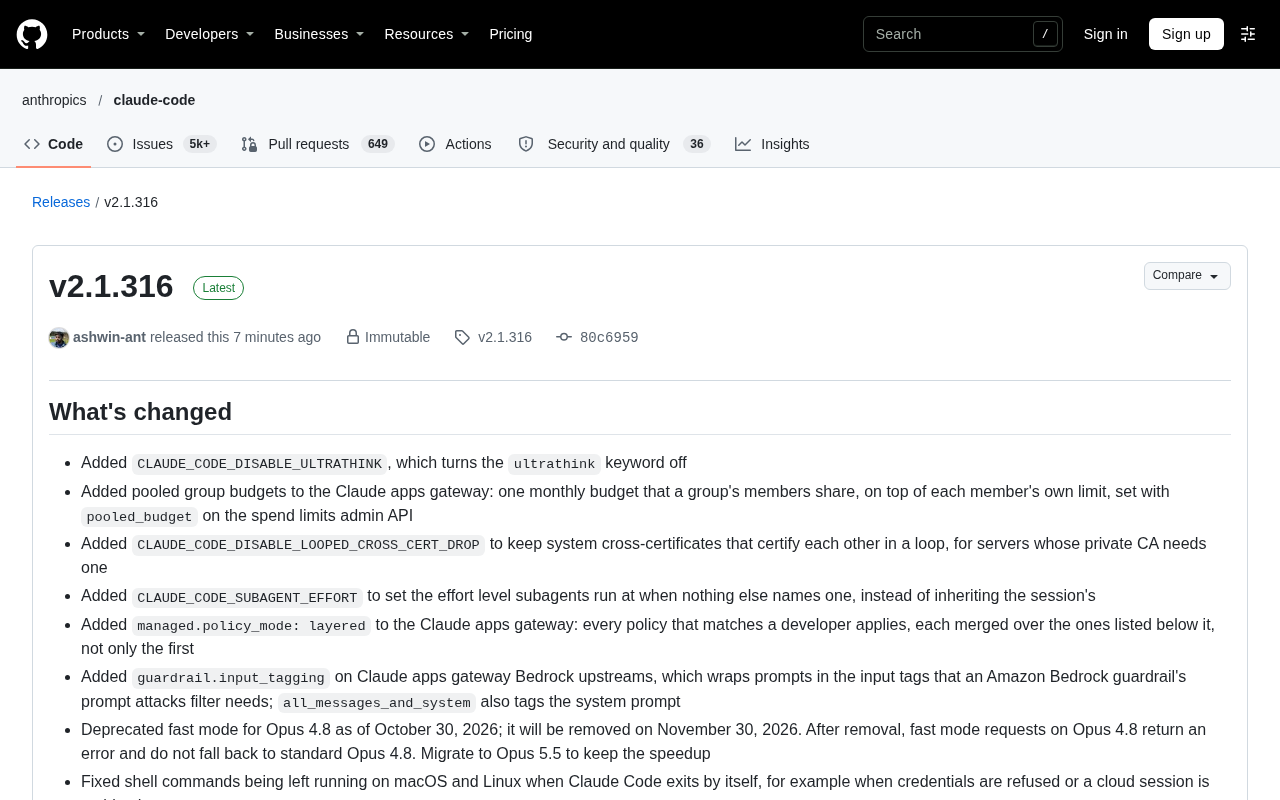
Claude Code v2.1.316 Update Analysis: Enterprise Gateway and Multiple Stability Fixes
Claude Code v2.1.316 released: new enterprise gateway pooled group budgets, layered policy mode, subagent effort control, dozens of Shell, network, and session recovery fixes, and Opus 4.8 fast mode deprecated.

17th-Century British Floods and Doomsday Panic: A New Perspective on Weather History
Based on a Hacker News discussion of '17th-Century British Floods and Foreboding,' this piece explores how extreme weather was given divine and political significance, and what weather history teaches us about contemporary climate communication.

Salesforce Acquires Rune for $375M: AI Logistics Tech Bolsters Defense Business
Salesforce reportedly acquires defense tech startup Rune for $375M. Rune's AI logistics tech will strengthen Salesforce's Missionforce defense platform, continuing its M&A spree.