Strawberry 1.0: The AI Browser Claiming to Save 100 Hours a Week
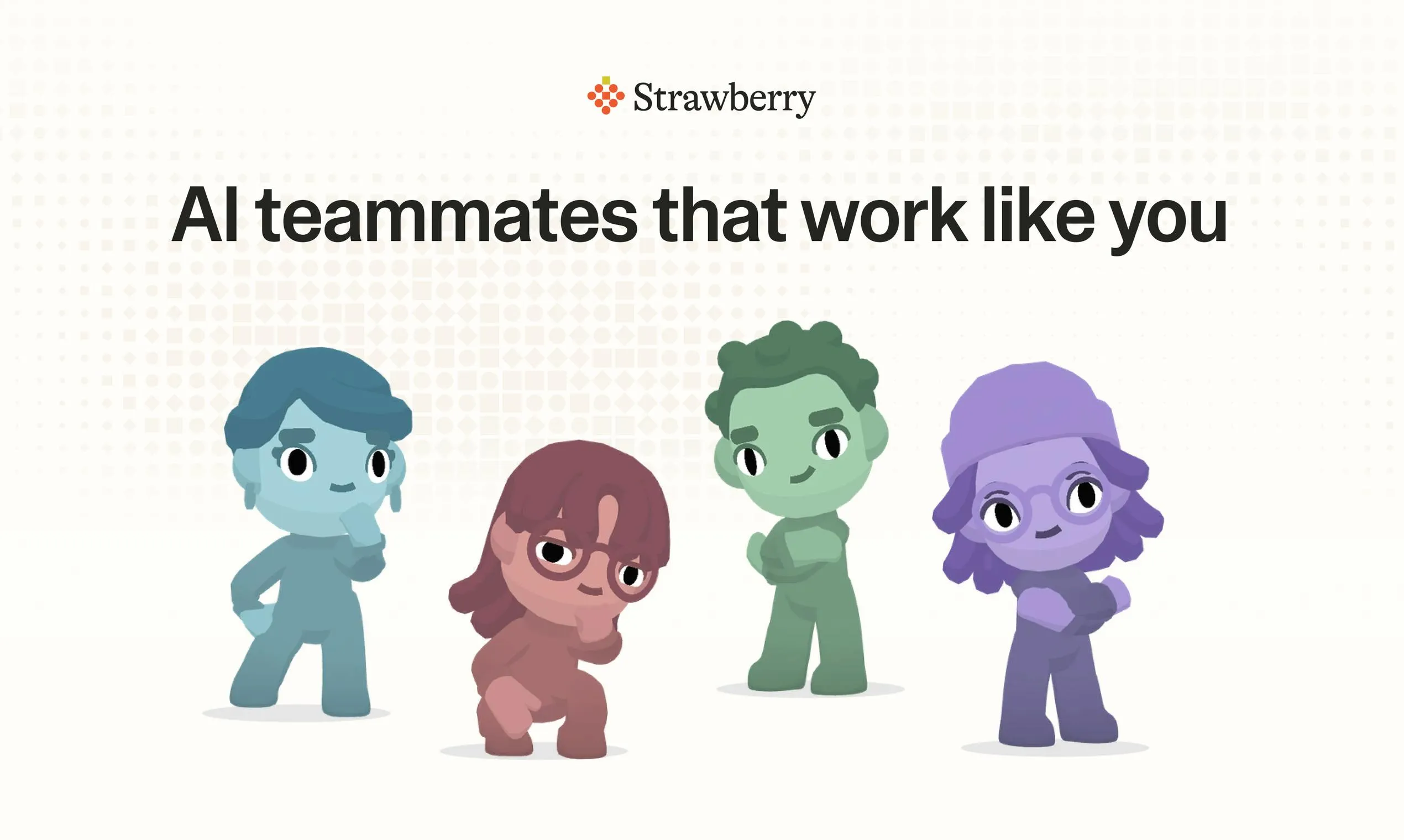
Strawberry 1.0 uses an AI browser as its entry point to build a team work platform of shareable agents.
Strawberry 1.0 launched on Product Hunt as an "AI browser" but is really a team work platform with embedded multi-agents. Its core is the "Companion" agent: pick one from a preset list or build from scratch, train it, and share it across the team so agents become a team asset. It covers parallel lead research, meeting transcription, automated follow-ups, and repetitive admin tasks. The company says hundreds of teams use it, including Lovable, Tandem Health, and ElevenLabs, claiming over 100 hours saved per week—though that's a team-level estimate without public data on active users, retention, or methodology. The form factor's differentiator is bundling capabilities into a browser entry point organized around shareable agents, but the browser space is crowded and deployment details like access permissions and data boundaries remain unverified.
From Browser to AI Workspace
Strawberry 1.0 launched on Product Hunt with the pitch of "saving teams over 100 hours per week," earning 130 upvotes and 37 comments to rank No. 2 on the day's leaderboard. It bills itself as an "AI browser," but its actual capabilities go far beyond web browsing—it's more like a multi-agent work platform embedded inside a browser.
According to the official description, Strawberry can complete in minutes work that would otherwise take hours. Its core philosophy is to hand repetitive administrative tasks over to automated agents, letting teams refocus on the work that genuinely requires human judgment.
"Companion": A Shareable Agent
Strawberry calls its agents "Companions." Users can get one in two ways: pick a ready-made one from a preset list, or create one from scratch. After creating one, users can "teach" it their preferences and working style, then share it with the entire team.
The key to this design is "sharing"—the agent isn't a personal productivity tool but a team asset. A well-tuned Companion can be reused by multiple members, which means the larger the team, the more pronounced the marginal benefit may be. This is also the underlying logic behind the official claim of "saving over 100 hours per week."
A multi-agent system refers to an architecture in which multiple agents with autonomous decision-making capabilities collaborate to complete tasks, with common patterns including parallel execution, task decomposition, and role division. Unlike a single assistant, multi-agent setups can assign different agents to subtasks such as retrieval, filtering, and summarization, thereby significantly boosting throughput in batch scenarios (such as researching hundreds of leads at once). The "trainable, shareable" nature of Companions also involves persistence of agent configurations and permission management: teams need to decide who can modify agent behavior, which data sources agents can access, and how changes sync to all users. These engineering details determine the reliability and security of shared agents in real team environments.
What It Can Actually Do
The official capability list covers several typical knowledge-work scenarios:
- Parallel lead research: Companions can research hundreds of leads in parallel, compressing what would otherwise be serial searching, filtering, and organizing into a single batch execution.
- Meeting transcription: Automatically transcribes meeting content, eliminating manual note-taking and post-meeting cleanup.
- Automated follow-ups: Handles follow-up actions, reducing losses caused by forgetfulness or procrastination.
- Repetitive administrative tasks: The official description calls these "the chores teams keep putting off," handed over to agents.
None of these capabilities is novel on its own, but bundling them all into a single browser entry point and organizing them as shareable agents is where Strawberry differs in form.
Who's Using It
The company says "hundreds of teams" already use Strawberry, naming Lovable, Tandem Health, and ElevenLabs. These are all product-driven teams with high demands for toolchain automation, and their adoption lends the product some credibility.
That said, it's worth keeping perspective: the company hasn't disclosed active user numbers, retention, or the methodology behind its time-savings estimate. "Over 100 hours per week" reads more like an overall team-level figure than measured data from any single user. For those evaluating the tool, a more pragmatic approach is to break it down into "how much repetitive work in your team could be taken over by an agent" and estimate from there.
The Lovable, Tandem Health, and ElevenLabs mentioned here are all product-led growth (PLG) teams, which typically have lightweight toolchains, fast iteration cycles, and high receptiveness to automation tools—which is why SaaS products often choose them as early benchmark customers. However, an early-adopter list alone doesn't equal broad validation: it reflects the product's fit within a particular type of team, not universal effectiveness across industries and scales. When evaluating such endorsements, what's more worth examining is usage depth (whether the tool is embedded in daily workflows) and renewal rates—data that official materials typically don't disclose.
Positioning and Limitations
Strawberry's choice of "AI browser" as its narrative framework has the advantage of a universal entry point—the browser is where knowledge workers spend most of their day, and placing agents there lowers the barrier to use. The potential problem is that the browser is also a highly mature battleground dominated by tech giants, where competition over AI capabilities will be fierce and prone to homogenization.
Moreover, having agents take over administrative tasks presupposes that they can reliably access the various systems teams use and correctly handle permissions and data boundaries. The official materials don't elaborate on these details, which are typically the areas most in need of validation when such products are deployed in real team environments.
For teams slowed down by lead research, meeting notes, and follow-up nudges, Strawberry is worth adding to the trial list; but "saving 100 hours" should be treated as a directional promise rather than a guaranteed benefit you can put directly into a budget.
One-line Summary
Strawberry 1.0 uses the AI browser as its entry point to build a team work platform of shareable agents.
Paragraph Summary
Strawberry 1.0 launched on Product Hunt positioned as an "AI browser," but it's essentially a team work platform with embedded multi-agents. Its core mechanism is the "Companion" agent: users can pick one from a preset list or create one from scratch, train it, and share it with the team for reuse, making agents a team asset rather than a personal tool. Capabilities cover parallel lead research, meeting transcription, automated follow-ups, and repetitive administrative tasks. The company says hundreds of teams use it, including Lovable, Tandem Health, and ElevenLabs, and claims "over 100 hours saved per week." But that figure is a team-level estimate, with no public data on active users, retention, or methodology. The article argues its formal differentiator is bundling multiple capabilities into a browser entry point organized around shareable agents, but the browser arena is fiercely competitive, and deployment details such as agent access permissions and data boundaries remain to be validated.
Related articles

14 Core Concepts of Reasoning Models: From Chain of Thought to GRPO Explained
A systematic breakdown of 14 core concepts of reasoning models: chain of thought, test-time compute, verifiers, RLVR and GRPO, distillation, and reward hacking, plus rules for controlling thinking-token costs to help you decide when reasoning is worth paying for.

OpenAI's Claimed Refutation of ETH Sparks Debate, Meta Bets Big on AI Infrastructure
OpenAI claims an AI-assisted discovery that challenges the Exponential Time Hypothesis (ETH) and launches the mid-tier GPT-6.1 Tera. Cloudflare discloses a cross-customer data leak postmortem, and Meta plans $95B in AI infrastructure financing.
Data Scraping, AI Proofs, and Open Source Contracts: This Week's Deep Dive into the Tech World
From the 3D model crawler controversy and OpenAI's Lean formal proofs to AI agents challenging Brooks' Law and Debian rejecting LLM review, this week's tech discussions center on openness and verifiability.