Superpowers: The 200K-Star GitHub Open Source Project Using a Seven-Step Engineering Workflow to End AI Code Junk

Superpowers enforces seven steps of engineering discipline on AI coding, mandating design-before-code and TDD.
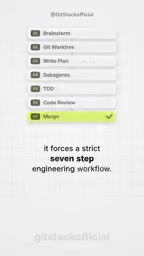
Superpowers is a GitHub open source project with over 200,000 stars that doesn't generate code directly but acts as an "engineering discipline layer" for AI coding tools like Clawed Code, Cursor, Codex, and Gemini CLI. Its core is a seven-step workflow: brainstorming to lock the design spec, creating an isolated Git worktree, decomposing tasks with file paths, enforcing test-driven development (deleting pre-test code), dispatching fresh sub-agents, and automated code review to catch critical defects. It codifies human engineering best practices into rules AI must follow, producing trustworthy code rather than "AI junk." Free and open source, it suits quality-focused medium-to-large projects, though it adds upfront time investment and strict TDD may not suit exploratory programming.
Why AI Programming Needs Engineering Discipline
AI coding assistants can already write code, but they often produce "AI junk"—poorly structured, lacking tests, and hard to maintain. According to the YouTube channel GitStack, a GitHub open source project called Superpowers (which has already gained over 200,000 stars) was created precisely to solve this problem. It doesn't generate code directly; instead, it first forces the AI agent through a rigorous seven-step engineering workflow, eliminating arbitrary guesswork at the source.
Superpowers positions itself as an "engineering discipline layer" that seamlessly integrates with mainstream AI coding tools such as Clawed Code, Cursor, Codex, and Gemini CLI. It pulls AI back from the impulse to "write code the moment it sees a requirement," insisting on design first, task decomposition second, and coding last.
AI coding assistants (such as Clawed Code, Cursor, Codex, and Gemini CLI) are typically based on large language models (LLMs) and generate code through natural language instructions. The advantage of these tools is rapid output, but they lack awareness of the project's overall structure and tend to generate repetitive, redundant, or non-compliant code—sometimes referred to in the industry as "AI junk." An engineering discipline layer injects human software engineering best practices (such as design review, test-driven development, and code review) before and after AI code generation, forcing AI to follow a predictable and verifiable process, thereby constraining AI's generative capabilities within a controllable quality framework.
Breaking Down the Seven-Step Workflow: From Brainstorming to Code Review
Step One: Brainstorming—Lock Down the Design Spec First
Superpowers' first skill is brainstorming. It "interrogates" your idea with a series of questions—what's the goal, where are the boundaries, how do we verify—until a clean design spec is formed, and only then does it allow touching any file. The core logic here is: coding without a clear spec is gambling.
Step Two: Isolated Environment and Task Decomposition
Once the design spec is confirmed, Superpowers automatically creates an isolated Git worktree to avoid polluting the main branch. It then breaks the entire build process into small tasks, each with precise file paths. This gives subsequent execution a solid basis rather than letting AI freestyle.

Git worktree is a Git feature that allows multiple independent working directories to be checked out simultaneously from the same repository, each corresponding to a different branch. Compared to cloning the entire repository, worktrees share the underlying object database, saving disk space and reducing switching costs. Superpowers automatically creating an isolated worktree means all of AI's modifications take place in a separate branch/directory, without accidentally affecting the main branch or other developers' work. This provides a safe sandbox environment for subsequent task execution and code review—even if AI makes a mistake, the worktree can simply be discarded.
Step Three: Enforcing Test-Driven Development (TDD)
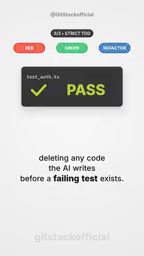
This is Superpowers' most hardcore rule: strict enforcement of test-driven development. If AI writes code before a failing test exists, Superpowers deletes that code outright. In other words, no tests means no implementation allowed. This rule fundamentally guarantees the verifiability of code quality.
Test-driven development (TDD) is a software development methodology whose core loop is "red-green-refactor": first write a failing test (red), then write the minimal code that just makes the test pass (green), and finally refactor and optimize under the protection of tests. The value of TDD lies in forcing developers to start from interfaces and requirements rather than writing implementation first and adding tests later, significantly improving code testability and maintainability. Superpowers takes this philosophy to an extreme, enforcing the discipline on AI by deleting "pre-test code"—essentially replacing human self-discipline with tool constraints.
Step Four: Dispatching Sub-Agents to Execute Tasks
Each small task is assigned to a fresh sub-agent for execution, rather than letting a single main agent with an ever-expanding context handle everything. According to GitStack, this "dispatching fresh sub-agents" approach avoids the quality degradation caused by long contexts, allowing each task to be completed in a clean state.
A sub-agent is an AI agent instance independently created for a specific subtask under the coordination of a main agent. Each sub-agent has its own independent context window and receives only the information needed to complete that task, so it doesn't carry the lengthy history of previous tasks. This approach effectively avoids the "context rot" problem of large language models—as context grows, the model's attention to earlier information declines and output quality degrades. By dispatching fresh sub-agents, each task executes in the cleanest possible context, maintaining consistency and accuracy of output.
Step Five: Automated Code Review to Catch Critical Defects
After a task is completed, Superpowers triggers an automated code review specifically designed to catch critical bugs. This acts as a quality gate at the end of the process, preventing seriously flawed code from entering the main branch.
Design and Ecosystem: Why This Approach Is Worth Noticing
Superpowers' design philosophy isn't complicated: it codifies the best practices of human engineering teams—design review, task decomposition, TDD, code review—into rules that AI agents must follow. It doesn't aim to make AI write faster; it aims to make AI write more correctly.
From an ecosystem perspective, Superpowers chose to be compatible with existing tools rather than start from scratch, which lowers the barrier to adoption. Developers don't need to switch editors or AI models—they just insert this discipline layer into their existing workflow. The project is completely free and open source, which is one reason it has quickly gained widespread attention.
Limitations and Applicable Boundaries
One caveat: the seven-step process increases upfront time investment, making it suitable for medium-to-large projects with quality requirements rather than rapid prototyping. Additionally, the strict TDD rule may not be friendly to exploratory programming. GitStack didn't discuss these trade-offs in the video, but developers should have realistic expectations when adopting it.
Conclusion
The bottleneck in AI programming is shifting from "can it generate code" to "can it generate trustworthy code." Superpowers offers its own answer with a practical engineering workflow: have the AI agent think it through first, decompose it clearly, then write test-driven code, with review as a final safety net. For teams looking to incorporate AI programming into serious engineering practice, this project provides a paradigm worth referencing.
One-line Summary
Superpowers constrains AI programming with seven steps of engineering discipline, enforcing design-before-code and TDD.
Paragraph Summary
Superpowers is a GitHub open source project with over 200,000 stars that doesn't generate code directly but serves as an "engineering discipline layer" integrated with AI coding tools like Clawed Code, Cursor, Codex, and Gemini CLI. Its core is a seven-step workflow: brainstorming to lock down the design spec, creating an isolated Git worktree, decomposing tasks with file paths, enforcing test-driven development (deleting pre-test code), dispatching fresh sub-agents to execute tasks, and automated code review to catch critical defects. The solution aims to codify human engineering team best practices into rules AI must follow, producing trustworthy code rather than "AI junk." The project is free and open source, suitable for medium-to-large projects with quality requirements, but it increases upfront time investment, and strict TDD may not be friendly to exploratory programming.
Related articles

Medicare Spends $50,000 Treating a Heart Attack but Won't Spend $100 Preventing One: The Mismatch in Healthcare
Medicare pays ~$50,000 to treat a heart attack but won't spend $100 to prevent one. This article unpacks the MedPage Today opinion piece and Hacker News debate on why healthcare payment favors treatment over prevention and the deep causes of incentive misalignment.

Nvidia May Cosign Loan for Nscale's West Virginia AI Data Center
Nvidia is considering cosigning a loan for Nscale's West Virginia AI data center. This article analyzes the signal significance of chip vendors entering data center financing, the risk-sharing logic, and project uncertainties.
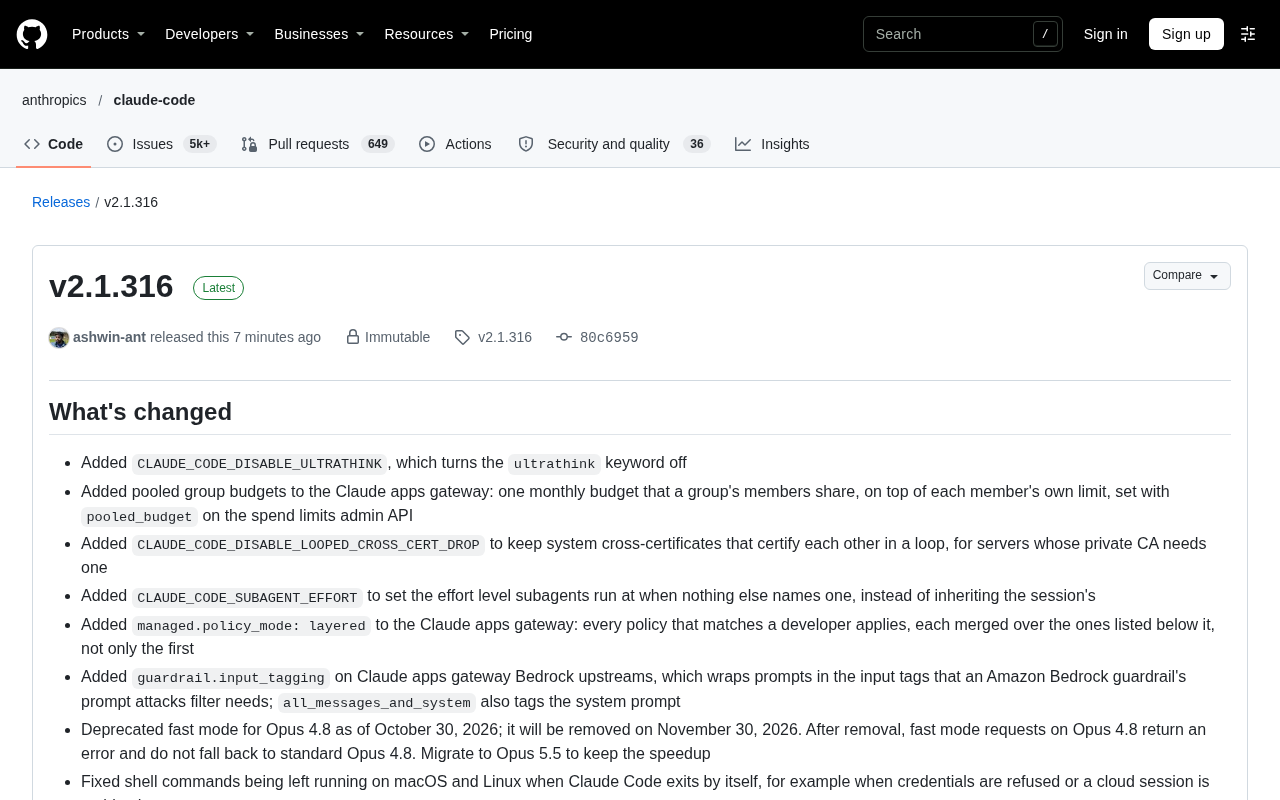
Claude Code v2.1.316 Update Analysis: Enterprise Gateway and Multiple Stability Fixes
Claude Code v2.1.316 released: new enterprise gateway pooled group budgets, layered policy mode, subagent effort control, dozens of Shell, network, and session recovery fixes, and Opus 4.8 fast mode deprecated.