Switch Between Models and Hosts Freely: A Practical Guide to Decoupling AI Agent Configuration
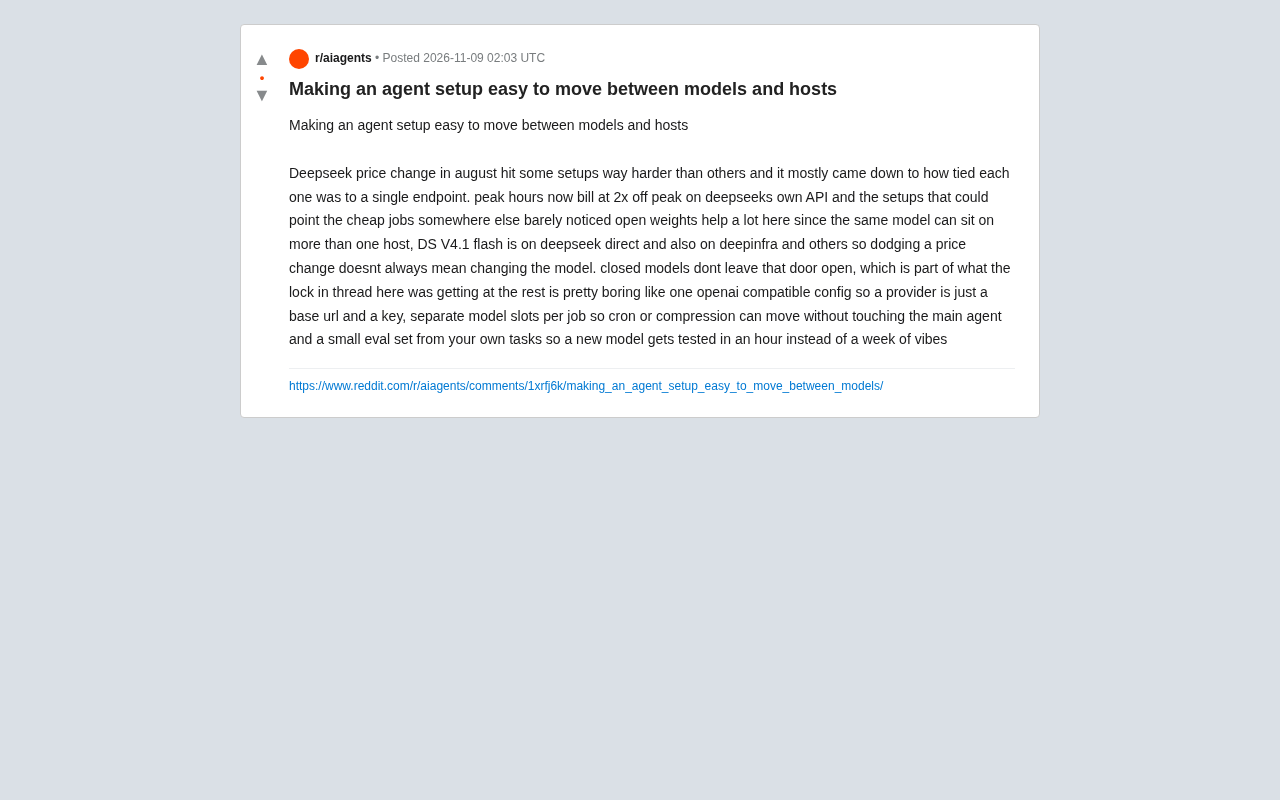
Use unified interfaces, task slots, and a self-built eval set to free Agents from single-vendor lock-in.
Using Deepseek's August price adjustment as an entry point, the article argues the real risk isn't the price increase itself but the Agent configuration's hardcoded dependence on a single endpoint: the deeper the binding, the greater the impact. It proposes leveraging the multi-host nature of open-weight models so price adjustments require only changing endpoints, not models. It then presents a three-layer migratable design—a single OpenAI-compatible configuration, independent model slots for tasks like cron and context compression, and a small real-world eval set—plus a four-element architecture for cost control and free switching.
Switch Between Models and Hosts Freely: A Practical Guide to Decoupling AI Agent Configuration
Recently, DeepseekAd's price adjustment sparked widespread discussion in the AI developer community. But what really deserves attention is the deeper issue this change exposed: how dependent is your Agent configuration on a single vendor?
The Configuration Fragility Behind Price Fluctuations
Deepseek adjusted its API pricing strategy in August, with peak-hour billing becoming twice that of off-peak hours. This change had vastly different impacts on different developers. Configurations that pointed cheap tasks to other endpoints barely felt the pressure, while solutions tightly bound to a single endpoint were forced to absorb the cost increase.
The key difference here isn't technical capability—it's architectural flexibility. When your Agent hardcodes model calls to a specific endpoint, price changes become an uncontrollable external risk. Conversely, if your configuration allows you to quickly switch vendors, the same price adjustment merely triggers a parameter change.
Open Weights: The Hidden Channel Around Price Adjustments
Open-weight models play an important role here. The same model can be deployed on multiple hosts, which means you don't need to switch models themselves to cope with price changes. Take DS V4.1 flash, for example: it can be called directly on Deepseek or used through platforms like Deepinfra.
This multi-host availability brings a key advantage: a price adjustment doesn't necessarily mean model migration. You can choose the more cost-effective endpoint while keeping the model consistent. Closed-source models, by contrast, don't offer this possibility—they naturally lock you into a single vendor's pricing system.
Open Weights refers to models whose training parameters are publicly released in downloadable form, so anyone can deploy them or host them on third-party inference platforms. The difference from fully open source is that open weights typically don't disclose training data and training code, only the final weights, so licenses may include commercial restrictions or user-scale thresholds (like the custom license for the Llama series). For Agent developers, the value of open weights lies in "model-host decoupling"—the same weight file can be served by official APIs, cloud providers, aggregator platforms, or self-built GPU inference, each with different pricing, latency, and availability. Choosing an endpoint thus becomes an operations decision rather than a re-selection. Note that different hosting providers may use different quantization precision, context length, and batching strategies, so the same model may show noticeable differences in output quality and throughput across hosts; verify consistency with an eval set before switching.
A Three-Layer Design for Migratable Agent Configuration
So how do you build a truly flexible Agent configuration? Several pragmatic design principles emerged from the community discussion—they aren't complex, but they're remarkably effective.
Unified OpenAI-Compatible Configuration
The first principle is to adopt a single OpenAI-compatible configuration. In this model, a vendor is simply a combination of a Base URL and an API Key. Changing vendors doesn't require refactoring code—just modifying these two parameters. This seemingly simple abstraction is actually the foundation of the entire migratable architecture.
OpenAI-compatible interfaces have become the de facto industry standard: the request body of /v1/chat/completions includes fields like model, messages, and temperature, and the response returns a unified choices structure. The vast majority of inference platforms (including Deepinfra, Together, Fireworks, self-hosted vLLM services, etc.) provide compatibility layers, so clients only need to replace the Base URL and API Key to point to a new backend. In practice, there are still several compatibility pitfalls: platforms differ in their support for tool_calls, streaming responses, and response_format; model name strings often need to be adjusted with platform-specific prefixes; and rate limits and timeout behavior also vary. It's advisable to keep an alias mapping of model names at the configuration layer and perform a lightweight health-check request at startup, so you don't discover field incompatibilities only after switching.
Task-Level Model Slot Separation
The second principle is to set up independent model slots for different tasks. Scheduled tasks (cron) or context compression can switch models independently without affecting the main Agent configuration. This separation means you can run background batch processing on cheap endpoints while keeping the main interaction flow on a more reliable model.
Build Your Own Small Eval Set
The third principle is to maintain a small eval set based on your own tasks. When a new model or endpoint comes online, you can complete testing within hours instead of spending a week making gut-feel judgments. This eval set doesn't need to be large and comprehensive, but it must come from your real usage scenarios so you can quickly verify whether a new configuration is viable.
An Eval Set is a fixed set of input samples with expected outputs, used for regression comparison of different models or endpoints. For Agent scenarios, the evaluation focus is usually not general knowledge Q&A, but rather whether tool-call formats are correct, whether multi-turn instruction following is stable, whether structured outputs can be parsed, and whether key information is preserved after long-context compression. A practical small eval set is about 30 to 100 entries, covering your most frequent task types, with an automatically determinable pass condition defined for each sample (such as JSON parsable, contains specified fields, correct tool name). Running costs should be kept within a few dollars so you can execute it without hesitation every time you switch endpoints. Be sure to retain historical baseline scores—only by comparing against the baseline can you judge whether a new endpoint has truly degraded.
From Reactive Response to Proactive Design
The core shift in this approach is turning the Agent's model calls from hardcoded into configurable infrastructure. When prices change, services go down, or new models are released, you no longer need to fight fires reactively—you can respond quickly by adjusting configuration.
Open-weight models plus unified interfaces plus task-level slots plus rapid evaluation—these four elements together form an Agent architecture with controllable costs and free switching. For any team seriously invested in Agent development, this decoupled design is worth incorporating early in the project, rather than scrambling when the first price shock arrives.
One-line Summary
Use unified interfaces, task slots, and a self-built eval set to free your Agent from single-vendor lock-in.
Paragraph Summary
Using Deepseek's August price adjustment as an entry point, the article argues that the real risk isn't the price increase itself but the Agent configuration's hardcoded dependence on a single endpoint: the deeper the binding, the greater the impact of price fluctuations. The author proposes leveraging the multi-host nature of open-weight models so that price adjustments only require changing endpoints, not models. It then presents a three-layer migratable design: adopt a single OpenAI-compatible configuration, abstracting vendors into a Base URL plus API Key; set up independent model slots for tasks like cron and context compression to enable task-level switching; and maintain a small eval set based on real scenarios to shorten new-endpoint validation from a week to a few hours. The conclusion is that open weights, unified interfaces, task-level slots, and rapid evaluation together form an Agent architecture with controllable costs and free switching, and should be incorporated into the design early in the project.
Related articles

Seven Years of Evolution: How Far Has the Foldable Come From the First Generation?
From the first foldable to today's latest models, what has seven years changed? Shallower creases, higher brightness, thinner bodies, and smoother software migration—has the foldable crossed the chasm from enthusiasts to ordinary users? This article discusses the question based on a video comparison.

When Did Humans Start Eating Salt? A 10,000-Year History of Salt
When did humans start eating salt? From salt use at the dawn of agriculture 11,000 years ago to ancient seawater evaporation and rock salt mining, and on to the salt trade, salt taxes, and Gandhi's Salt March, this article traces salt's key role in human civilization.
Microsoft Paza Research: How African Language Speech Recognition Breaks Through Architecture and Data Bottlenecks
Microsoft's Paza research evaluates 53 speech models across 39 African languages, revealing architecture choice matters more than pre-training coverage, 200-300 hours is the practical data threshold, and language typology deeply influences recognition performance.