Symbolic Layer Reinforcement: How Agentic GraphRAG Achieves Deterministic Reasoning
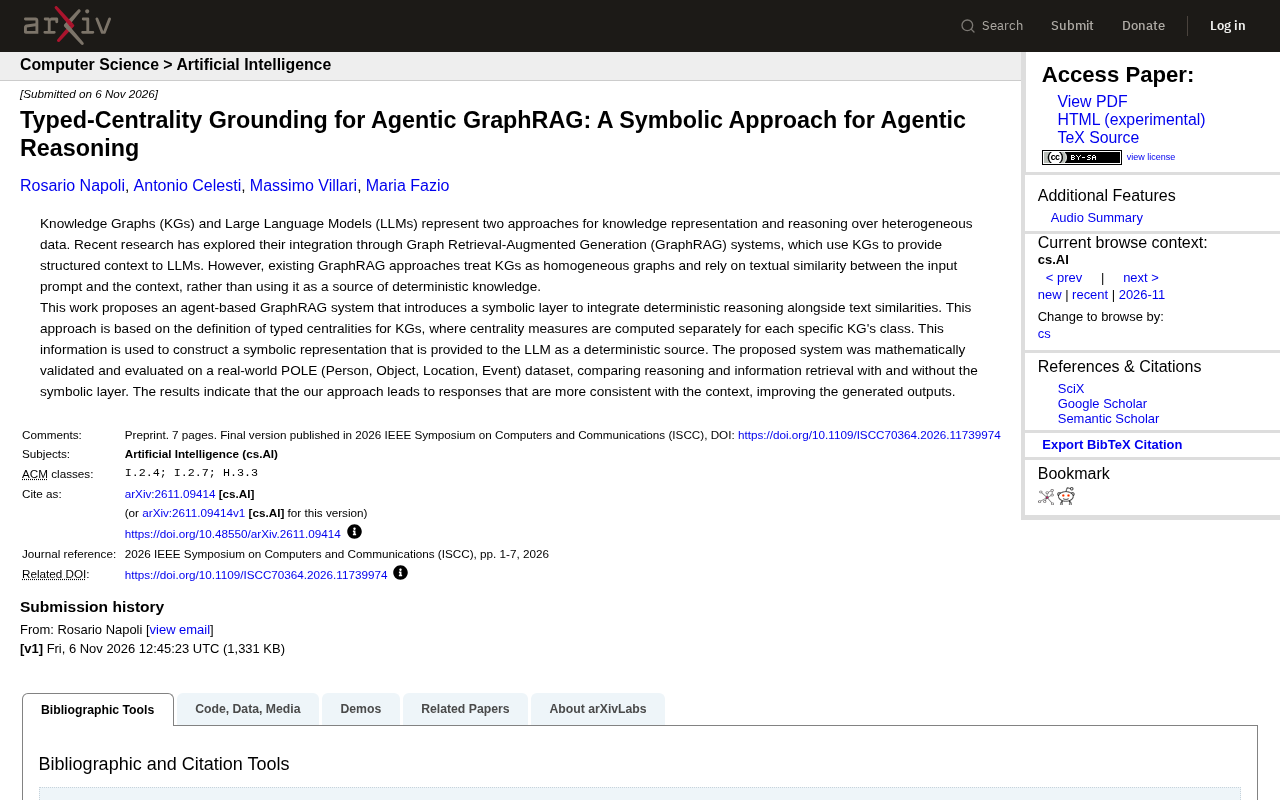
Proposes typified centrality to build a symbolic layer, making knowledge graphs a deterministic reasoning basis for GraphRAG.
The article introduces research from rss addressing the limitation that existing GraphRAG treats knowledge graphs as homogeneous graphs and relies only on text similarity retrieval, proposing an agent-based GraphRAG system. Its core is to introduce a symbolic layer beyond text similarity, built on "typed centralities"—computing centrality measures separately for each class in the knowledge graph, acknowledging the differing roles of node categories in reasoning, and constructing this information into a symbolic representation provided to the LLM as a source of determinism. The agent invokes this symbolic layer during reasoning, constraining generation by explicit relations rather than merely guiding it with similar text. Validated on the POLE dataset, introducing the symbolic layer yields responses more consistent with context and improved output quality, supported by mathematical validation.
From "Text Similarity" to "Symbolic Certainty"
The combination of knowledge graphs and large language models has given rise to GraphRAG, but most existing systems treat knowledge graphs as homogeneous graphs, relying on text similarity between input prompts and context during retrieval, without using the knowledge graph as a deterministic knowledge source. This research from rss proposes an agent-based GraphRAG system whose core idea is to introduce a symbolic layer beyond text similarity, providing the LLM with the deterministic structural information in the knowledge graph as well.
The cornerstone of this symbolic layer is "typed centralities"—computing centrality measures separately for each specific class in the knowledge graph. Unlike the traditional approach of treating the entire graph as a single homogeneous network, typed centralities acknowledge that nodes of different categories play different roles in reasoning and require independent evaluation of their importance. This centrality information is constructed into a symbolic representation and provided to the LLM as a source of determinism.
GraphRAG is a retrieval-augmented generation (RAG) paradigm proposed by Microsoft Research in 2024. Traditional RAG recalls text fragments by vector similarity, whereas GraphRAG first uses an LLM to extract entities and relations from a corpus, builds a knowledge graph, and then performs community detection and summarization on the graph, thereby supporting answers to "global" questions. Its typical pipeline includes graph index construction, community partitioning, and retrieval based on community summaries. GraphRAG was originally intended to solve the problem that vector RAG struggles to aggregate information across documents, but most implementations still use text chunks as the retrieval unit, with the graph structure mainly serving summary generation rather than acting as an explicit reasoning constraint. Understanding this background helps clarify the limitation referred to in this article as "treating knowledge graphs as homogeneous graphs."
Centrality is a classic concept in social network analysis and graph theory, used to measure the importance of a node in a graph; common metrics include degree centrality, betweenness centrality, closeness centrality, and eigenvector centrality. The traditional approach computes centrality once on a homogeneous graph, with all nodes compared on the same scale. However, in a typed knowledge graph, a person node and a location node differ greatly in degree distribution and connection patterns, and directly mixing them in computation masks structural differences within categories. Typed centralities compute centrality separately for each category of nodes—either by building a separate graph per category or by normalizing within each category—so that importance evaluation is comparable within the same semantic category, which is also the technical foundation of the symbolic layer in this article.
How Agents Use the Symbolic Layer
The agent component of this system is responsible for invoking the symbolic layer during reasoning. When a user poses a query, the system not only performs text similarity matching but also provides structured deterministic knowledge to the LLM based on the symbolic representation constructed from typed centralities. This means the LLM's generation process is constrained by explicit relations in the knowledge graph, rather than merely being "guided" by similar text.
The paper evaluates on the real-world POLE (Person, Object, Location, Event) dataset, comparing reasoning and information retrieval performance with and without the symbolic layer. The results show that after introducing the symbolic layer, generated responses are more consistent with the context and output quality improves.
"Agent" in this context refers to an LLM-driven program entity capable of multi-step reasoning and tool invocation. Unlike single-pass "retrieve–generate," an agent can plan steps, choose which tools or data sources to invoke, observe returned results, and decide the next action. Introducing agents into GraphRAG means the system can actively query the knowledge graph mid-reasoning rather than stuffing context into the prompt all at once. The key to the agent in this article is that it treats the symbolic layer as an invocable deterministic tool: when text-similarity recall is insufficient to support a judgment, the agent turns to query structured information based on typed centralities, thereby obtaining verifiable constraints during generation. This "tool-invocation-style" knowledge injection is the core feature that distinguishes the agent architecture from traditional RAG pipelines.
What the Symbolic Layer Changes
The value of this work lies in repositioning the role of knowledge graphs in GraphRAG. Previous systems viewed knowledge graphs as a tool to supplement text context, which in essence remained a "retrieval augmentation" mindset; the introduction of the symbolic layer makes the knowledge graph a basis for deterministic reasoning, allowing agents to make more reliable judgments based on structured centrality information.
The paper also provides mathematical validation of the system, offering formal support for the construction of typed centralities and the soundness of the symbolic representation. This path—starting from mathematical definitions and then landing on real datasets—makes the method more credible and leaves room for extension to more complex knowledge graphs in future work.
For agent applications that require high reliability, this dual-channel design of "text similarity + symbolic certainty" offers a new idea: text similarity handles recall, while the symbolic layer handles calibration. Combined, the two may allow GraphRAG to go further in scenarios that demand factual consistency.
The POLE dataset refers to a knowledge graph dataset built around four categories of entities: Person, Object, Location, and Event. These four categories cover the most common semantic roles in narrative and event-oriented text and are often used to evaluate entity extraction, relational reasoning, and graph retrieval methods. Choosing data with clear type divisions like POLE precisely demonstrates the value of typed centralities: nodes of different categories assume different structural roles in the graph—for example, Event nodes often connect multiple Person and Location nodes, and their centrality distribution differs significantly from that of Object nodes. Comparing performance with and without the symbolic layer on this dataset allows a relatively direct test of the symbolic layer's contribution to generation consistency.
Related articles

Seven Years of Evolution: How Far Has the Foldable Come From the First Generation?
From the first foldable to today's latest models, what has seven years changed? Shallower creases, higher brightness, thinner bodies, and smoother software migration—has the foldable crossed the chasm from enthusiasts to ordinary users? This article discusses the question based on a video comparison.

When Did Humans Start Eating Salt? A 10,000-Year History of Salt
When did humans start eating salt? From salt use at the dawn of agriculture 11,000 years ago to ancient seawater evaporation and rock salt mining, and on to the salt trade, salt taxes, and Gandhi's Salt March, this article traces salt's key role in human civilization.
Microsoft Paza Research: How African Language Speech Recognition Breaks Through Architecture and Data Bottlenecks
Microsoft's Paza research evaluates 53 speech models across 39 African languages, revealing architecture choice matters more than pre-training coverage, 200-300 hours is the practical data threshold, and language typology deeply influences recognition performance.