The Biggest Hidden Risk of MCP Servers: Connecting Tools Doesn't Mean Understanding the Business

MCP only solves connectivity; Agent reliability depends on the semantic context layer above it.
The article points out that MCP is becoming the standard channel for AI Agents to connect to enterprise systems, but many teams mistakenly believe integration alone delivers a reliable Agent. Two traps exist: tool overload—exposing dozens or hundreds of tools to the LLM raises token costs, latency, and selection errors, and limiting visible tools only mitigates it; and missing semantics—the Agent doesn't know that customer IDs across systems point to the same entity, nor how revenue definitions differ, causing silent deviations. The root cause is that MCP is only a connectivity protocol. The solution is a context layer above MCP handling metric standardization, entity linking, business rules, and controlled execution.
The Biggest Hidden Risk of MCP Servers: Connecting Tools Doesn't Mean Understanding the Business
MCP (Model Context Protocol) is becoming the standard channel for AI Agents to connect to enterprise systems. It lets Agents call a wide range of tools—CRMs, databases, ticketing systems—and appears to solve the integration problem. But one widely overlooked fact is that MCP is only responsible for connection, not for making the Agent understand the business.
A tech creator recently analyzed this issue systematically in a video, pointing out that teams building Agents with MCP connectors alone often fall into two traps—the first wastes resources, and the second directly makes the Agent unreliable.
Trap 1: Tool Overload Drags Down Agent Efficiency
The first problem is intuitive: when you expose your entire enterprise system to the LLM through MCP, the Agent faces dozens or even hundreds of tools. It has to figure out on its own which tools are relevant, how to call them, and how to chain multiple tools together to complete a task.

The cost of this process is real: token consumption rises sharply, response latency increases, and tool-selection accuracy drops. The more tools there are, the higher the probability that the LLM makes a mistake at the "which one to pick" step.
The good news is there's a way to mitigate this—you can limit the set of tools the Agent can see, exposing only the subset relevant to the current task. But that's only a symptomatic fix.
The cost mechanism of tokens and tool selection: Every inference of the LLM has to send the system prompt, conversation history, and descriptions of available tools (names, parameter schemas, usage notes) into the model as context. As the number of tools grows, context length expands linearly, producing three consequences: first, input token costs rise directly; second, attention is diluted in long contexts, reducing the model's precision in understanding each tool description; third, when tool descriptions are semantically similar, the model's decision space for "which one to pick" widens, and the error rate rises accordingly. This is why "limiting the visible tool set" works—it compresses both context length and the candidate space. But this approach merely moves the selection problem from the model side to external routing logic, and it still requires human or rule-based judgment about "which tools should be exposed for the current task."
Trap 2: The Agent Doesn't Know What the Data Means
The video's author emphasizes that tool overload is "not even the bigger problem." What's truly tricky is the missing semantic layer: even if the Agent correctly calls the tool, it doesn't know what the returned data means in business terms.

A concrete example: a customer ID in two different systems actually points to the same company, but the Agent doesn't know they're the same thing; the two systems define "revenue" differently, and the Agent doesn't know which one to trust. These problems don't raise errors, but they cause the Agent's output to silently deviate from the facts.
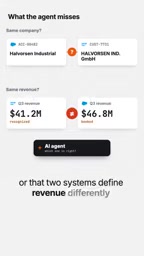
The result is that the Agent appears to complete the task, but in reality it reasons on wrong premises. It burns plenty of tokens, yet reliability is out of the question.
Master data management and entity resolution: The "customer IDs in two systems pointing to the same company" mentioned in the article is a classic entity resolution problem and one of the core topics of master data management (MDM). When enterprise systems are built independently, they often generate different internal identifiers for the same entity and maintain their own attributes. The goal of entity resolution is to determine, through features such as name similarity, address, tax ID, and email, whether records across systems point to the same object, and to establish a stable global identifier mapping. Similar problems include inconsistent metric definitions—for example, "revenue" may mean recognized revenue in the financial system but contract value in the CRM. In traditional data warehouses, these problems are solved through ETL and a metric dictionary, whereas an Agent calling raw tools directly bypasses this layer of governance, resulting in "correct calls, wrong understanding."
Why MCP Itself Can't Solve This Problem
The key to understanding this limitation is recognizing what MCP is positioned to do. MCP is a connectivity protocol—it exposes data and capabilities in systems for Agents to call. But it doesn't reconcile data, doesn't establish shared business definitions, and isn't responsible for determining whether two entities are the same.
In other words, MCP solves "can I get it," not "how do I understand what I got." Treating the integration layer as a semantic layer is the root cause of many teams' pitfalls.
The protocol boundary of MCP: MCP defines a standard way of interaction between clients (such as AI applications) and servers (tool providers), with core abstractions of tools (callable functions), resources (readable data), and prompts (preset templates). Its value lies in unifying call formats, discovery mechanisms, and permission passing, making tools plug-and-play. But the protocol itself doesn't specify data semantics, doesn't align identifiers across servers, and doesn't handle business rule validation. In other words, MCP is an "interface standard," similar in positioning to HTTP or JDBC, not a "data governance layer." Understanding this helps you judge: any requirement involving unified definitions, entity merging, or policy constraints must be built separately outside the protocol.
The Solution: Add a Context Layer on Top of MCP
The solution presented in the video is to build a context layer on top of MCP and enterprise systems. This layer takes on four responsibilities:

- Standardize metrics: unify definitions of core metrics like revenue and eliminate definition conflicts across systems
- Connect related entities: link records across systems that point to the same object, such as identifying duplicate customer IDs
- Define business rules and policies: clarify the triggers and constraints for state changes
- Build a controlled execution layer: govern the scope of operations the Agent can actually perform
With this layer, the Agent doesn't receive a raw tool list and bare data, but curated context and specific tools relevant to the current task. Only by reasoning and operating within this controlled scope can reliability be guaranteed.
Context engineering and the semantic layer: The context layer often overlaps in concept with the "semantic layer" in the industry. In traditional BI, the semantic layer is responsible for mapping physical tables to business-friendly metrics and dimensions, unifying definitions, and shielding underlying structural differences; an Agent-oriented context layer extends this with two additional capabilities: first, dynamic curation by task (presenting only the entities, metrics, and tools relevant to the current goal), and second, execution governance (restricting writable operations and validating business rules). Its difference from RAG is that RAG solves "finding relevant text," whereas the context layer solves "providing correct business meaning and legitimate actions." The two can be used together but cannot replace each other.
The Recommended Architecture Path
The implementation path the author gives can be summarized in three steps:
- Use MCP to connect enterprise system data and capabilities to the context layer
- Have the context layer expose curated, relevant context and specific tools to the AI Agent
- Let the Agent perform controlled, reliable business operations on top of that
The core idea of this architecture is division of labor: MCP handles connectivity, the context layer handles semantics and governance, and the Agent handles reasoning and execution. Each does its own job, rather than expecting a single protocol like MCP to do everything.
Implications for Teams Building Agents
If you're building enterprise Agents with MCP connectors, this analysis is worth checking against: Does your Agent face a pile of unfiltered tools? Does it know whether metrics with the same name in two systems share the same definition? Do the operations it performs have clear boundary constraints?
MCP lowers the barrier to integration, but it also makes it easy to assume that once integration is done, everything is fine. In reality, making an Agent truly understand the business means most of the work happens after connection.
One-line Summary
MCP only solves connectivity; Agent reliability depends on the semantic context layer on top of it.
Paragraph Summary
The article points out that MCP is becoming the standard channel for AI Agents to connect to enterprise systems, but many teams mistakenly believe that once integration is complete, they can deliver a reliable Agent. In reality, there are two traps: first, tool overload—when dozens or hundreds of tools are exposed to the LLM at once, token consumption rises, latency increases, and tool-selection accuracy drops, and limiting visible tools only mitigates this; second, missing semantics—the Agent doesn't know that customer IDs in different systems point to the same entity, nor does it know how revenue definitions differ across systems. These problems don't raise errors but cause output to silently deviate from the facts. The root cause is that MCP is only a connectivity protocol: it doesn't reconcile data or establish shared business definitions. The solution is to build a context layer on top of MCP, taking on four responsibilities: standardizing metrics, connecting entities, defining business rules, and controlled execution—forming a division-of-labor architecture where "MCP handles connectivity, the context layer handles semantics, and the Agent handles reasoning."
Related articles

LangChain Retry Middleware Configuration: Practices and Selection Guide
Based on Reddit community discussion, this article analyzes LangChain ModelRetryMiddleware retry parameter configuration practices, covering the selection logic and alternatives for key options like max_retries, backoff_factor, and jitter.

Texas Senate Race in Trouble: Why Are Republicans Nervous?
Texas Senate race stirs Republican anxiety. Based on street interviews, this article analyzes the Democratic offensive in funding, organization, and running everywhere, and how Republicans are defending "Texas, Texas" amid the political pendulum effect.

Gemini Chat Now Generates and Edits Google Docs Directly, a New Breakthrough in Office Productivity
Google Gemini's chat interface now generates and edits PDF, Google Docs, Sheets, Slides, Markdown, TXT, and code files. Available to all users; web supports all formats, mobile only PDF for now.