The Endgame of FSDP Communication: TIDE Zero-Copy Collective Communication Optimization

TIDE significantly reduces FSDP2 training step time and compute interference through zero-copy layout-aware communication.
TIDE is an optimization solution targeting the communication bottleneck in FSDP2 training. It identifies layout conversion and communication kernel interference as the main overheads, and designs three zero-copy collective communication primitives: TIDE-AG uses NVSwitch multicast and RDMA to deliver shards directly to parameter storage without occupying SMs; TIDE-RS directly consumes bf16 gradients and reduces them to fp32 shards using copy engines and short-lived thread blocks; and a two-stage pipeline separates gradient reading from network progress. On 64 GPUs, TIDE reduces step time by up to 27.1% vs. Stock FSDP2, cuts reduce-scatter SM time by 12.5-14.5x, reduces interference by an order of magnitude, and maintains nearly constant buffer size with lower peak memory. TIDE provides an efficient communication optimization path for large-scale mixed-precision training.
The Root of FSDP2 Communication Overhead
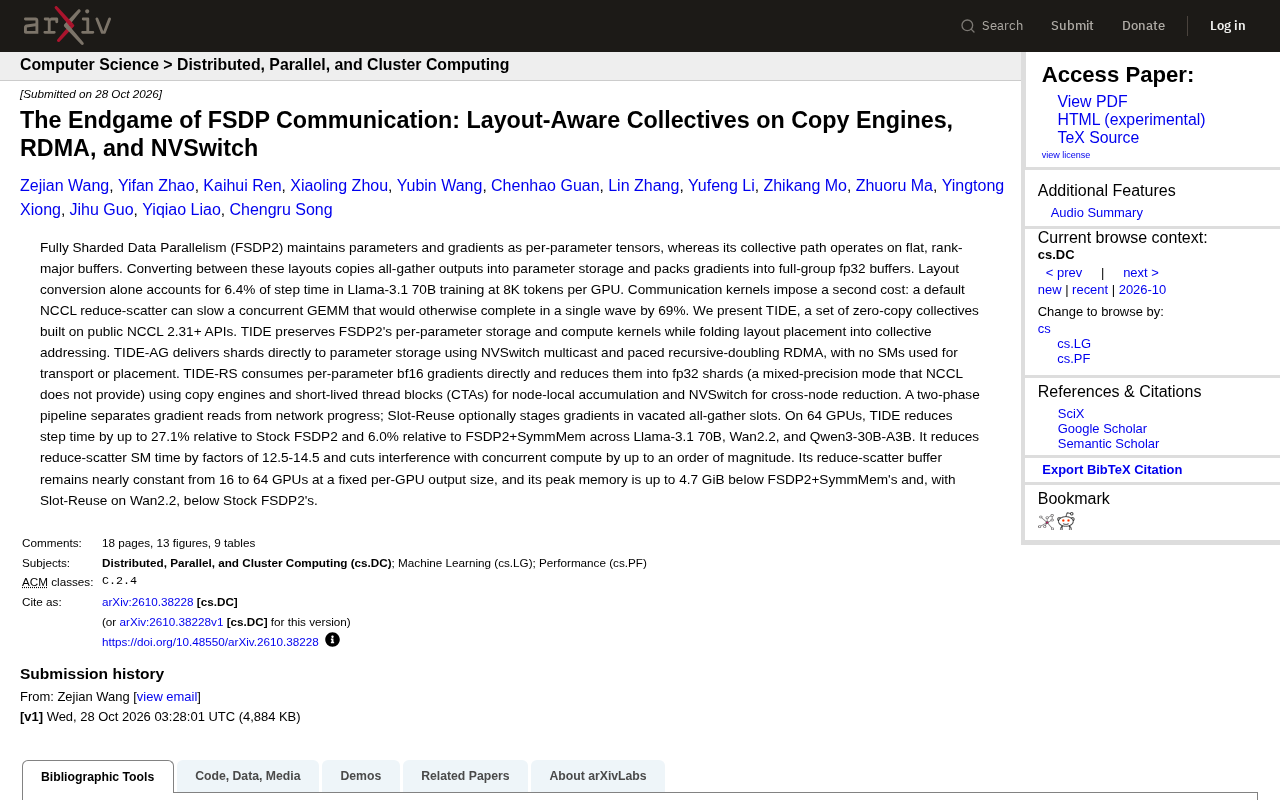
Fully Sharded Data Parallelism (FSDP2) maintains parameters and gradients as per-parameter tensors, yet its collective communication path operates on flat rank-major buffers. This layout mismatch means the output of every all-gather must be copied into parameter storage, and gradients must be packed into full fp32 buffers. According to the original data, in Llama-3.1 70B training (8K tokens per GPU), layout conversion alone accounts for 6.4% of step time. More seriously, communication kernels interfere with concurrent computation: the default NCCL reduce-scatter can slow down a GEMM that would otherwise complete in a single wave by 69%. These two costs combine to make communication optimization a critical bottleneck for large-scale training.
Rank-major buffer refers to a data layout in memory where data is arranged with rank (process) as the primary dimension: for a data block containing multiple ranks, all elements of the same rank are stored contiguously, and blocks for different ranks are arranged sequentially. In contrast, FSDP2's parameter storage consists of per-parameter tensors, each independently contiguous. This layout mismatch prevents direct mapping of collective communication inputs and outputs, necessitating data rearrangement (copying). For example, the output of all-gather in a rank-major buffer is partitioned by rank, but each parameter expects data that is interleaved across ranks or a contiguous block after sharding, thus requiring additional copy operations to move data from the communication buffer to parameter storage.
NCCL reduce-scatter is an operation in NVIDIA's collective communication library: each rank holds a full buffer, and after the operation each rank obtains a partial reduction result (i.e., each rank is responsible for one shard). In FSDP2, gradients need to be reduced from full buffers on each rank to a sharded form, but the default NCCL implementation may use SMs (streaming multiprocessors) to perform the reduction, which competes with concurrent compute kernels for SM resources and slows down computation.
TIDE's Design Approach: Layout-Aware Zero-Copy Communication
TIDE is a set of zero-copy collective communication primitives built on the public NCCL 2.31+ API. Its core idea is to preserve FSDP2's per-parameter storage and compute kernels while folding layout placement into the addressing of collective communication. Specifically:
- TIDE-AG: Leverages NVSwitch multicast and paced recursive doubling RDMA to deliver shards directly into parameter storage, with the transfer and placement process completely avoiding SMs (streaming multiprocessors).
- TIDE-RS: Directly consumes per-parameter bf16 gradients and reduces them into fp32 shards (a mixed-precision mode not provided by NCCL). It uses copy engines and short-lived thread blocks (CTAs) for intra-node accumulation, while inter-node reduction is performed via NVSwitch.
- Two-stage pipeline: Separates gradient reading from network progress, with an optional Slot-Reuse mechanism that temporarily stores gradients in vacated all-gather slots.
These designs allow communication operations to bypass SMs, significantly reducing interference with compute kernels while avoiding the copy overhead of layout conversion.
NVSwitch multicast is a hardware feature of the NVLink Switch system that allows one GPU to send data to multiple GPUs at once without duplicating for each destination. This reduces network traffic and latency, and is particularly suitable for one-to-many communication patterns like all-gather. Recursive doubling RDMA is a communication algorithm based on remote direct memory access that achieves efficient all-gather or reduction operations by recursively doubling and exchanging data, especially suitable for inter-node communication. Copy engine is a hardware unit in the GPU independent of SMs, dedicated to memory copy operations, capable of performing data transfers without occupying compute resources. Short-lived thread blocks (CTAs) are lightweight thread blocks in CUDA used to execute brief parallel tasks such as intra-node accumulation, releasing resources immediately upon completion. Together, these technologies enable TIDE to complete communication and layout conversion without interfering with computation.
Performance: Step Time Reduction and Interference Cut
At 64 GPU scale, TIDE achieves significant improvements over both Stock FSDP2 and FSDP2+SymmMem. Original data shows:
- On Llama-3.1 70B, Wan2.2, and Qwen3-30B-A3B, TIDE reduces step time by up to 27.1% (vs. Stock FSDP2) and 6.0% (vs. FSDP2+SymmMem).
- Reduce-scatter SM time is reduced to 1/12.5 to 1/14.5 of the original, with interference with concurrent computation reduced by up to an order of magnitude.
- With fixed per-GPU output size, the reduce-scatter buffer remains nearly constant from 16 to 64 GPUs, indicating excellent scalability.
- Peak memory is up to 4.7 GiB lower than FSDP2+SymmMem, and even lower than Stock FSDP2 on Wan2.2 with Slot-Reuse enabled.
These data indicate that TIDE not only accelerates communication itself but also improves overall training efficiency by reducing interference.
Stock FSDP2 refers to the official PyTorch implementation of FSDP2, using standard NCCL communication primitives. FSDP2+SymmMem is a variant of FSDP2 that utilizes symmetric memory to optimize communication and reduce layout conversion overhead. Symmetric memory allows multiple GPUs to access each other's memory at the same addresses, simplifying communication addressing, but may still require partial copying. TIDE's comparison with both demonstrates further improvements in zero-copy and interference reduction.
Significance for Large-Scale Training
TIDE's contribution lies in rethinking the layout problem of FSDP communication. Traditional methods treat layout conversion as necessary overhead, whereas TIDE eliminates it through layout-aware collective communication. At the same time, it leverages copy engines and NVSwitch hardware features, rather than SMs, to handle transfer and reduction, offering new ideas for overlapping communication and computation. Although the original article does not discuss scalability beyond 64 GPUs, the constant buffer characteristics suggest potential. For teams training ultra-large-scale models, TIDE provides a viable path to reduce communication overhead, especially suitable for mixed-precision training scenarios.
Conclusion
FSDP2's communication overhead mainly stems from layout conversion and kernel interference. TIDE, through zero-copy, layout-aware collective communication design, achieves significant step time reduction and interference cut on multiple models. Its implementation based on the public NCCL API also increases usability. As model sizes continue to grow, such communication optimizations will become increasingly critical.
One-line Summary
TIDE significantly reduces FSDP2 training step time and compute interference through zero-copy layout-aware communication.
Paragraph Summary
TIDE is an optimization solution targeting the communication bottleneck in FSDP2 training. It identifies layout conversion and communication kernel interference as the main overheads in FSDP2, and designs three zero-copy collective communication primitives: TIDE-AG uses NVSwitch multicast and RDMA to deliver shards directly to parameter storage without occupying SMs; TIDE-RS directly consumes bf16 gradients and reduces them to fp32 shards using copy engines and short-lived thread blocks; and a two-stage pipeline separates gradient reading from network progress. On 64 GPUs, TIDE reduces step time by up to 27.1% compared to Stock FSDP2, cuts reduce-scatter SM time by 12.5-14.5x, reduces interference by an order of magnitude, and maintains nearly constant buffer size with lower peak memory. TIDE provides an efficient communication optimization path for large-scale mixed-precision training.
Related articles

Salesforce Acquires Rune for $375M: AI Logistics Tech Bolsters Defense Business
Salesforce reportedly acquires defense tech startup Rune for $375M. Rune's AI logistics tech will strengthen Salesforce's Missionforce defense platform, continuing its M&A spree.

Why Fair Use Benefits Everyone in the AI Era
Starting from a Hacker News discussion, this article analyzes the legal logic and controversies of the fair use principle in AI training and content creation, and its dual impact on creators and the tech ecosystem.

Mistral Large 4 Open-Sources a Trillion Parameters, Microsoft Offers Voluntary Severance to 60,000 Employees
Mistral Large 4 open-sources a trillion-parameter multimodal model with a coding agent score of 48; SanDisk earnings show AI inference reshaping NAND demand; Google Gemini adds in-app file editing, OpenAI raises Codex quotas, and Microsoft offers voluntary severance to 60,000 employees.