The Era of Agent-Driven Automated Research: Where Should Graduate Students Be Heading?
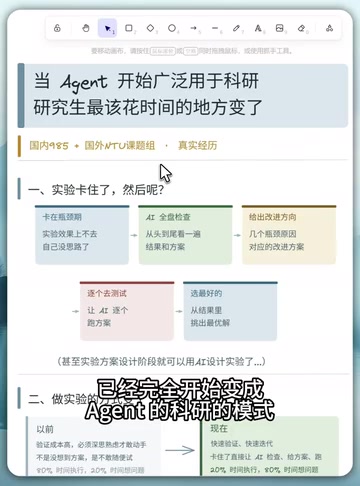
AI Agents are automating research execution — grad students must pivot to asking better questions.
AI Agents are transforming research workflows by automating experiments, literature reviews, and paper writing. As execution costs plummet, the 80/20 time split between doing and thinking is inverting. Graduate students must evolve from efficient executors to insightful questioners, because while AI can run fast, only humans can decide where to run.
The Research Workflow Is Being Reshaped by Agents
While we're still debating whether AI can help polish papers, a qualitative shift has already quietly taken place on the research front lines. A graduate student working simultaneously in research groups both in China and abroad shared his firsthand experience: This year, both groups have been aggressively pushing AI-driven automated research, especially in the experimental phase.
This is no longer simple "AI-assisted writing" — it's a genuine entry into the Agent-driven research paradigm, where AI can not only help you write but also help you think, try, and run experiments.
The Agents (intelligent agents) here are fundamentally different from conversational AI tools like ChatGPT. Research Agents are AI systems with autonomous planning, tool invocation, and multi-step reasoning capabilities that can independently decompose complex tasks. For example, upon receiving the instruction "optimize catalyst ratios," an Agent can automatically retrieve relevant literature, design an experimental matrix, invoke computational simulation tools, analyze results, and generate a report. This capability relies on the deep integration of a large language model (LLM) reasoning core with external tool chains, including code execution environments, database interfaces, laboratory automation equipment APIs, and more. Notable systems in academia currently include Microsoft's AutoGen, Stanford's Generative Agents, and domain-specific research tools like ChemCrow (for chemistry) and Coscientist.
Real-World Case: How AI Broke Through an Experimental Bottleneck
This graduate student shared a very specific scenario: his experimental results had hit a plateau — performance wouldn't improve, and he was out of ideas.
What would the traditional approach look like? Dig through literature, discuss with the advisor, deliberate over hypotheses — potentially spending one to two weeks before daring to modify the plan. But he chose a radically different path:
- Full Review: Have AI examine the experimental results and plan from start to finish
- Diagnostic Analysis: AI identifies multiple possible bottleneck causes with corresponding improvement strategies
- Batch Verification: Have AI test each of these strategies one by one
- Select the Best: Pick the best-performing strategy from the results
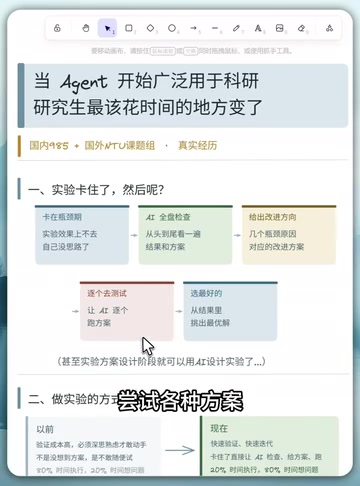
The efficiency gains in the "batch verification" step are particularly staggering. AI's ability to batch-verify experimental plans fundamentally relies on two key technologies: first, Automated Experimentation — executing experiments unattended through robotic laboratories or computational simulation environments; second, intelligent search algorithms like Bayesian Optimization, which efficiently locate optimal solutions within vast parameter spaces rather than exhaustively enumerating all possibilities. In materials science, for example, AI can screen simulation results for thousands of alloy compositions in hours, whereas a traditional lab might need months. In machine learning research, this capability is even more direct — Agents can automatically modify model architectures, adjust training strategies, and run dozens of experiments in parallel on GPU clusters.
He had even started using AI to plan experimental designs at the design stage itself. This means the graduate student's role is shifting from "executor" to "decision-maker".
The 80/20 Rule Inverted: Redistributing Time Between Execution and Thinking
The most profound aspect of this change lies in the complete inversion of time allocation.
The old research model:
- High verification costs meant you had to think long and hard before acting
- 80% of time spent on executing plans
- 20% of time spent on thinking and designing
The new Agent-driven research model:
- Rapid verification, rapid iteration
- When stuck, just have AI inspect, propose solutions, and run tests
- Only 20% of time spent on execution, 80% available for deep thinking
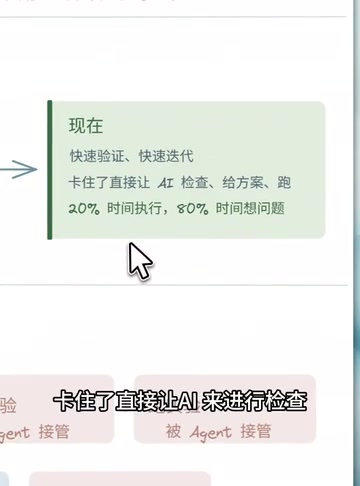
The 80/20 rule (Pareto Principle) referenced here has deep historical context in research. For a long time, researchers have faced a structural contradiction: the most valuable creative thinking is often crowded out by massive amounts of repetitive execution work. A 2014 Nature survey showed that researchers spent an average of over 40% of their time on administrative tasks and repetitive experimental operations. This "execution-intensive" work model not only reduced research efficiency but also prevented the systematic exploration of vast numbers of "negative results." The Agent research model's inversion of this ratio essentially liberates researchers from a "cottage industry" mode, returning them to the most core intellectual activity of scientific research — hypothesis generation and problem definition.
The significance of this transformation runs far deeper than it appears on the surface. When execution costs drop dramatically, researchers can explore more directions simultaneously, and the tolerance for error increases substantially. A wrong experimental direction that once might have wasted a month can now be ruled out in a single day.
Agents Are Taking Over More Than Just Experiments
Here's a telling detail: it's not just core experimental work being gradually taken over by Agents. A whole range of research "chores" are also being systematically replaced:
- Information Gathering: Literature searches, tracking developments in the field
- Weekly Reports: Organizing and reporting experimental progress
- Paper Writing: The entire pipeline from first draft to polishing
- Experimental Design: Plan formulation and parameter searches
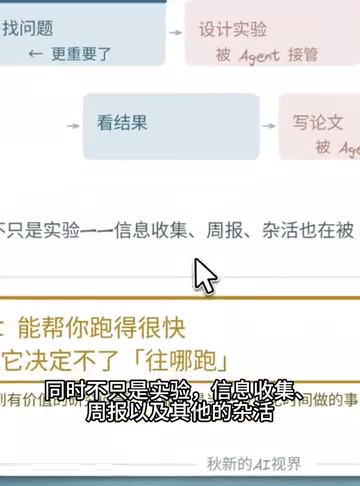
Designing experiments, running experiments, writing papers — these three traditionally most time-consuming phases are being progressively taken over by Agents. The graduate student's workflow is being compressed and restructured.
It's worth noting that research automation didn't appear overnight but evolved through three stages. The first stage (early 2010s) was computational tool assistance, with software like Mathematica and MATLAB accelerating data analysis. The second stage (2018–2022) was AI model embedding, where systems like AlphaFold predicting protein structures and GNoME discovering new materials demonstrated superhuman capabilities at specific steps. The third stage (2023–present) is full-process Agent integration, where AI has upgraded from point tools to autonomous systems capable of spanning the entire chain from "hypothesis → design → experiment → analysis → writing." Carnegie Mellon University's release of Coscientist in 2023 and Sakana AI's release of "AI Scientist" in 2024 marked the formal beginning of this stage. Notably, this trend is equally rapid in China — institutions like the Chinese Academy of Sciences and Tsinghua University have established multiple AI-driven automated laboratories.
The Core Proposition: AI Runs Fast, but It Can't Decide Where to Run
When execution-level time is drastically compressed, a fundamental question surfaces: Where should we spend the time we've saved?
The answer points to the very top of the research chain — finding a valuable research question.
This is precisely the capability AI currently cannot replace. AI can efficiently verify hypotheses, optimize plans, and traverse parameter spaces, but it cannot tell you "what problem is worth studying." It's an extraordinarily powerful execution engine, but the steering wheel must remain in human hands.
Problem Selection as the Core Competitive Advantage
In the era of Agent-driven research, the gap between graduate students will no longer be defined by "who codes faster" or "who runs more experiments," but rather by:
- Who can pose more insightful research questions
- Who can identify truly valuable research directions
- Who can make the right judgment among multiple AI-generated proposals
Why is "asking good questions" the hardest capability for AI to replace? This touches on the "Frame Problem" in cognitive science. AI excels at searching for optimal solutions within a defined problem space, but the most critical breakthroughs in research often come from redefining the problem space itself — what's known as a "Paradigm Shift." For example, Einstein proposed relativity not because he calculated faster than his contemporaries, but because he questioned the fundamental assumptions of Newtonian mechanics. This ability requires cross-disciplinary intuition, sensitivity to anomalies, and value judgments about "what matters" — all of which deeply depend on human embodied experience and social cognition, representing a fundamental blind spot in current AI architectures. Thomas Kuhn offered profound insights on this in The Structure of Scientific Revolutions.
Lower Trial-and-Error Costs Actually Enable Bolder Moves
Interestingly, AI support actually gives researchers greater courage. As this graduate student put it: With AI assistance, we can even dare to attempt research questions we previously wouldn't have touched.
The reason they wouldn't try before was that the cost of failure was too high — if a direction didn't pan out, half a year could be lost. But now, the ability to verify quickly lets researchers explore more ambitious questions at much lower cost. For the entire research ecosystem, this could be an enormous positive driving force.
The reduction in trial-and-error costs doesn't just affect individual researchers' behavior — it may reshape the incentive structure of the entire research ecosystem. Under the traditional model, high failure costs led to pervasive "Publication Bias" in academia — only successful experiments get published, while vast amounts of valuable failed explorations are buried. When AI compresses verification costs to extremely low levels, researchers can systematically explore more "high-risk, high-reward" directions, echoing the "portfolio strategy" in venture capital. Additionally, this may help alleviate the "Replication Crisis" in research — AI-driven automated experiments inherently offer high reproducibility and complete experimental logs, helping improve the credibility of research results.
Final Thoughts
The wave of research automation isn't in the future tense — it's in the present tense. The simultaneous push by research groups both in China and abroad shows this is an irreversible trend. For today's graduate students, the most important thing isn't learning to use a specific AI tool, but rethinking their position in the research chain: transforming from an efficient executor into an insightful questioner.
After all, in an era where AI can help you run at blazing speed, figuring out where to run is the truly scarce ability.
Related articles
Military Analyst Breaks Down the Russia-Ukraine Strategic Bombing Dilemma
A military analyst on the Lex Fridman podcast dissects the Russia-Ukraine battlefield: Ukraine's ground performance is its best since summer 2023, while Russia faces diminishing returns and turns to strategic bombing — a strategy with a poor historical record of achieving political goals.
Microsoft's Six-Pillar Framework for Productionizing AI Agents
A detailed look at Microsoft's framework for productionizing AI agents: six pillars—Center of Excellence, governance, landing zone, security, AgentOps, and optimization—with real enterprise cases and actionable steps.
Codex Security: A Configuration Guide to Automatically Blocking Vulnerabilities at the PR Stage
OpenAI engineers demonstrate Codex Security PR Reviews: automatically scan for vulnerabilities at the GitHub PR stage, have AI generate fix commits and re-verify, with repository-level automatic review and alert threshold configuration.