The Fatal Limitations of Latent World Models: Accurate Prediction Doesn't Equal Understanding the Environment

New research shows state-of-the-art latent world models excel at tasks but fail to truly learn environment dynamics.
The article reexamines how latent world models are evaluated, noting that current evaluations overemphasize task performance and cannot judge whether a model truly captures the underlying structure of environment transitions. It proposes the concept of "faithful latent world models" requiring equivariance between the environment's true transition mapping and learned latent dynamics, and designs the Latent Rollout Consistency (LRC) metric accordingly to test multi-step latent rollouts. Evaluations of several state-of-the-art models show none completes tasks by faithfully modeling environment dynamics, prompting a call to shift evaluation from scores to structure.
World models are often seen as the core component that enables agents to reason over long time horizons. But a new study throws cold water on current state-of-the-art latent world models: they perform impressively on tasks, yet have barely learned the underlying dynamical structure of the environment.
From "performing well" to "modeling correctly": rethinking world models
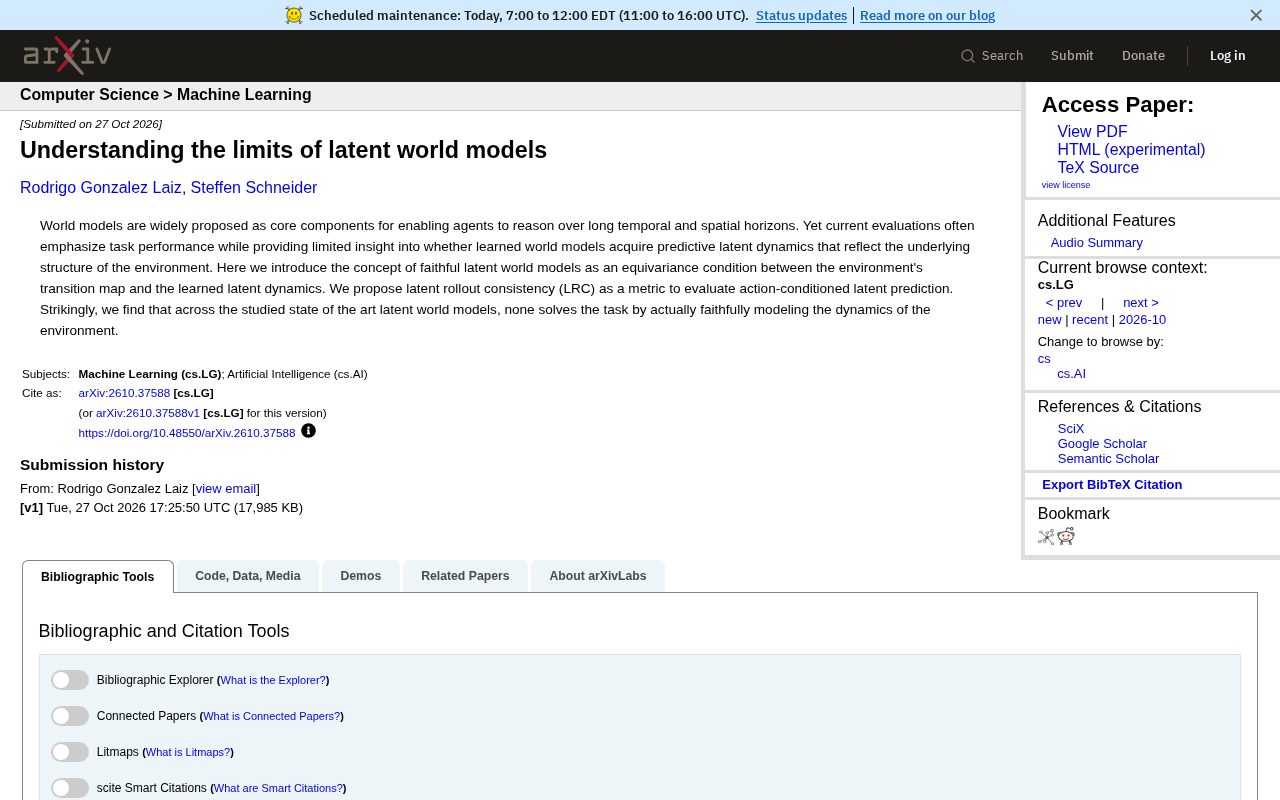
Most existing evaluations focus on task performance, but rarely ask: does the learned world model actually capture the underlying structure of environment transitions? The study proposes the concept of faithful latent world models—requiring that the environment's true transition mapping and the learned latent dynamics satisfy equivariance with respect to each other.
In other words, a faithful world model should not merely produce the right answers for a specific task; it should guarantee that prediction behavior in latent space aligns with the structural regularities of the environment itself. This offers a principled new perspective for evaluating world models.
A world model in reinforcement learning and agent research typically refers to a learned predictive model of environment state transitions: given the current state (or observation) and action, it predicts the next state, observation, or reward. It can be a pixel-level generative model, or a latent world model that makes predictions in a low-dimensional latent space—the latter first compresses high-dimensional observations into latent vectors via an encoder, then learns dynamics in latent space, and finally connects to the task via a decoder or value head. The appeal of latent world models lies in their computational efficiency and suitability for long-horizon reasoning; the Dreamer series and methods based on the Joint Embedding Predictive Architecture (JEPA) both belong to this lineage.
Equivariance is a core concept in geometry and representation learning: if a transformation applied to the input should cause the output to transform in a predictable way, the mapping is said to be equivariant to that transformation. A classic example is the equivariance of convolutional networks to translation—when the image is shifted, the feature map shifts accordingly. In the context of this article, equivariance requires that the environment's true state transition mapping and the learned latent dynamics remain structurally consistent under the latent coordinates induced by the encoder, i.e., "predict in latent space then encode" and "execute the true transition then encode" should yield consistent results. In contrast, invariance only requires that the output remain unchanged under transformation—a stronger condition that is less suitable for dynamics modeling. Equivariance is a suitable criterion for faithfulness because it constrains the structure of the mapping rather than the output values of a specific task.
Latent Rollout Consistency (LRC): a new yardstick
To measure the quality of action-conditioned latent predictions, the study proposes the latent rollout consistency (LRC) metric. It directly tests whether the model, when rolling out multi-step predictions in latent space, maintains consistency with environment transitions, rather than only looking at final task reward.
The significance of this yardstick is that it distinguishes "whether the model is truly modeling the environment" from "whether the model happens to solve the task," avoiding structural flaws masked by task performance.
Multi-step rollout means the model does not just make one-step predictions, but repeatedly feeds its own predictions as the next step's input, autoregressively unfolding several steps in latent space. This is a necessary capability for long-horizon planning, but also a hotspot for error accumulation: small deviations in single-step predictions get amplified during rollout, causing the latent trajectory to quickly drift away from the true trajectory. LRC is designed precisely for this: it tests the consistency of the entire rollout trajectory with environment transitions, rather than comparing only single steps or looking only at final returns. This also explains why task scores cannot replace it: a model may perform well on short-horizon tasks yet systematically drift in multi-step rollouts.
Surprising main findings
The study evaluated several state-of-the-art latent world models and reached a rather direct conclusion: no model completes its task by faithfully modeling environment dynamics.
This means that current systems' high task performance may rely on shortcuts or overfitting to specific tasks, rather than a genuine understanding of world structure. When task conditions change or long-horizon generalization is required, such models may be exceptionally fragile.
Notably, the disconnect between "task performance" and "model faithfulness" has an often-cited analogy in reinforcement learning: model-based agents can achieve high scores through model exploitation—the planner actively seeks out "loophole" states in the world model that are predicted to have high reward but are actually infeasible, thereby gaming good results on an inaccurate model. Such shortcuts are often hard to detect within the training distribution, and quickly fail once the environment or task conditions shift. Therefore, the conclusion of this article is not to deny the effectiveness of these models on benchmarks, but to point out that high scores cannot serve as evidence that "the environment structure has been learned"; evaluation needs to introduce structural tests decoupled from task reward.
Reflections and implications
This result reminds us that the evaluation system for world models needs to shift from "looking at scores" to "looking at structure." Faithful latent dynamics is not only a theoretically elegant condition, but also relates to the robustness and generalization ability of agents in real environments. Future model design may need to treat equivariance and rollout consistency as first-class citizens in training and evaluation, not merely post-hoc metrics.
One-line Summary
A new study points out that state-of-the-art latent world models perform impressively on tasks but have not truly learned the structure of environment dynamics.
Paragraph Summary
The article reexamines how latent world models are evaluated, pointing out that current evaluations focus excessively on task performance and cannot determine whether a model truly captures the underlying structure of environment transitions. The authors propose the concept of "faithful latent world models," requiring that the environment's true transition mapping and the learned latent dynamics satisfy equivariance, and based on this design the Latent Rollout Consistency (LRC) metric, which directly tests whether the model remains consistent with environment transitions when rolling out multiple steps in latent space. Evaluation of several state-of-the-art latent world models shows that none completes its task by faithfully modeling environment dynamics. The article accordingly calls for the evaluation system to shift from "looking at scores" to "looking at structure," incorporating equivariance and rollout consistency into the core of training and evaluation.
Related articles

Microsoft Fabric Database Agent in Action: From Reactive Firefighting to Intelligent Detective
A deep dive into the Microsoft Fabric Database Agent: how to enable it, supported monitoring scenarios, a blocking-issue demo, and the roadmap from reactive to autonomous operations.

Zendesk Uses ChatGPT Enterprise to Build a Sales Agent with 1,000 Daily Active Users
Zendesk opened ChatGPT Enterprise to all employees, who built about 600 apps themselves, including a sales expansion agent with about 1,000 daily active users. This article analyzes how it turns internal data into sales opportunities and its "don't wait" implementation strategy.

Google Releases Gemini 4 Carbon: Its Strongest Model Yet, Debuting with a Cybersecurity Focus
Google releases Gemini 4 Carbon, calling it its strongest model, with a cybersecurity focus. It tops the third-party composite ranking at 59 points but leads by only one or two. This article analyzes its security test results, staged rollout, token pricing, and the divergence between self-reported and third-party tests on hallucinations.