The Most Comprehensive AI Agent Development Tutorial on Bilibili: 748 Episodes from Beginner to实战

Bilibili's 748-episode AI Agent tutorial covers the complete path from large model fundamentals to hands-on intelligent retrieval Agent development.
The article introduces a 748-episode AI Agent development tutorial launched on Bilibili, positioned as a systematic course friendly to zero-foundation learners. The tutorial follows a "theory to practice" path, covering large model fundamentals, Prompt engineering, LangChain and LangGraph frameworks, RAG knowledge bases, model fine-tuning, and multi-agent collaboration, with an intelligent retrieval Agent as the deployment project. The article points out that the core value of the tutorial lies in solving the pain point of fragmented learning materials and connecting scattered knowledge points into a system. At the same time, it reminds learners to view promotional rhetoric such as "employment upon completion" rationally, and suggests jumping around according to personal goals, focusing on hands-on practice and project works, using the tutorial as a main course supplemented by official documentation and community practice.
The Most Comprehensive AI Agent Development Tutorial on Bilibili: 748 Episodes from Beginner to Hands-On
In the field of AI application development, AI Agents are becoming the key bridge connecting large model capabilities with real-world business scenarios. For learners who want to systematically master Agent development, a complete, structured tutorial that progresses from shallow to deep is especially valuable. Recently, Bilibili launched a set of AI Agent development tutorials号称 "748 episodes in total", covering the entire process from environment setup to project deployment, and emphasizing friendliness to zero-foundation learners.
The value of this tutorial lies not only in its content volume but also in its attempt to solve a common pain point: fragmented learning materials. In the past, developers often had to search for materials separately across multiple directions such as large model fundamentals, Prompt engineering, LangChain, RAG, and fine-tuning, making it difficult to form a system. This tutorial connects these knowledge points together and arranges hands-on projects, such as an intelligent retrieval Agent, to help learners build a complete knowledge framework.
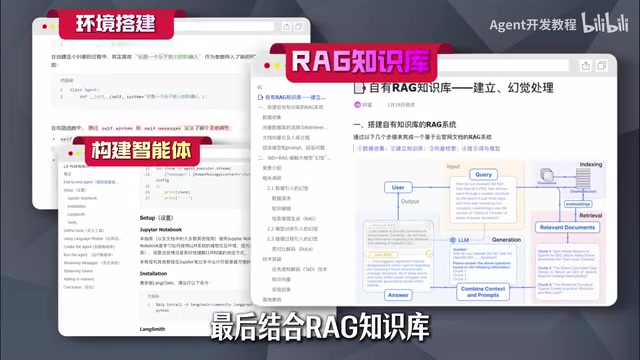
Core Content of the Tutorial: From Large Model Fundamentals to Agent Hands-On
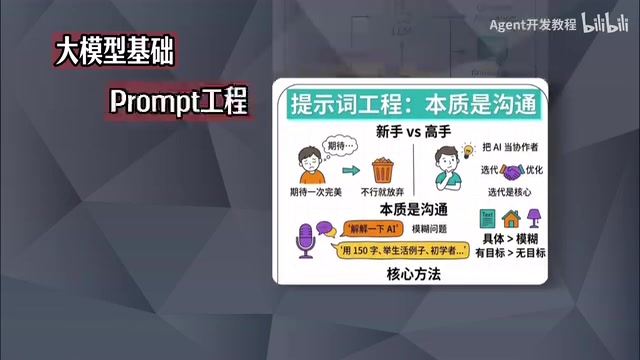
The course design follows a path from theory to practice. First, it explains the basic concepts of large models and Prompt engineering, which are the prerequisites for effective interaction with models. Next, the course introduces the core frameworks for Agent development, including LangChain and LangGraph, helping learners understand how to organize model calls, tool usage, and process control with code. Then, the tutorial goes deep into RAG (Retrieval-Augmented Generation) knowledge bases and ultimately completes a hands-on project on an intelligent retrieval Agent.
According to the tutorial introduction, the content also covers advanced topics such as model fine-tuning, multi-agent collaboration, and Agent scheduling logic. This means learners can not only build simple question-answering agents but also further explore more complex application forms such as automated task Agents and private knowledge base robots.
The Positioning Difference Between LangChain and LangGraph
LangChain is an open-source framework for building large model applications. Its core abstractions include Model (model wrapper), Prompt (prompt template), Chain (call chain), Tool (tool), and Memory (memory). It orchestrates "model calls + external tools + data retrieval" into reusable components. LangGraph is an extension library launched by the LangChain team that uses a "Graph" to express an Agent's execution flow: nodes represent one step of operation (such as calling a model or executing a tool), edges represent transition conditions, and it supports loops, branches, and state persistence. Simply put, LangChain solves "how to assemble components," while LangGraph solves "how to control the flow." The two are often used together for complex Agents that require multi-round reasoning, tool fallback, or human intervention. Understanding this difference helps learners judge when to use Chain and when to use Graph in the course.
The Basic Mechanism of RAG (Retrieval-Augmented Generation)
The core idea of RAG is: before the model generates an answer, first retrieve text fragments related to the question from an external knowledge base, splice them into the Prompt as context, and then let the large model answer based on this evidence. A typical process is divided into two stages: offline database construction and online retrieval. In the offline stage, documents are chunked, converted into vectors using an embedding model, and stored in a vector database. In the online stage, the user's question is also vectorized, similarity retrieval is performed (such as cosine similarity), and after retrieving the Top-K fragments, they are sent to the model together with the question. RAG can alleviate the problems of outdated knowledge and hallucination in large models, and it also allows private data to be utilized without fine-tuning. It is the technical foundation for applications such as "private knowledge base robots." The intelligent retrieval Agent in the tutorial is exactly the engineering implementation of this paradigm.
Target Audience and Learning Path
This tutorial is clearly aimed at zero-foundation beginners but also covers the needs of advanced developers. For beginners, the course starts from environment setup and guides them step by step to complete the first intelligent Agent project, lowering the entry barrier. For developers with some foundation, the content on RAG, fine-tuning, and multi-agent collaboration can serve as directions for deepening technical skills.
The tutorial emphasizes that "every lesson is疯狂 outputting knowledge points" and promises to explain core knowledge points in a "broken down and crushed" way. This intensive knowledge output model is suitable for learners who want to use time efficiently and quickly build a knowledge system. However, the volume of 748 episodes also means a longer learning cycle, requiring learners to maintain sustained investment.
Solving the Pain Point of Fragmented Learning Materials
The tutorial specifically mentions in its promotion that "you no longer need to piece together materials from everywhere," which precisely hits the common dilemma of current AI learners. As large model technology iterates rapidly, tutorials on the internet are often outdated or scattered and lack systematicity. A complete course covering everything from beginner to project deployment can help learners reduce the cost of information screening and focus their energy on core concepts and hands-on practice.
In addition, the content covered by the tutorial, such as "Agent scheduling logic" and "multi-agent collaboration," reflects the current frontier directions in the AI Agent field. Multi-agent systems have potential in scenarios such as automated workflows and complex task decomposition. Learning these contents helps developers keep up with technological evolution.
Multi-Agent Collaboration and Agent Scheduling Logic
A multi-agent system refers to an architecture in which multiple Agents with different roles or tools collaborate to complete tasks. Common patterns include: a Supervisor distributing tasks to sub-Agents, role division (such as a "researcher" responsible for retrieval and a "writer" responsible for writing), and debate/review-style collaboration. The difficulty lies in scheduling logic—who decides which Agent executes the next step, how context is passed, when to terminate the loop, and how to adjudicate conflicts. In engineering, this is usually implemented with LangGraph's state graph, message-passing mechanisms, or specialized orchestration frameworks, and it requires handling issues such as token costs, infinite loops, and error propagation. This direction is particularly valuable in automated workflows and complex task decomposition scenarios, and it is also a hot spot in current Agent research and applications.
Learning Suggestions and Precautions
For learners preparing to start, it is recommended to first clarify your goals: if you want to quickly get started building simple question-answering agents, you can focus on Prompt engineering and basic Agent construction; if you plan to develop private knowledge base robots, you need to go deep into RAG and vector database-related content. You do not have to watch all 748 episodes in one go; you can jump around according to project needs.
It is worth noting that phrases such as "employment upon completion" in the tutorial title are promotional rhetoric. Actual employment competitiveness depends on personal project experience and technical depth. Learners should focus on hands-on practice and accumulate presentable works through the projects in the tutorial.
Overall, this Bilibili AI Agent tutorial has obvious advantages in content coverage and structural completeness. It is suitable for learners who want to systematically learn Agent development to use as a main course, supplemented by official documentation and community practice, to form their own technical stack.
Trade-offs Between Model Fine-Tuning, Prompt Engineering, and RAG
Fine-tuning is the process of continuing to train a pre-trained model with domain data to adjust model parameters. Common methods include full-parameter fine-tuning and parameter-efficient fine-tuning (such as LoRA and QLoRA). Together with Prompt engineering and RAG, it forms three complementary routes: Prompt engineering has the lowest cost and quick results, and is suitable for standardizing output formats and role settings; RAG is suitable for injecting frequently updated or private external knowledge without changing the model; fine-tuning is more suitable for enabling the model to acquire a stable domain style, terminology, or specific task capabilities, but it requires annotated data and computing power, and knowledge updates are less flexible than RAG. In practice, a combination of "RAG as the main approach and fine-tuning as a supplement" is often adopted. Learners should understand the applicable boundaries of the three and avoid mistakenly using fine-tuning for problems that could be solved with retrieval.
One-line Summary
Bilibili's 748-episode AI Agent tutorial covers the complete path from large model fundamentals to hands-on intelligent retrieval Agent development.
Paragraph Summary
The article introduces a 748-episode AI Agent development tutorial launched on Bilibili, positioned as a systematic course friendly to zero-foundation learners. The tutorial follows a "theory to practice" path, covering large model fundamentals, Prompt engineering, LangChain and LangGraph frameworks, RAG knowledge bases, model fine-tuning, and multi-agent collaboration, with an intelligent retrieval Agent as the deployment project. The article points out that the core value of the tutorial lies in solving the pain point of fragmented learning materials and connecting scattered knowledge points into a system. At the same time, it reminds learners to view promotional rhetoric such as "employment upon completion" rationally, and suggests jumping around according to personal goals, focusing on hands-on practice and project works, using the tutorial as a main course supplemented by official documentation and community practice.
Related articles

Tencent WorkBuddy Hands-On: How AI Agents Crush Traditional Chat Assistants
WorkBuddy vs Doubao tested: how AI Agents directly operate computers to convert PPT to PDF, archive files and more. Analysis of WorkBuddy's low barrier, domestic ecosystem, pricing and plugin marketplace, plus AI Agent selection advice.

Azure Cross-Tenant Attack Chain: Root Cause Analysis of Five Paths
Binary Security analyzes five full cross-tenant compromise paths in Azure, trending 271 points on HN. This article interprets their shared root cause perspective and offers defense recommendations for cloud tenant isolation and reflections on responsibility boundaries.

Recreating a Real Bubble Tea Station in Isaac Sim: Script-Driven Unitree G1 Brews Tea
Developers recreated a real self-service tea station in NVIDIA Isaac Sim, using scripts to drive a Unitree G1 through a five-step tea-brewing process, exploring whether physics simulation can be a source of synthetic robot demonstration data and discussing contact stability and imitation learning.