The Most Comprehensive AI LLM Application Development Course on Bilibili: Cognition Determines Success

To learn LLM app development, first change your cognition: treat AI as a person and start with familiar domains.
Sun Zhigang's AI LLM Application Development course emphasizes that the first step is not coding but "rewiring cognition"—treating AI as a person, not a deterministic machine. It predicts AGI may arrive in 3–5 years, but foundation model training has an extremely high barrier; most opportunities lie in becoming AI product makers who understand business, AI, and programming. There is no Killer App yet; adoption should start with small scenarios in familiar domains. Prioritize Prompt and RAG; avoid fine-tuning unless necessary. Choose models by suitability, not rankings. The ultimate mindset is object awareness—interact with AI as you would with people.
Why "Cognition" Matters More Than "Hard Skills"
On Bilibili, a tutorial series titled AI Large Model Application Development has been hailed as "the most comprehensive and detailed," taught by Sun Zhigang. Unlike typical technical courses, the first lesson contains almost no code and instead spends a great deal of time on "cognitive alignment." Behind this design is a judgment: The first step in learning about large models is not learning technology, but changing your habitual cognition about machines.
Sun Zhigang states bluntly at the outset that this lesson is "not hardcore enough." But he believes that while traditional skill learning can go straight to code, large models are different. "The most important first step in learning large model AI is to rewire your cognition, to change the habits you've formed over the years toward machines, toward computers, toward programming."
The logic behind this: a large model is not a deterministic software system; it is more like a probabilistic "person." If you apply machine thinking—input A必然 yields output B—you will hit walls everywhere. The course summarizes this shift as "treat AI as a person." Turing Award winner Geoffrey Hinton has pointed out that digital neural networks share underlying principles with the biological neural networks of the human brain; Kevin Kelly has expressed a similar view: how we get along with people is how we should get along with AI.

This cognitive shift manifests on multiple levels. For example, don't ask "Can a large model do X?"—just let it do it and judge from the result. Sun Zhigang says: "Even the designers of large models don't know what they can and cannot do, so don't ask whether it can; try it yourself."
Deterministic systems refer to systems that always produce exactly the same output given the same input; most traditional software and algorithms fall into this category. Large models are the opposite: their output is determined by sampling from a probability distribution, so the same prompt may yield different results. This non-determinism stems from the fact that what the model learns during training is the statistical patterns of word sequences, not hard-coded rules. Therefore, when using large models, you cannot debug with the mindset of "input A必然 yields output B." Instead, you should communicate with it as you would with a person—adjusting prompts and providing context to constrain the probability space—and accept a certain degree of result fluctuation.
The AGI Timeline and Three Types of Participants
The course offers a predicted range for AGI (Artificial General Intelligence): mainstream opinion holds it may be achieved within three to five years, while academia is more pessimistic, believing it will take ten years. Sun Zhigang personally leans toward the three-to-five-year judgment and jokes that "I'm working out desperately just so I can live to see AGI."
In the AGI era, the relationship between humans and AI can be divided into three layers:
- Users of AI products: Those who use AI products developed by others—the largest group, but "not scarce at all."
- Makers of AI products: Those who build AI products to meet their own or others' needs—this is the core goal of the course.
- Foundation model-related workers: Those who train foundation models or provide infrastructure such as compute and frameworks—the barrier to entry is extremely high.
Sun Zhigang reveals that the number of core teams worldwide that truly train foundation models from scratch is very small; a typical team has no more than twenty core members, of whom often only two or three are directly involved in training. He believes the number of completely original domestic large models will not exceed twenty, with most being optimizations on open-source models. "The number of foundation model companies left in the world may not exceed one hundred, or even fewer than ten."
For most learners, the course positions them at the second layer: becoming AI product makers.
The Capability Model for AI Product Makers: Three Understandings
The course proposes that AI product makers need three capabilities: understanding the business, understanding AI, and understanding programming.
- Understanding the business: Knowing how an industry makes money and how it operates.
- Understanding AI: Knowing what AI can and cannot do, and how to make it better, faster, and cheaper.
- Understanding programming: Being able to independently complete a full program.
Sun Zhigang emphasizes that all three are indispensable. "Lack any one, and the product is incomplete: either performance suffers, or results suffer, or it's perfectly built but yields no commercial return." The course aims to cultivate "AI full-stack engineers," but students can position themselves as "business-oriented" or "programming-oriented" based on their circumstances—at minimum two understandings are required, and regardless, understanding AI is mandatory.
Current State of Large Model Adoption: No Killer App
The course summarizes the current state of adoption with a doggerel: "No Killer App in sight, AI-native yet to prove, those with scenarios need not rush, internal efficiency quietly pursued."
Sun Zhigang believes that large models have not created new scenarios but rather enhanced old ones, so there's no need to obsess over finding a "killer app." He warns that if someone keeps talking about Killer Apps, "stay away from them—they're living in the last era."
He categorizes current AI products into several types:
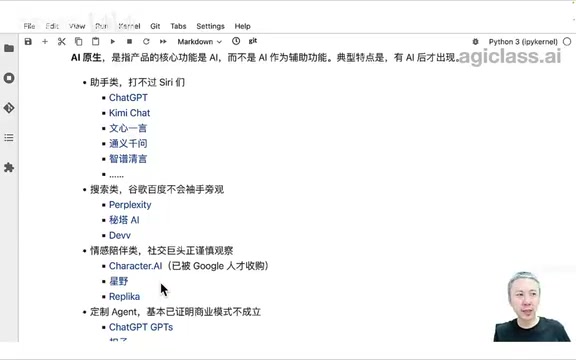
- AI-native: The core function is AI, not an auxiliary feature. But most so-called AI-native applications, such as emotional companion products, face business model dilemmas—once adult content is filtered out, willingness to pay drops sharply.
- Giants with scenarios: In areas like photo-based Q&A, office work, and programming, existing top players integrate AI capabilities into their products and continue to lead.
- Internal efficiency: A large number of enterprises use large models to reduce costs and increase efficiency in customer service, marketing, R&D, and other areas, but they don't publicize it.
Sun Zhigang points out that the biggest obstacle to large model adoption is "cognitive misalignment"—some people have overly high expectations, others too low. Successful adoption requires five key elements: enthusiastic business personnel, a correct understanding of AI capabilities, business teams with in-house programming ability, starting small, and a patient boss.
Start with the Most Familiar Domain
For individuals looking to find adoption scenarios, the course offers a core principle: start with the most familiar domain.
"Working with large models doesn't mean changing careers; it means making you more formidable in your previous industry." Sun Zhigang says, "There is no AI industry—only specific domains like education, finance, manufacturing, and power." The approach: find tasks that can be described in language, because what large models are currently best at is processing language; don't aim for big and comprehensive—break down the business and solve small scenarios first.
He cites his own projects as examples: his first startup combined AI with education, teaching AI technology; his second project, "Master Ai," uses AI directly as a teacher delivering lessons. "I only do this one thing—no AI sales, no full AI suite—just find small scenarios."
Principles of Large Models: Probabilistic Prediction and Tokens
The course spends considerable time explaining the underlying principles of large models: guessing the next character based on probability.
In a demonstration, given the input "Today I am very," the model might generate different content like "busy" or "happy"; given "After work today I am very," the generated content leans toward work scenarios; given "After school," it leans toward a child's perspective. This shows that the role of prompts is to constrain the probability space. "If the prompts you input earlier can narrow the scenario more tightly and finely, the probability of generating content that meets requirements later will be greater."
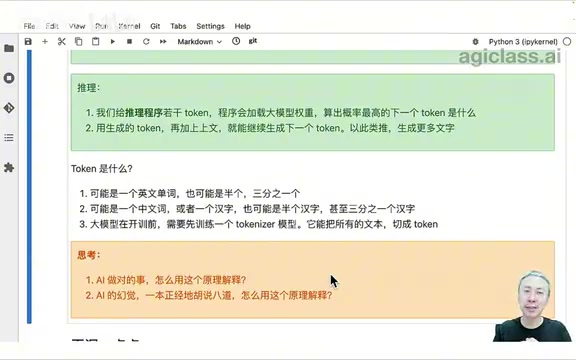
Large models have two core processes: training and inference. Training is learning—storing word co-occurrence probabilities into neural network weight files; inference is using—generating the next Token one by one based on the weights and the input prompt.
A Token is the smallest unit of data that a large model processes; it may be an English word, half a word, a Chinese character, or half a character. Foreign large models often break Chinese characters apart, so one Chinese character may occupy multiple Tokens, whereas Chinese large models generally do not. This directly affects the efficiency and cost of Chinese processing.
Token is the smallest unit of text processed by a large model, but it is not equivalent to a "character" or a "word." A tokenizer splits text into subword units; common algorithms like BPE (Byte Pair Encoding) decide merge rules based on corpus frequency. For example, the English word "unbelievable" might be split into three Tokens: "un," "believ," and "able"; for Chinese, one character may correspond to one Token, or multiple characters may be merged. The number of Tokens directly affects API billing (charged by Token) and context window length, so understanding Tokens helps optimize prompt length, control costs, and explain why the same Chinese text performs and costs differently across models.
Technology Selection: Prompt, RAG, Function Calling, and Fine-Tuning
The course outlines the technical architecture of large model applications:
- Pure Prompt: The simplest architecture, controlling the large model through prompts.
- Function Calling + Agent: Having the large model proactively request external functions, such as checking the weather or querying a database.
- RAG (Retrieval-Augmented Generation): Using vector databases for semantic search to inject relevant knowledge into prompts, addressing large models' insufficient knowledge and hallucination issues.
- Fine-Tuning: Writing new knowledge into the model through training—the highest cost, not to be done unless necessary.
The decision process for technology selection is: first prepare test data, use part of the data to verify feasibility on a general-purpose large model; when basic capabilities are insufficient, prioritize RAG to supplement knowledge; if external systems need to be integrated, use Function Calling; only consider fine-tuning in scenarios such as improving stability, reducing inference costs, or private deployment.
RAG (Retrieval-Augmented Generation) core idea: before generating an answer, retrieve document fragments relevant to the question from an external knowledge base, inject these fragments as context into the prompt, and then have the large model answer based on this context. It typically relies on a vector database—converting text into high-dimensional vectors through an embedding model and retrieving by semantic similarity. RAG can alleviate large models' outdated knowledge and hallucination problems without retraining the model, at a cost far lower than fine-tuning. However, its effectiveness highly depends on retrieval quality; if relevant content cannot be retrieved, the model may still fabricate answers.
How to Choose a Foundation Model
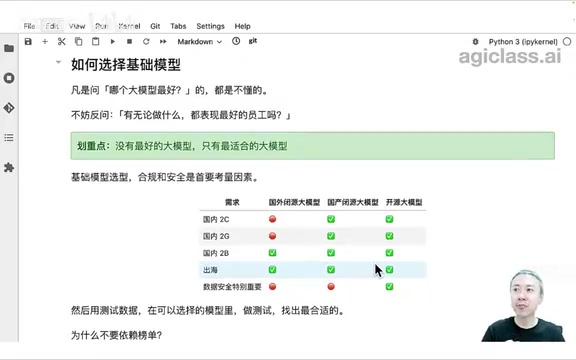
"Anyone who asks which large model is the best doesn't understand." Sun Zhigang says, "There is no best—only the most suitable."
Choosing a model requires considering several factors: compliance and safety (domestic 2C products must use domestic large models), cost, and performance on specific tasks. He warns against blindly trusting leaderboards: "Leaderboards have been polluted by exam-oriented education; many companies have dedicated leaderboard-climbing teams."
The course uses OpenAI as an example because "it's the most popular, and the entire playbook is being imitated by other models; once you learn OpenAI, you'll understand the others by extension."
Leaderboards such as MMLU and C-Eval rank models through standardized test sets. However, these leaderboards have obvious limitations: test questions may leak into training data, inflating scores; some companies specifically optimize for leaderboard questions (i.e., "leaderboard climbing"), so rankings do not truly reflect model performance in specific business scenarios. Therefore, when selecting a model, you should build a small-scale test set from your own business data and compare candidate models on actual tasks, rather than blindly trusting public rankings.
The Underlying Mindset for Using AI: Establishing Object Awareness
The course finally returns to the core mindset: treat AI as a person.
In different scenarios, assign AI different roles: a teacher when learning, an assistant when working, a friend when relaxing. When interacting with AI, establish "object awareness"—know what role you play and what role the AI plays.
"People can't be 100% correct, and AI can't either. Turing said that if a machine cannot make mistakes, it cannot be intelligent." Sun Zhigang says that almost all techniques, frameworks, and approaches for using AI can find counterparts in human society and management science.
This may be the most counterintuitive and most valuable aspect of this course: to learn large models, first learn to be human.
Related articles

Google Search's Share of Revenue Falls Below 50% for the First Time — Alphabet's Inflection Point Has Arrived
Google Search's share of Alphabet revenue falls below 50% for the first time, signaling search ads are no longer the sole pillar. This article examines the AI disruption, revenue diversification logic, and ripple effects on the digital ad industry behind this inflection point.

@ai-sdk/vue 3.0.319 Released: Routine Maintenance and Version Alignment in the AI SDK Ecosystem
@ai-sdk/vue 3.0.319 patch release syncs with core package ai@6.0.319. Here's what this version alignment means for Vue AI app developers.

Entra to Stop Updating MemberOf Dynamic Groups: SCIM Provisioning Faces Silent Failure Risk
Microsoft Entra memberOf-based dynamic groups will stop updating on November 3, 2026, silently breaking apps that rely on them for SCIM provisioning. This article explains the scope of impact, troubleshooting methods, and migration recommendations.