The Most Systematic Agent Development Course on Bilibili: From Zero to Enterprise-Level Practice

A systematic Agent development course on Bilibili covering five core modules with enterprise-aligned practical projects.
The article introduces an Agent development course on Bilibili that learners call the most systematic and practical. It covers five core modules—prompts, tool calling, memory and context management, knowledge bases, and multi-agent collaboration—plus hands-on projects aligned with real enterprise Agent development hiring requirements. It targets transitioning programmers, complete beginners, and college students, and offers rational advice on turning the course into job-seeking competitiveness.
Why Learn Agent Development Now
If you're looking for a course that can truly put large models to work, Agent development is almost an unavoidable direction. This Agent course on Bilibili, which many learners call the "most systematic and most practical," is built precisely for this need. It's aimed not only at experienced programmers but also at complete beginners and college students—according to the course, as long as you follow along, you can build an Agent project worthy of your resume and even land your first offer.

The course's reasoning for learning is straightforward: Agents are the form in which large models actually get real work done, they're the current mainstream technology, and they're an enterprise necessity. The talent gap for related positions is especially large, and the course content fully matches the hiring requirements for enterprise-level Agent development roles. For anyone looking to land a job, raise their salary, or stand out in fierce competition, this is a key core competency.
Course Structure: Core Modules and Practical Projects
The entire course is clearly split into two parts: the first part breaks down the core functional modules of Agents, and the second part walks you through hands-on practical projects. The former is responsible for thoroughly explaining the underlying logic, while the latter is responsible for connecting the technologies together, achieving the landing from theory to practice.

This "break down modules first, then do projects" design is fairly friendly to beginners. Because Agent development involves many interwoven concepts, if you jump straight into a project, it's easy to end up just copying code; by first clarifying each module's responsibilities and boundaries, you'll know what problem each step is solving when you do the project later.
Part One: Breaking Down the Five Core Modules of Agents
The first part of the course starts from the underlying logic and breaks down the core modules of agents, including prompts, tool calling, memory and context management, knowledge bases, and multi-agent collaboration. The goal is to thoroughly master agents from 0 to 1, rather than staying at the level of calling APIs.
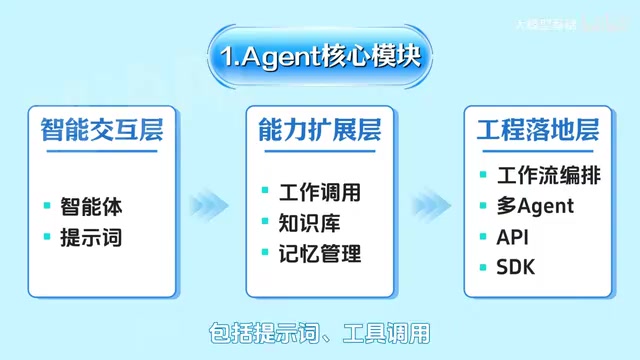
These modules actually form the complete skeleton of an Agent. Prompts determine how the Agent understands tasks and constrains its output; tool calling lets it truly interact with external systems rather than just chat; memory and context management solve the problem of retaining information across multi-turn conversations; knowledge bases provide the Agent with reliable domain-specific grounding; and multi-agent collaboration splits complex tasks among multiple roles working in division of labor. Once you understand these five pieces, looking at any Agent framework will be much easier.
Prompt Engineering is the most fundamental and most easily underestimated part of Agent development. It's not simply typing a question into a dialog box, but rather designing structured instructions so that the large model reliably outputs according to the expected role, format, and constraints. In actual Agents, prompts often include system role settings, task decomposition steps, output format specifications, few-shot examples, and safety boundaries. Prompt quality directly determines the Agent's precision in understanding tasks and the controllability of its output, so in engineering practice, prompts usually need repeated iteration and version management, and are even incorporated into testing processes like code. Understanding prompt engineering is the prerequisite for subsequent modules like tool calling and memory management to work together.
Tool Calling (Function Calling) is the key mechanism by which large models go from "being able to chat" to "being able to get work done." Its basic flow is: developers declare a set of external tools and their parameters with structured descriptions (usually JSON Schema), the large model determines during reasoning whether it needs to call a tool and generates a call request in the correct format; the execution layer receives the request and actually runs the function (such as querying a database, calling an API, sending an email), then returns the result to the model to continue reasoning. This mechanism allows Agents to break through the boundaries of the model's own knowledge and interact with real systems. Whether tool descriptions are clear, whether parameter design is reasonable, and whether error handling is complete all directly affect the Agent's reliability and success rate.
Memory and Context Management solves the problem that large models "can't remember." Large models have limited context windows, and each call is stateless, so Agents need a mechanism to maintain conversation history, task state, and long-term knowledge. Common approaches include: using short-term memory to save the most recent several turns of conversation, compressing long-term memory through summaries or vector retrieval, and dynamically trimming information in context by priority. In addition, context management also involves how to avoid irrelevant information interfering with model judgment and how to maintain goal consistency across multi-turn tasks. For Agents that need to run for a long time, memory design often determines the final result more than model selection.
Knowledge Bases and Retrieval-Augmented Generation (RAG) are a common solution for giving Agents domain expertise. The core idea is: split materials such as enterprise documents, product manuals, and FAQs into chunks and store them as vectors; when a user asks a question, first retrieve the most relevant chunks from the knowledge base, then pass these chunks as context to the large model to generate an answer. This both reduces the risk of the model "making things up" and lets the Agent answer with the latest information that doesn't exist in the training data. In Agent development, the knowledge base module also involves engineering details such as chunking strategy, embedding model selection, retrieval ranking, and citation tracing, and is one of the parts most often probed by interviewers in practical projects.
Part Two: Practical Projects Aligned with Enterprise Hiring Requirements
The second part of the course is a hands-on practical case study, with the goal of connecting all the core technologies learned earlier and completing the landing from theory to practice. The course emphasizes that these projects are aligned with the hiring requirements of real enterprise Agent development positions, not toy-level demos.
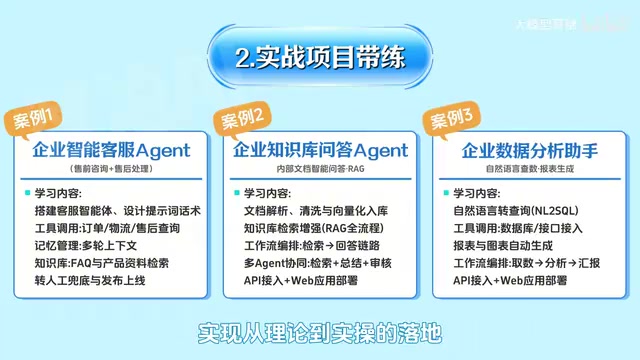
For job seekers, this may be more important than the technology itself. Whether a project on your resume can withstand an interviewer's probing depends on whether it covers the capability points that real positions examine—how tools are selected, how context is managed, how knowledge bases are connected, and how multiple Agents collaborate. By practicing these steps within projects, the course essentially simulates the job content in advance.
Learning Support and Target Audience
The course makes a clear commitment regarding questions during learning: any questions you encounter can be asked in the comments section, and the instructor will answer every one. For people self-studying Agents, this can significantly reduce the probability of giving up after getting stuck.
The target audience is fairly broad: traditional programmers looking to transition, complete beginners, and college students are all within scope. The course's positioning is "no nonsense," focused on practical landing, and minimizing detours. Of course, zero foundation doesn't mean zero threshold—concepts like prompts and tool calling still require hands-on practice to master. The course provides the path and the projects; true understanding still depends on writing code yourself.
A Bit of Rational Advice
Demand for Agent development positions is indeed growing, but the claim that "you'll get an offer after finishing the course" should be viewed rationally. What the course can provide is a systematic knowledge framework and practical projects aligned with job requirements. Whether it ultimately translates into competitiveness depends on how deeply you do the projects and whether you can clearly explain your design trade-offs. It's recommended not to just type along with the video once, but to try migrating each completed module to your own scenario—even if it's just swapping in a different knowledge base for the project or adding a tool. That's how the value of this course will truly land in your resume and interviews.
One-line Summary
A systematic Agent development course on Bilibili that breaks down five core modules with practical projects aligned to enterprise hiring.
Paragraph Summary
The article introduces an Agent development course on Bilibili that learners call the "most systematic and most practical." The course is divided into two parts: the first part breaks down the five core modules of Agents from the underlying logic—prompts, tool calling, memory and context management, knowledge bases, and multi-agent collaboration; the second part connects the core technologies together through hands-on practical projects, which are aligned with the hiring requirements of real enterprise Agent development positions. The course targets traditional programmers in transition, complete beginners, and college students, and promises to answer every question in the comments. The article also offers rational advice: the course provides a knowledge framework and project path, and whether it translates into job-seeking competitiveness depends on how deeply the projects are done and whether you can clearly explain your design trade-offs.
Related articles

Tencent WorkBuddy Hands-On: How AI Agents Crush Traditional Chat Assistants
WorkBuddy vs Doubao tested: how AI Agents directly operate computers to convert PPT to PDF, archive files and more. Analysis of WorkBuddy's low barrier, domestic ecosystem, pricing and plugin marketplace, plus AI Agent selection advice.

Azure Cross-Tenant Attack Chain: Root Cause Analysis of Five Paths
Binary Security analyzes five full cross-tenant compromise paths in Azure, trending 271 points on HN. This article interprets their shared root cause perspective and offers defense recommendations for cloud tenant isolation and reflections on responsibility boundaries.

Recreating a Real Bubble Tea Station in Isaac Sim: Script-Driven Unitree G1 Brews Tea
Developers recreated a real self-service tea station in NVIDIA Isaac Sim, using scripts to drive a Unitree G1 through a five-step tea-brewing process, exploring whether physics simulation can be a source of synthetic robot demonstration data and discussing contact stability and imitation learning.