The Truth About Data Quality: Response Ratio Is the Key Metric for Instruction Fine-Tuning

Research finds response ratio predicts instruction fine-tuning utility better than language quality.
An empirical study decomposes "data quality" into sample-level metrics like response ratio, text fluency, and instruction complexity, then sorts and buckets them to fine-tune models under a fixed budget. Results show response ratio predicts instruction fine-tuning utility better than common proxies like language quality and instruction complexity, and is more transferable. This challenges the practice of prioritizing fluent or complex samples, suggesting supervision density may matter more than surface quality in early fine-tuning. The study also notes that common quality scorers may not align with training objectives, and generalization to larger-scale fine-tuning remains to be validated.
Introduction: The Misused Term "Data Quality"
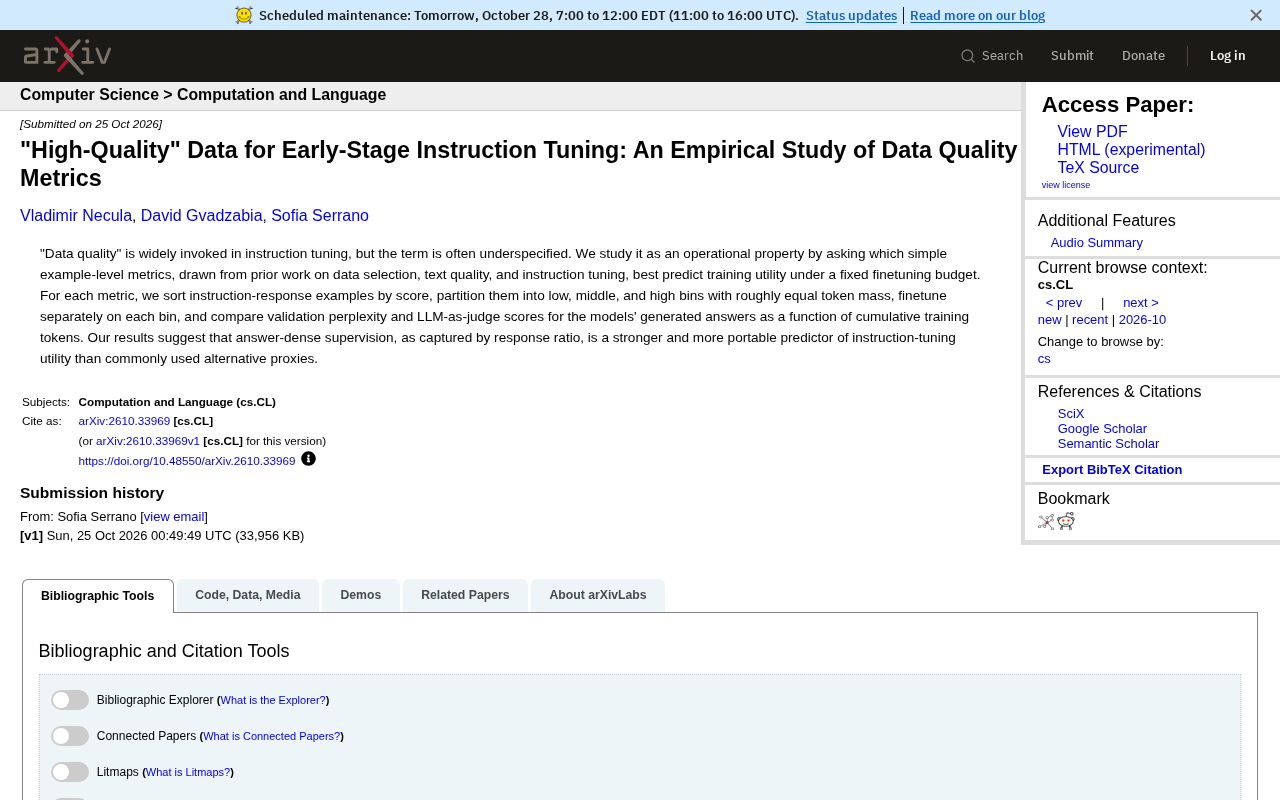
In the field of instruction tuning, "data quality" is a concept that almost everyone mentions yet few can clearly define. What counts as "high-quality" data? Is it fluent language, clear instructions, or rich answer content? A recent empirical study attempts to pull this question from vague intuition back to an operational level: under a fixed fine-tuning budget, which simple sample-level metrics best predict training utility?
The researchers' approach is straightforward: for each metric, sort instruction-response samples by score into low, medium, and high buckets (each bucket containing roughly equal total tokens), fine-tune models separately, then compare the models' generated responses using validation perplexity and LLM-as-judge scores. The results point to a counterintuitive conclusion: the density of the response (response ratio) predicts instruction fine-tuning utility better than common proxy metrics such as language quality and instruction complexity.
Method: Breaking "Quality" into Operational Metrics
The starting point of this research is to treat "data quality" as an operational property rather than an abstract concept. The authors extract a series of simple sample-level metrics from prior work in data selection, text quality, and instruction tuning—such as response ratio (the proportion of answer tokens relative to total sample tokens), text fluency, and instruction complexity.
The key design element: each metric is sorted and bucketed independently, ensuring that each bucket has approximately equal total tokens, thereby comparing models trained on different buckets under the same training budget. Evaluation dimensions include validation perplexity and LLM-as-judge scores on generated responses, observing how these metrics change with cumulative training tokens. This design turns "data quality" from a vague label into a set of variables that can be tested individually.
Instruction Tuning refers to continuing to train a pretrained language model on data in the form of "instruction-response" pairs, so that the model learns to follow human instructions to complete tasks. Its key characteristic is that the training objective is highly aligned with downstream usage: each sample the model sees contains a task description (instruction) and expected output (response), so the model directly learns the mapping of "given an instruction, generate a response" during fine-tuning. Unlike continued pretraining, instruction tuning typically involves a smaller amount of data, but data composition significantly affects final behavior—which is why "data quality" has become a core topic.
LLM-as-judge is a paradigm that uses strong language models to replace human or traditional automatic metrics for evaluating generation quality. Specifically: the response to be evaluated, along with the instruction (sometimes also a reference answer or scoring criteria), is fed into a judging model, which outputs a score or preference judgment. Compared to word-overlap-based metrics like BLEU and ROUGE, LLM-as-judge better captures semantic correctness, helpfulness, and instruction-following ability, and is therefore widely adopted in instruction tuning research. Its limitation is that scores may be influenced by the judging model's own preferences, prompt design, and position bias, so it typically needs to be used alongside objective metrics such as perplexity.
Core Finding: Response Density Beats Language Quality
The most striking conclusion of the research is: answer-dense supervision—the metric captured by response ratio—is a stronger and more transferable predictor of instruction fine-tuning utility, outperforming commonly used proxy metrics. In other words, the higher the proportion of response content in a sample, the greater that sample's contribution to model training tends to be.
This finding challenges common intuition. Many data filtering pipelines prioritize samples with beautiful language, complex instructions, or diverse topics, but this research shows that in the early stages of instruction fine-tuning, the density of supervision signals may be more important than surface-level "quality." Samples with high response ratios mean the model receives more actual task-completion signals under the same token budget, rather than spending budget on lengthy instruction descriptions.
The research also notes that response ratio's predictive power is more "portable," meaning it may perform more consistently across different datasets and tasks, unlike some proxy metrics that only work in specific scenarios.
Validation perplexity measures how difficult it is for the model to predict the next token on a held-out validation set; lower values indicate better fit to the validation text. In instruction tuning, it is often used as a proxy for training utility: if a model trained on a certain data bucket has lower perplexity on the validation set, it suggests that bucket's data more effectively improved the model's language modeling ability. However, perplexity only reflects token-level prediction probabilities and does not directly correspond to response helpfulness or correctness, so the research also incorporates LLM-as-judge scores to evaluate generation quality at the semantic level. Combining the two allows distinguishing between "the model is better at predicting the next word" and "the model answers better"—two different types of improvement.
Implications: Data Filtering Strategies Need Recalibration
For teams actually working on instruction fine-tuning, this research offers several actionable insights.
First, revisit the priorities of data filtering. If the goal is early-stage instruction fine-tuning, sorting by response ratio and prioritizing high-ratio samples may be more effective than relying on language quality scores or instruction complexity filtering. This does not mean language quality is unimportant, but under a fixed budget, the gains from supervision density may be more direct.
Second, beware the misleading nature of "high-quality" labels. Several commonly used proxy metrics in the research did not show strong correlation with training utility, suggesting that widely used quality scorers may not truly align with training objectives. When using LLMs to score and filter data, high-scoring samples do not necessarily yield greater training benefits.
Third, the evaluation approach is worth adopting. Using validation perplexity combined with LLM-as-judge to observe how model performance changes with increasing training tokens is a more nuanced approach than single-point evaluation, revealing differences in the strengths and weaknesses of different data buckets at different training stages.
Limitations and Open Questions
This research focuses on early-stage instruction fine-tuning; whether the conclusions apply to larger-scale, more mature fine-tuning stages still requires further validation. Additionally, as a simple metric, response ratio's advantage may partly stem from how it interacts with the training budget rather than being a pure "quality" signal. The research also does not provide a universal threshold or composite metric; how to combine response ratio with other filtering criteria in practice still requires teams to experiment with their own data and tasks.
Overall, this empirical study pulls "data quality" from a slogan back to measurable dimensions and provides a clear direction: in the early stages of instruction fine-tuning, the density of supervision signals deserves more attention than surface-level language quality. For teams building data pipelines, this is a reminder worth taking seriously.
One-line Summary
Research finds that response ratio predicts instruction fine-tuning utility better than language quality.
Paragraph Summary
An empirical study under a fixed fine-tuning budget decomposes "data quality" into sample-level metrics such as response ratio, text fluency, and instruction complexity, sorts and buckets them separately, fine-tunes models, and evaluates training utility using validation perplexity and LLM-as-judge scores. Results show that response ratio predicts instruction fine-tuning performance better than common proxy metrics like language quality and instruction complexity, and is more transferable. This challenges the common practice of prioritizing samples with beautiful language or complex instructions, suggesting that supervision signal density may be more important than surface language quality in early instruction fine-tuning. The research also notes that commonly used quality scorers may not align with training objectives, and generalization to larger-scale fine-tuning still needs validation.
Related articles

LangChain Retry Middleware Configuration: Practices and Selection Guide
Based on Reddit community discussion, this article analyzes LangChain ModelRetryMiddleware retry parameter configuration practices, covering the selection logic and alternatives for key options like max_retries, backoff_factor, and jitter.

Texas Senate Race in Trouble: Why Are Republicans Nervous?
Texas Senate race stirs Republican anxiety. Based on street interviews, this article analyzes the Democratic offensive in funding, organization, and running everywhere, and how Republicans are defending "Texas, Texas" amid the political pendulum effect.

Gemini Chat Now Generates and Edits Google Docs Directly, a New Breakthrough in Office Productivity
Google Gemini's chat interface now generates and edits PDF, Google Docs, Sheets, Slides, Markdown, TXT, and code files. Available to all users; web supports all formats, mobile only PDF for now.