TheySaid 4.0: Predict User Reactions Right Inside Your Dev Tools

TheySaid 4.0 embeds real and synthetic user feedback into Claude, Cursor, and Jira, so product validation no longer relies on guesswork.
TheySaid 4.0 is a product that moves user feedback forward into development tools, with the core philosophy of "Nothing ships on a guess." Without leaving Claude, Cursor, or Jira, users can put their designs in front of real customers or test them with synthetic users trained on real customer data—the latter responding within minutes and dramatically shortening the validation loop. The product offers dual tracks of real and synthetic users, balancing credibility and speed. It earned 160 upvotes and 32 comments on Product Hunt, topping the day's charts in the UX and AI categories, reflecting market demand for embedded user validation. The article argues this represents user research being broken down from an isolated step into developers' daily tools, though whether synthetic users can replace real feedback still requires practical testing.
When building products, the biggest fear is "guessing." Guessing whether users will like a new feature, guessing whether a design will confuse people. TheySaid 4.0 aims to put an end to the guessing—by bringing real or synthetic user feedback directly into the place where you write code and design.
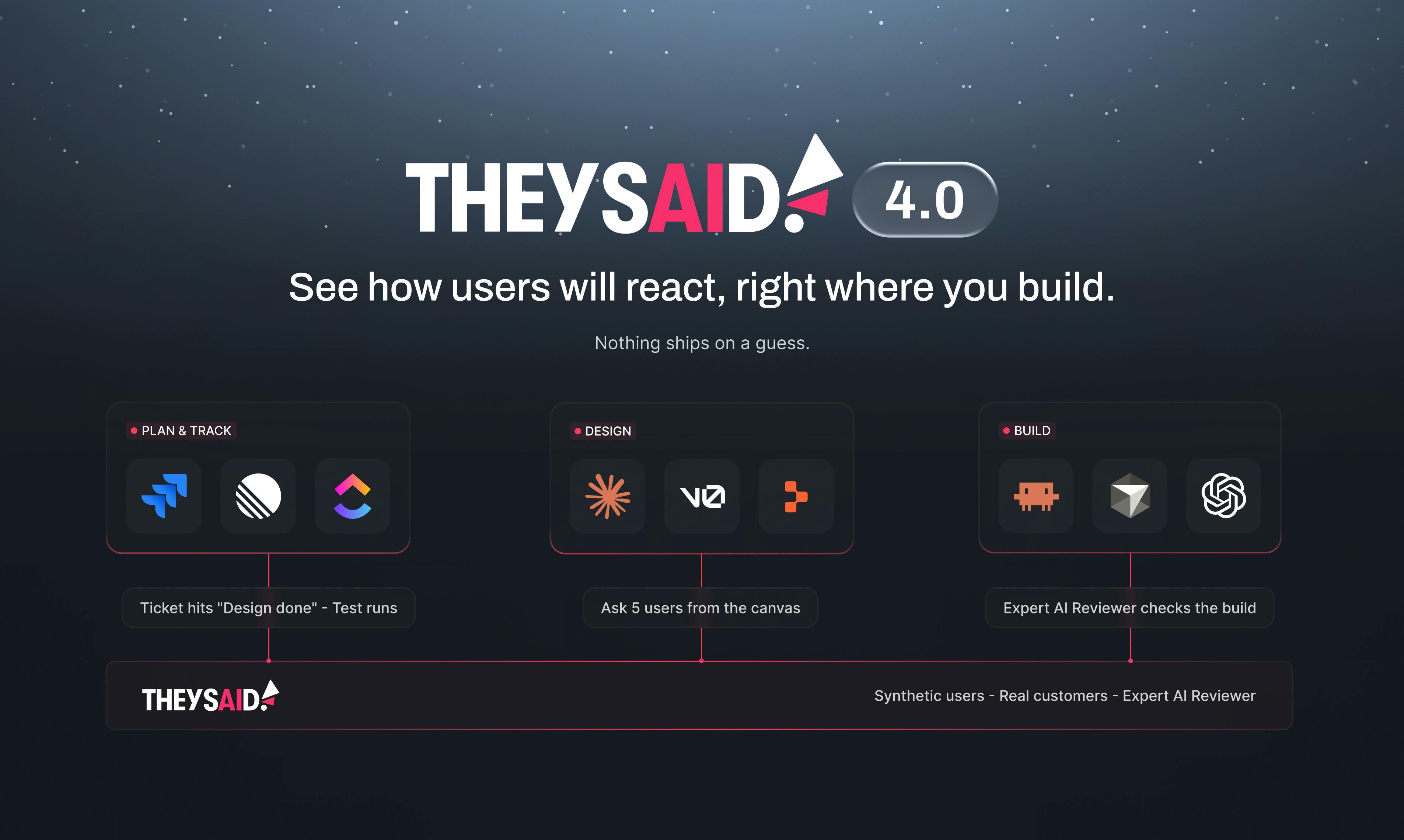
Ask Users Directly Inside Claude, Cursor, and Jira
The core selling point of TheySaid 4.0 is "See how users will react, right where you build." In other words: see how users will react, right inside the environment where you're building your product.
Specifically, you don't need to leave Claude, Cursor, or Jira to put what you're working on in front of real customers—or to test it with synthetic users trained on real customer data. If you need an answer fast, synthetic users can respond within minutes.
This solves a long-standing pain point in product development: validating ideas typically requires switching tools, organizing tests, and waiting for results—a lengthy process. TheySaid 4.0 compresses this step into the development environment itself, making the feedback loop extremely short.
The Claude, Cursor, and Jira mentioned here represent three categories of tools: Claude is Anthropic's large language model chat assistant, commonly used for writing, analysis, and code generation; Cursor is an AI-native code editor built on VS Code, where developers can collaborate directly with models to write and modify code; Jira is Atlassian's project and issue tracking platform, widely used for task management in agile development. Embedding user feedback capabilities into these three types of tools means covering the three stages of "thinking—coding—project management," bringing validation actions into requirement discussions, code implementation, and task workflows—without having to jump to a standalone user research platform. Such "embedded" integrations are typically implemented through plugins, extensions, or API connections.
Dual Track: Real Users and Synthetic Users in Parallel
TheySaid 4.0 offers two sources of feedback: real customers and synthetic users.
The value of real customer feedback is obvious, but it's costly and slow to obtain. Synthetic users are virtual users trained on real customer data that can react to your proposals within minutes. For scenarios requiring rapid iteration, synthetic users offer a middle ground—neither pure guesswork nor lengthy user testing.
The official tagline is "Nothing ships on a guess." This captures the product's positioning: making user validation a default step in the development process rather than an after-the-fact remedy.
Synthetic Users is an emerging concept at the intersection of user research and AI in recent years. It refers to virtual user profiles built using large language models or specially trained generative models, based on real user behavioral data, interview records, survey answers, and more. Unlike traditional "personas," synthetic users can dynamically respond to specific design proposals or feature descriptions rather than statically listing characteristics. Their advantages lie in speed, low cost, and the ability to run large-scale parallel tests; their limitations lie in the fact that their responses are essentially statistical extrapolations of training data, which may amplify biases in the data and struggle to capture the nuances of real users' emotions, context, and unexpected behaviors. Therefore, the industry generally positions them as a supplement to—not a replacement for—real user testing, suitable for early-stage direction screening and eliminating obvious problems, followed by real user validation for key decisions.
Product Background and Market Reception
TheySaid 4.0 received 160 upvotes and 32 comments on Product Hunt, ranking #1 for the day. It was categorized under User Experience, Artificial Intelligence, and UX Design.
Based on the makers list, the team includes Chris Hicken, Arnab K, Lihong Hicken, and Jaala Seifipour. The product's official website is accessible via the Product Hunt link.
The #1 ranking indicates clear market interest in the concept of "getting user feedback directly inside development tools." Especially against the backdrop of AI-assisted development tools (like Cursor and Claude) becoming increasingly popular, embedding user validation into these tools' workflows is a natural direction.
Product Hunt is a community platform for launching and discovering new products, where product teams can publish their work and community users express support through upvotes and comments. The daily ranking is calculated based on the number of votes and engagement received that day; "#1 of the day" means having the highest attention among new products launched that day. It's worth noting that Product Hunt vote counts typically range from dozens to hundreds—160 votes is a mid-to-upper performance range. It reflects early tech community interest but does not directly equate to market size or commercial success; it's more of a signal for product exposure and early user acquisition.
Potential Impact on Product Teams
TheySaid 4.0 represents a trend: user research is no longer just an isolated step for UX teams but is being broken down and embedded into every developer's daily tools.
For product managers and designers, this means getting feedback while writing PRDs or sketching prototypes, rather than waiting until development is complete to validate. For developers, it means confirming whether a feature meets user expectations while writing code in Cursor, reducing the risk of rework.
Of course, whether synthetic users can truly replace real user feedback remains a question that needs to be tested in practice. But TheySaid 4.0 at least offers a lighter-weight option, making "no guessing" possible.
Summary
TheySaid 4.0 moves the user feedback step forward into development tools, giving product teams answers during the building process through two paths: real users and synthetic users. Its #1 Product Hunt ranking reflects market demand for this type of "embedded user validation" tool. For product teams pursuing rapid iteration without shipping blindly, this is a direction worth watching.
Related articles

LLM Application Development: A High-Paying Career Guide for Ordinary People
LLM application development offers fresh graduates up to 35K/month, with SP offers reaching 600K. This article explains the core skills, how to break in, and how ordinary people can seize AI opportunities through learning by doing.

Say Goodbye to AI Influencer Faces: A Complete Guide to Creating Visual Assets for AI Comic Dramas from Scratch
Bilibili creator shares a full workflow for zero-basics AI comic drama visual assets: use Doubao Work skills with script-first, visual references, and real-person texture to escape AI influencer faces, then lock character and scene consistency with asset sheet layouts, weapon detail images, scene nine-grids, and cinematic color palettes.

The AI Production Pipeline Behind Great Videos: From Research to Agent Validation
AI video production isn't just a model race. This article breaks down a transferable four-step pipeline: researching professional workflows, organizing a skill checklist, configuring agents, and experimental validation—and explains how general-purpose LLMs like DeepSeek can replace paid tools to run the entire process.