Trump Bans Three Media Outlets from White House, Escalating Press Freedom Controversy

Trump turned his Truth Social threat into reality, banning reporters from CNN, MSNBC, and Politico from the White House.
President Trump swiftly acted on his Truth Social threats, banning reporters from CNN, MSNBC, and Politico from White House access that same morning. Widely seen as a significant escalation of executive power over press access, the move has reignited debate over press freedom. Critics warn that treating journalist access as a privilege subject to executive whim — rather than an institutionally protected right — directly undermines independent press oversight. Whether the ban triggers legal challenges and how industry associations and other outlets respond will be closely watched.
Overview
According to NPR, President Trump had previously threatened on his social media platform Truth Social to ban CNN, MSNBC, and Politico from the White House. Initially, many observers dismissed this as yet another emotional outburst on social media. However, the situation quickly materialized into reality — reporters from all three outlets were turned away from the White House that same morning.
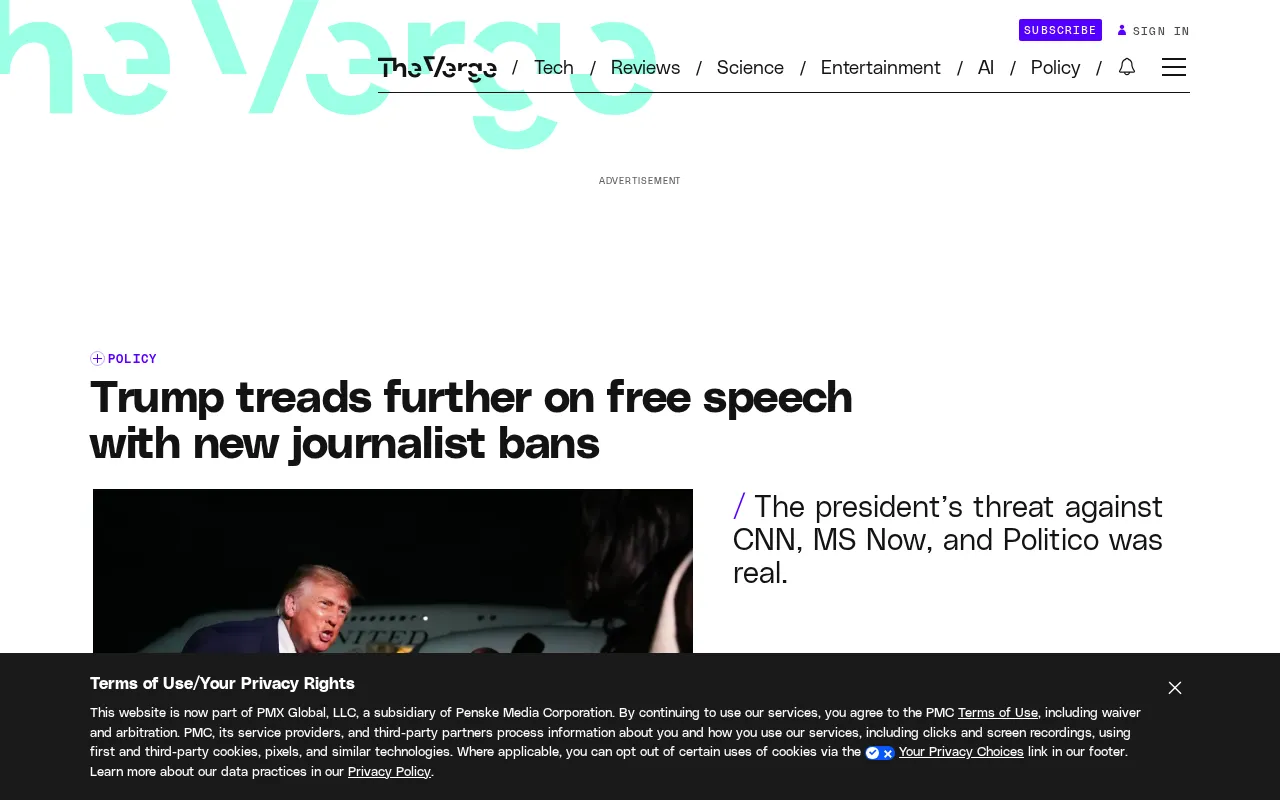
The move has been widely interpreted as a significant escalation in the White House's efforts to restrict press access, reigniting debates over the limits of presidential power and the boundaries of press freedom.
From Social Media Threat to Real-World Enforcement
What makes this incident particularly notable is that the ban didn't remain at the level of rhetoric. Initial reports noted that Trump's original post on Truth Social could easily have been written off as one of his characteristically impulsive statements, lacking any real enforcement mechanism. But NPR's reporting confirmed that journalists from CNN, MSNBC, and Politico were indeed denied entry to the White House that morning.
The rapid shift from threat to action fundamentally changed the nature of this incident. When an access restriction targeting specific media organizations is actually enforced, it is no longer merely an expression of the president's personal views — it becomes a direct exercise of executive power over the channels through which the press reports on government.
Truth Social is a social media platform Trump founded in 2022, following his permanent suspension from Twitter (now X) and Facebook in the wake of the January 6, 2021 Capitol riot. Positioned as a haven for "free speech," the platform's user base consists primarily of Trump supporters. Given its far smaller reach and influence compared to mainstream social media, Trump's posts on Truth Social have historically been viewed as emotional rallying calls to his base rather than formal policy announcements. The rapid translation of this threat into concrete action shatters the conventional assumption that his Truth Social statements are "merely rhetorical," prompting observers to reassess how seriously to take everything he posts on that platform.
The Press Freedom Debate
At the heart of this controversy is the question of whether the executive branch has the right to selectively restrict press access based on its preferences toward certain media organizations. The White House, as a primary venue for official government communications, has long been a place where journalist access is regarded as a key mechanism for safeguarding the public's right to information and holding government accountable.
Imposing a ban on CNN, MSNBC, and Politico — three outlets whose editorial coverage has frequently diverged from the administration's preferred narrative — has been condemned by critics as a further erosion of press freedom. When access to the White House becomes a privilege that executive power can arbitrarily grant or revoke, rather than a right protected by institutional norms, the independence of press oversight is directly threatened.
The White House Correspondents' Association (WHCA) is the primary organization that manages the relationship between the press and the White House, overseeing press credential issuance and seating arrangements at briefings. Historically, White House restrictions on press access have sparked multiple legal battles. In 2018, when CNN reporter Jim Acosta had his press credential revoked, a federal judge ruled that the move violated due process principles and ordered its restoration. This precedent demonstrates that the executive branch's removal of press access rights is not beyond judicial review, and that both the First Amendment and due process clauses can serve as grounds for legal challenge. The legal validity and litigability of this collective ban on three outlets will be a key focal point going forward.
Potential Implications
For the affected outlets, losing direct access to the White House means a concrete reduction in their ability to gather information, potentially affecting the depth and timeliness of their government coverage. At a broader level, if this kind of action sets a precedent, it could have lasting effects on the relationship between the entire news industry and the government.
Other media organizations, journalism associations, and free speech advocacy groups typically maintain close vigilance over incidents like this. Whether the ban will face legal challenges and whether more outlets will join in protest are developments worth watching closely in the days ahead.
Conclusion
This White House ban reflects the ongoing and intensifying tension between executive power and the press. When access restrictions targeting specific media organizations move from social media threats to operational reality, they strike at press freedom — a foundational pillar of democratic society. The subsequent developments, and the checks and responses that various parties mount, will serve as an important benchmark for measuring where the boundaries of press freedom truly lie.
(Note: This article is based on NPR's reporting, and some details are pending further verification.)
Related articles

RAG Interview Essentials: Breaking Down the Full Offline Indexing and Online Retrieval Pipeline
A complete breakdown of the RAG retrieval-augmented generation workflow: offline document loading, chunking, vectorization, and indexing; online query rewriting, vector retrieval, reranking, and generation, plus core interview points and system optimization directions.

AI Large Models for Absolute Beginners: Principles and API Calling in Practice
From AI's evolution to large model training principles and core concepts like Token, Temperature, and Top-P, this article explains system prompts, Function Call, RAG, and memory with hands-on examples and four API call scenarios—ideal for beginners.

Will GitHub Die? Open Source Maintainer Burnout and the Collaboration Crisis in the AI Era
Lex Fridman podcast discussion on open source maintainer burnout and GitHub's predicament: massive pull requests overwhelm core maintainers, and AI worsens code bloat. Using math journal peer review and Poincaré conjecture verification as analogies, the article analyzes why verification in knowledge production must be deliberately slow, and how open source communities can avoid the failure mode of maintainers exiting.