Understanding AI Usage Through Unix Permissions: The 0rwx Model
Borrowing Unix read-write-execute permissions, the 0rwx model simplifies understanding of AI capability boundaries and authorization layering.
The article introduces the 0rwx model discussed on Hacker News, which borrows read (r), write (w), and execute (x) from Unix file permissions to categorize AI usage into information input, content generation, and action triggering. Read maps to data access, write to generation and modification, and execute to tool calls and external actions. It helps non-technical users build intuition and informs layered permission design, but the analogy oversimplifies semantic understanding and composite operations and omits authorization duration and revocability, making it better as a communication tool than an engineering spec.
When AI Usage Meets Unix Permissions: A Simple Mental Model
A post titled "0rwx – A simple model of AI usage, inspired by Unix permissions" sparked discussion on Hacker News. It doesn't propose a new model architecture or training technique; instead, it borrows the classic rwx (read, write, execute) concept from Unix file permissions to re-examine how we interact with AI. The analogy is interesting because it compresses complex AI usage scenarios into three perceptible dimensions, helping developers, product managers, and ordinary users quickly judge what an AI feature actually does and where its boundaries lie.
Why rwx?
The Unix permission model uses three bits to represent the ability to operate on a file: read (r), write (w), and execute (x). This model has endured for decades because it is simple enough yet expressive enough to capture core intent. The author migrates the same idea to AI usage: an AI system's processing of information can also be summarized as reading input, generating or modifying content, and performing some action. This mapping is not a strict technical equivalence but a mental model—it gives a more intuitive answer to the question "what can AI do?"
The rwx in the Unix permission model corresponds to three basic operations: read, write, and execute, with origins dating back to the Unix operating system developed at AT&T Bell Labs in the 1970s. Each file or directory is associated with a set of permission bits, targeting the file owner, group, and other users respectively. Read permission allows viewing file content, write permission allows modifying files, and execute permission allows running a file as a program. This model has endured because it expresses the core logic of access control with minimal bits, becoming a design template for many subsequent permission systems. Migrating this concept to the AI field is essentially analogical thinking, using a familiar framework to lower the barrier to understanding.
Deconstructing 0rwx: Three Dimensions of AI Capability
Read (r): The Boundaries of AI's Information Input
In Unix, read permission determines whether a process can access file content. Mapped to AI usage, read permission represents the range of information the model can access: prompts provided by users, uploaded documents, retrieved knowledge base snippets, and external data obtained through tool calls. Understanding the boundaries of "read" means clarifying what AI can and cannot see. This directly relates to privacy and data security—a model that can only read the current conversation and one that can access an entire enterprise knowledge base have completely different risk levels.
Write (w): AI's Generation and Modification Capabilities
Write permission corresponds to AI's output capabilities: generating text, modifying code, creating images, updating database records. In Unix, write permission is often the one that requires the most caution when granting, because writing means state change. The same applies to AI scenarios—having a model generate a draft and having a model directly modify production code are two entirely different levels of authorization. The 0rwx model reminds us that when granting AI write capabilities, we should distinguish between "writable" and "read-only" scenarios, just as we configure file permissions.
Execute (x): AI's Action Triggers
Execute permission in Unix determines whether a file can run as a program. In the AI context, it corresponds to the model's ability to trigger external actions: calling APIs, executing code, operating toolchains, initiating transactions. This is the most sensitive link in the permission model, because execution means AI transforms from an "advisor" into an "actor." The current popularity of AI Agents is essentially about continuously expanding the scope of granted "x," and the value of the 0rwx model lies in reminding us that execute permission should be examined separately rather than conflated with read and write.
An AI Agent refers to an AI system capable of perceiving its environment, autonomously planning, and executing actions to achieve goals. Unlike traditional passive responsive models, Agents can call external tools, access APIs, execute code, or operate software, thereby translating language understanding into actual behavior. This capability expands AI's practicality but also introduces new risks: a single tool call may involve a composite of data reading, state modification, and external interaction, which is difficult to describe with simple permission labels. Current industry discussions on Agent security focus on mechanisms such as least privilege, action auditing, and human confirmation, and the "x" dimension in the 0rwx model precisely echoes these concerns.
What Practical Insights This Model Offers
Helping Non-Technical Users Build Intuition
For users unfamiliar with AI's internal mechanisms, rwx is a metaphor that has existed in the computing world for years. Three questions—"Can this AI read my files?" "Can it directly modify things?" "Will it execute operations on its own?"—can outline the capability profile of an AI feature. Building this intuition is much faster than reading technical documentation.
Providing a Permission Layering Approach for AI Product Design
At the product level, the 0rwx model suggests a layered authorization design direction: read, write, and execute should be independent permission switches rather than bundled into a single "enable AI" button. When granting AI access to calendars, emails, or code repositories, users should be able to separately control whether it can view, modify, or act on their behalf. This aligns with Unix permissions' fine-grained control philosophy.
Points of Disagreement in the Discussion
The discussion on Hacker News (the post received 15 points and 4 comments) also reflects some differing views. Some commenters argue that AI's "read" is far more complex than Unix file reading, because the model's understanding and memory of input are not transparent, and simple rwx labels may mask semantic-level risks. Others point out that execute permission in AI Agent scenarios is often composite—a single tool call may simultaneously involve reading and writing—making it difficult to express with a single bit. These disagreements indicate that 0rwx is better suited as a communication tool than a strict engineering specification.
Prompt injection is an attack technique targeting AI systems, where attackers embed malicious instructions in input to induce the model to deviate from its original task or leak sensitive information. Such risks cannot be captured by traditional read-write-execute permission labels because they involve semantic-level manipulation rather than simple data access. Context leakage refers to the model inadvertently exposing private content from training data or conversation history when generating responses. The existence of these issues shows that AI's "read" permission boundaries are far more complex than Unix file reading; the opacity of the model's understanding and memory mechanisms makes it difficult for bit-based permission models to fully cover semantic-level security considerations.
Limitations and Applicable Boundaries
The value of this model lies in simplification, and simplification also means trade-offs. Unix permissions act on clearly defined file objects, whereas AI's input-output boundaries are often fuzzy—issues such as prompt injection, context leakage, and model hallucination cannot be fully covered by three bits. Additionally, 0rwx does not address "authorization duration" and "revocability," two dimensions that are equally important in AI scenarios. It is appropriate as a quick reference or discussion starter, but should not replace specific security assessments and permission design.
Conclusion
The most interesting thing about the 0rwx model is not how much it proposes that is new, but that it chooses a framework everyone is familiar with to organize the discussion. At a time when AI capability boundaries are increasingly blurred, asking questions from the perspective of Unix permissions—what can AI read, what can it write, what can it execute—is itself a valuable way of thinking.
One-line Summary
Borrowing Unix read-write-execute permissions, the 0rwx model simplifies understanding of AI capability boundaries and authorization layering.
Paragraph Summary
The article introduces the 0rwx model discussed on Hacker News, which borrows the read (r), write (w), and execute (x) concepts from Unix file permissions to categorize AI usage into three dimensions: information input, content generation, and action triggering. Read permission corresponds to the range of data AI can access, write permission to generation and modification capabilities, and execute permission to tool calls and external actions. The model helps non-technical users build intuition and offers ideas for layered permission design in products. However, the discussion also points out that the analogy oversimplifies in scenarios involving semantic understanding and composite operations, and does not cover dimensions such as authorization duration and revocability, making it better suited as a communication tool than an engineering specification.
Related articles
AI Penetration Testing Agents in Practice: From Skill Configuration to Fully Automated Vulnerability Discovery
Starting from the six core capabilities of agents, this article breaks down how to build an AI penetration testing agent: why chat tools can't find vulnerabilities, how Skill configuration encapsulates pentesting skills, and how SRC automated vulnerability discovery impacts the way security engineers work.
Scientific Evidence vs. Regulatory Rol…
Scientific Evidence vs. Regulatory Rollback: Europe's Chemical Rules Debate
A Le Monde opinion piece argues that science increasingly links chemical exposure to "lifestyle diseases" while Europe weakens regulation. This article examines the evidence, policy drivers, and HN debate.
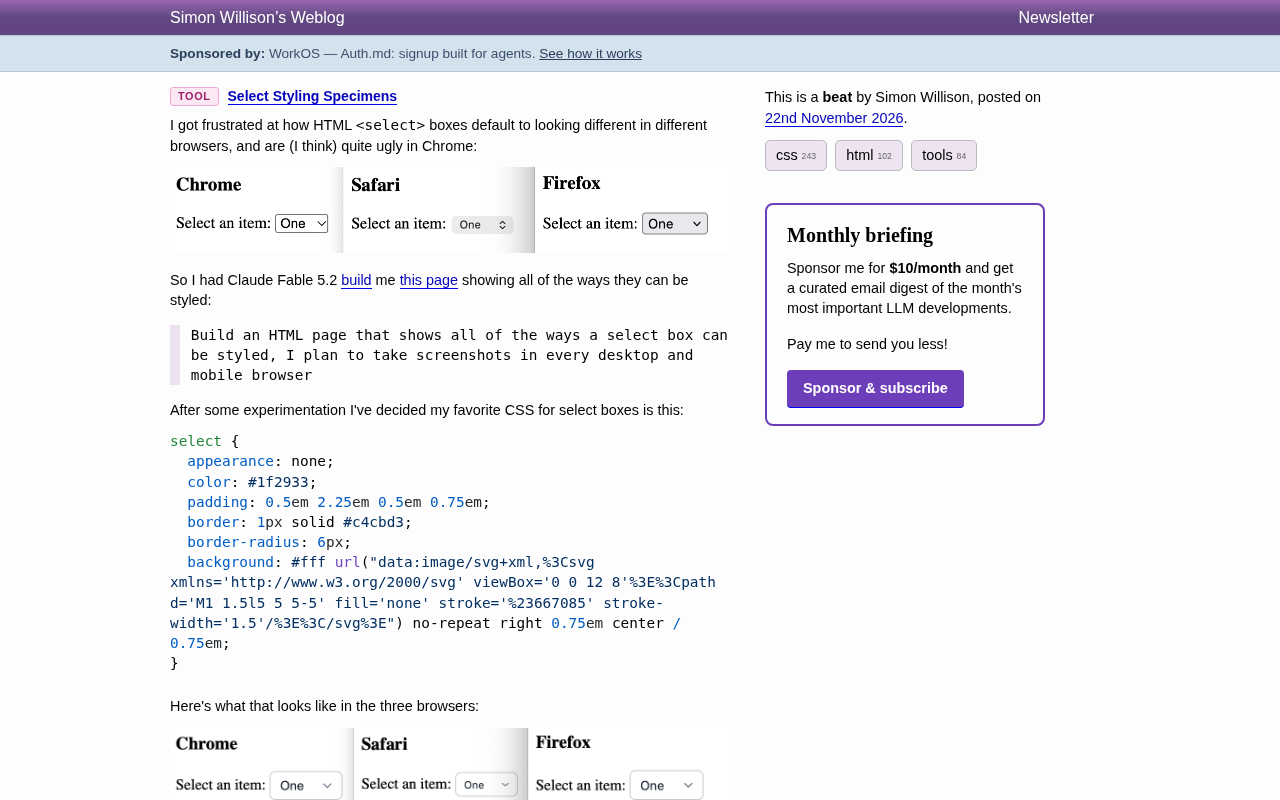
Cross-Browser Unified Select Styling: A CSS Approach and AI-Assisted Practice
Simon Willison shares using Claude to generate a select styling test page, plus a cross-browser CSS approach: appearance:none with an inline SVG arrow to fix Chrome, Safari, Firefox differences.