Unsloth Dynamic Quantization 3.1 Tested: 15% Accuracy Boost, 117 tok/s on M5 Max

Unsloth dynamic quantization 3.1 tested: 15% accuracy gain at the same compression rate, with MTP delivering 1.3 to 1.7x speedup.
Based on hands-on testing by a Bilibili creator on Apple M5 Max with the Strata inference engine, this article evaluates Unsloth dynamic quantization 3.1. It compares the 4-bit Unsloth UDQ4-KXL model (~111GB) with the 3-bit GSQ-RCO model (<70GB). Results show Unsloth averages 70-80 tok/s with peaks of 117 tok/s, close to the 3-bit GGUF version; in a .NET 8 to .NET 10 code migration task, Unsloth used only 3 minutes, 69 tool calls, and about 86K tokens, far fewer than the baseline's 82 calls and 1.3M tokens; SVG image generation quality was clearly better than 3-bit and slightly better than 5-bit while being faster. Strata supports offloading weights from RAM to SSD, enabling large models on 64GB devices, and with MTP support, local deployment quality, speed, and resource efficiency all improve together.
A New Breakthrough in Quantization: Unsloth Dynamic Quantization 3.1
In the field of local large language models, quantization has always been a key means of balancing model quality and hardware overhead. Recently, Unsloth released version 3.1 of dynamic quantization for the QN3.8 Flash Next model, claiming a 15% accuracy improvement while maintaining the same compression rate as other leading quantizers, and achieving top scores on benchmarks such as Terminal Bench, DEEP, and SWE. According to a hands-on video by a Bilibili creator, this version also adds support for MTP (Multi-Token Prediction), boosting output speed by 1.3 to 1.7 times in Unsloth's own environment.
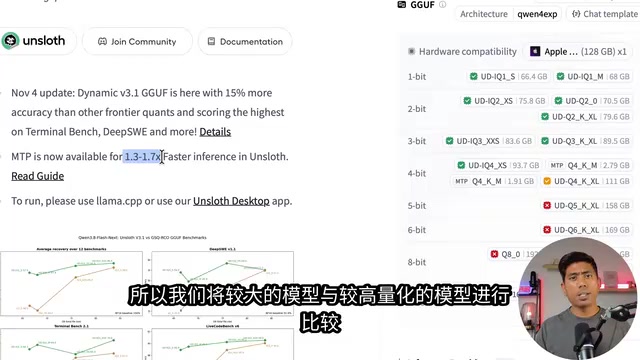
The creator compared two quantization schemes in the video: a 3-bit quantized GSQ-RCO model (taking up less than 70GB) and a 4-bit quantized Unsloth UDQ4-KXL model (taking up about 111GB). Although the quantization bit widths differ, the creator wanted to verify whether Unsloth's new model delivers better quality while maintaining the acceleration effect.
Quantization is a compression technique that maps neural network weights and activations from high-precision floating point (such as FP16/BF16) to lower-precision representations (such as 3-bit or 4-bit integers). Its core goal is to reduce VRAM usage and memory bandwidth requirements by several times while preserving model output quality as much as possible. Traditional quantization is mostly static: calibration data is first used to measure the distribution of activations in each layer, then scale factors and zero-points are determined once and for all. Dynamic quantization, by contrast, computes quantization parameters dynamically at inference time based on the actual input, or applies mixed bit widths across different layers/tensors—keeping higher precision for sensitive layers and compressing redundant layers more aggressively. This is the technical basis for Unsloth's claim of "15% accuracy improvement at the same compression rate": the total bit budget is unchanged, but it is allocated more intelligently. It is important to distinguish that quantization bit width does not directly equal file size; factors such as group size and whether high precision is retained for embedding layers and output heads also matter. Therefore, the difference between the 3-bit model at 70GB and the 4-bit model at 111GB mentioned in the article is reasonable.
MTP (Multi-Token Prediction) was originally a training objective: having the model predict tokens at multiple future positions simultaneously in a single forward pass, rather than only the next token, thereby forcing the model to learn longer-range dependencies. At inference time, the MTP head can be adapted into a speculative decoding-style acceleration method—the main model proposes multiple candidate tokens at once, and a verification step confirms in parallel which ones are accepted. When the acceptance rate is high, this is equivalent to producing multiple tokens per step. This is the source of the "1.3 to 1.7 times output speed improvement" mentioned in the article: it does not increase the computation speed of a single forward pass, but rather increases the "effective output" per forward pass. The acceleration from MTP depends heavily on the predictability of the task itself; high-regularity tasks such as code completion and formatted output typically have higher acceptance rates than open-ended creative writing, which also explains the variation in speedup ratios across tasks in the tests.
Test Environment and Benchmarks
The test was conducted on an Apple M5 Max using the latest version of the Strata inference engine. The creator first had the model inspect code in a repository to verify its practical understanding capability. During execution, monitoring showed a generation rate of roughly 107 to 117 tokens per second, depending on how it was launched. On average, the model reached 70 to 80 tokens per second, which the creator rated as "quite good." For comparison, the 3-bit GGUF version runs at about 110 tokens per second, but the quality trade-off needs to be considered.
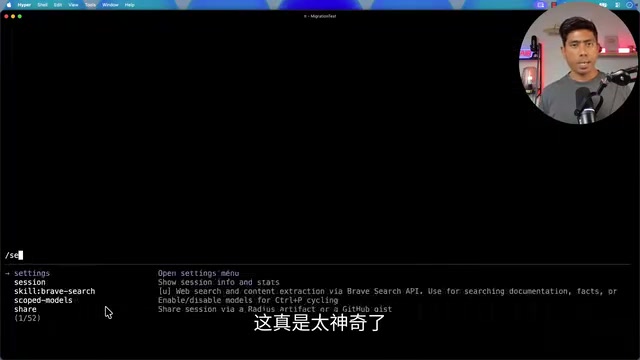
In just 26 seconds, the model returned results, correctly identifying the repository contents and making about 20 tool calls, with a total of about 138 tokens for input and output. This demonstrates the model's efficiency on code understanding tasks.
GGUF, which appears repeatedly in the article, is the model file format promoted by the llama.cpp ecosystem. It packages weights, tokenizer vocabulary, and quantization metadata into a single file, and optimizes memory layout for the CPU/Apple Silicon Metal backend, making it one of the most common distribution formats for local inference. GGUF quantization naming follows the K-quant system; for example, the "4" in Q4_K_M means the main weights are about 4 bits, "K" means a block-based k-quant scheme is used, and "M" represents a medium mixed-precision tier. It should be noted that GGUF quantization and Unsloth dynamic quantization are solutions at different levels: the former emphasizes generality and cross-platform compatibility, while the latter emphasizes precision allocation under a specific inference engine. Therefore, the comparison in the article between "3-bit GGUF at about 110 tok/s" and the Unsloth model is not strictly under identical conditions. Readers should separate format differences, engine differences, and bit-width differences when interpreting the speed numbers, and avoid attributing all acceleration to the quantization algorithm itself.
Code Migration in Practice: .NET 8 to .NET 10
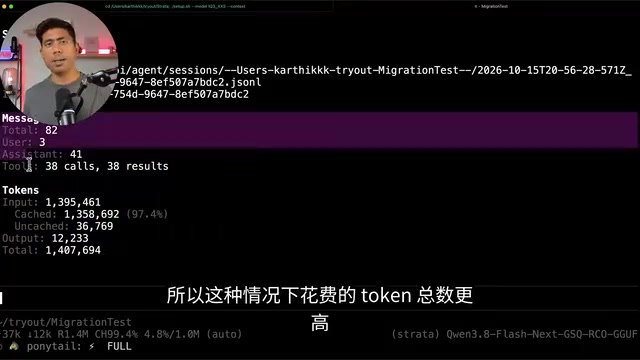
A more complex test involved migrating a product API project from .NET 8 to .NET 10, fixing all breaking changes and updating NuGet packages. The creator used the same prompt to run the 4-bit quantized Unsloth model and the 3-bit quantized GSQ-RCO model separately.
The Unsloth model completed the entire migration in just three minutes, at an overall speed of about 73 tokens per second, with 69 tool calls and about 86,000 tokens consumed (including input and output). The GSQ-RCO model took 2 minutes 51 seconds, consumed 82 tool calls, and used 1.3 million input/output tokens. The creator noted that the execution time difference between the two was very small, at most about 5 seconds, but the Unsloth model used significantly fewer tokens.
This result echoes Unsloth's claimed 15% accuracy improvement—fewer tool calls and lower token consumption mean the model understood the task more precisely and made fewer ineffective attempts.
Image Generation Quality Comparison
For a creative task, the creator asked the model to generate an SVG image of "two dodos riding bicycles in New York." Unsloth's 4-bit quantized model took about 6 minutes 40 seconds and produced a fairly good-quality image. The 3-bit quantized GSQ-RCO version took only 3 to 4 minutes, but the image quality was noticeably worse.
When compared with GSQ-RCO's 5-bit quantization, the creator found that the image quality generated under the Strata output engine was "slightly better," but generation took about 8 to 9 minutes. This shows that Unsloth's dynamic quantization achieves a better balance between quality and speed, especially at 4-bit quantization, where quality is sufficient for practical needs.

Strata Engine and the Future of Edge Computing
The Strata inference engine supports Unsloth dynamic quantization V3.1 and reduces virtual memory overhead when running on Apple M5 Max by moving weights from RAM to SSD. The creator mentioned that this makes it possible to run similar models on small machines with only 64GB of memory. Combined with the speed improvement from MTP support, overall rendering speed is significantly faster.
The creator concluded that Unsloth provides better model compression and optimization for consumer-grade hardware while improving output quality by 15%, and the newly added MTP makes output speed 1.7 times faster than the previous version. These improvements make local large language models work better, and the creator believes this is the future direction of edge computing.
Moving weights from RAM to SSD is essentially implemented using the operating system's memory mapping (mmap) mechanism for on-demand paging: the model file remains on the solid-state drive, and during inference only the weight pages needed for the current layer or current expert are loaded into memory, then reclaimed by the page cache after use. The cost is I/O latency on first load, and speed can drop noticeably when memory is severely insufficient and frequent page swapping (thrashing) occurs. The benefit is that the threshold for "whether it can run" is lowered from "memory ≥ model size" to "memory ≥ single-layer/single-expert working set." This is exactly the principle that allows a machine with 64GB of memory to run hundred-gigabyte-scale models. With a MoE (Mixture of Experts) architecture, only some experts are activated in each forward pass, further shrinking the working set and keeping SSD paging pressure manageable. For edge devices, the practical significance of this path is that compute is no longer the only bottleneck; storage bandwidth and random read performance are becoming new key metrics.
Summary and Outlook
This hands-on test demonstrates the combined advantages of Unsloth dynamic quantization 3.1 in accuracy, speed, and resource efficiency. Although the quantization bit widths differ, the 4-bit Unsloth model showed lower token consumption and comparable speed on code tasks, and clearly better quality than 3-bit quantization in image generation. With the Strata engine's support for dynamic quantization and the introduction of MTP, deploying large models on consumer-grade hardware is becoming more feasible. The creator also revealed that more impressive models will be released this month and next month, and developments in the local large language model field deserve continued attention.
Related articles
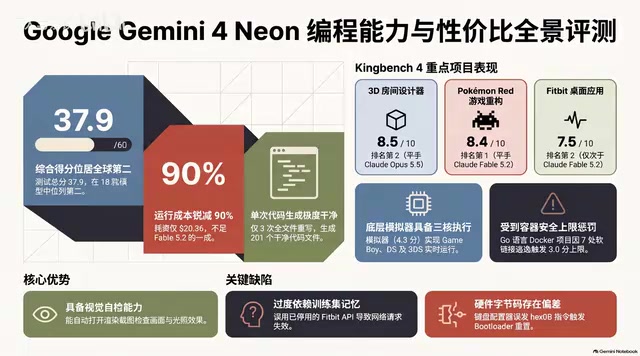
Gemini 4 Neon Hands-On: Value King or Confident Catastrophe?
Gemini 4 Neon review: 1M-token context, four thinking levels, 201 files in one KingBench4 pass at one-tenth Fable 5.2's cost—but it hallucinates fake data, leaves 7 symlink escapes, and bricks keyboards.

Google Gemini 4 Neon Hands-On: 6 3D Works That Impress and Fail
Hands-on with Google Gemini 4 Neon on a 3060 laptop: 6 3D works tested. Sunshower Fishing Harbor and mechanical keyboard impress; soft-body physics and faces fall short.

Gemini 4 Neo Web Novel Writing Test: Faint AI Flavor, Textured Dialogue
Bilibili creator's first-look review of Gemini 4 Neo for Chinese web novel writing: testing a Three Kingdoms transmigration opening with faint AI flavor, emotionally textured dialogue, and strong crisis building, plus comparison of 4A/4H/4C models and full workflow demos.