US Media and Arts Industries Shed 200,000 Jobs: Is AI to Blame?

US creative industries lost 200,000 jobs; AI is an accelerant but not the only variable, and causal attribution requires unpacking the data.
The US media, film and television, and arts industries recently lost about 200,000 jobs, fueling debate over whether AI is responsible. The article notes that this figure blends very different roles—traditional media, film production, and broader arts creation—each affected by AI through different mechanisms, and that attributing it wholesale to AI without sub-industry breakdowns is an oversimplification. AI impacts creative employment mainly through task substitution, efficiency compression, and lower barriers to entry, but lagged and inconsistent data and the frequent simultaneity of AI adoption and layoffs make causal proof difficult. Demand-side shifts, such as declining trust in AI content, may also drive contraction. For workers, the pragmatic move is to identify tool-absorbable tasks and pivot toward hard-to-replace skills.
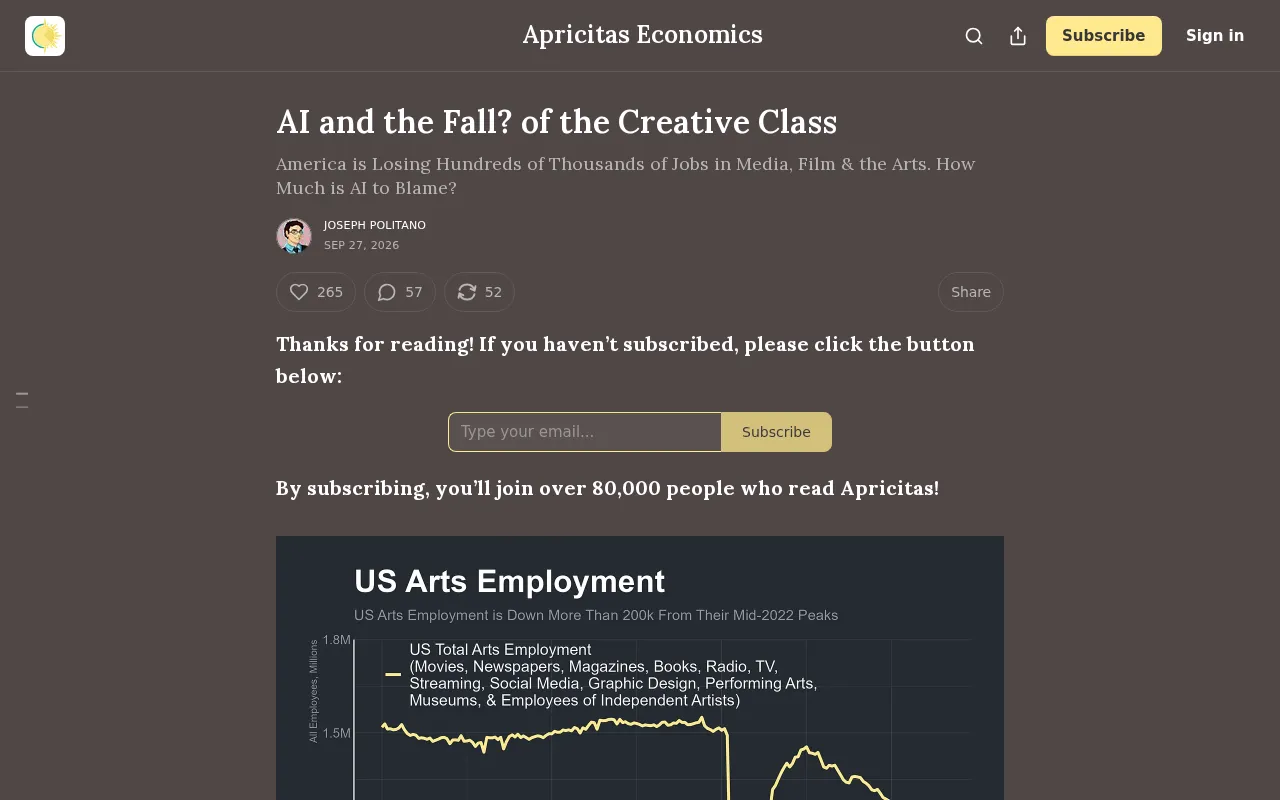
The US media, film and television, and arts industries have recently lost approximately 200,000 jobs. This figure sparked discussion on Hacker News under a headline that cuts straight to a sensitive question: how many of these job losses should be attributed to AI? The original discussion provided only this core data point, without breaking down industry distribution, time span, or attribution analysis. This article therefore takes the question itself as a starting point, outlines the possible pathways through which AI affects employment in the creative industries, and highlights the complexities that are easily overlooked in this debate.
200,000 Jobs Lost: A Figure That Needs Unpacking
"The US media, film and television, and arts industries lost 200,000 jobs" is a highly aggregated statement. It blends at least three very different categories of roles: traditional media editors and journalists, film and television production and post-production staff, and arts creators and support roles in the broadest sense. The mechanisms through which AI affects these three categories are not the same—automated writing tools on the content production side affect text output efficiency, generative image and video tools affect the barriers to producing visual assets, and post-production tasks such as visual effects, dubbing, and subtitling were penetrated by specialized tools even earlier.
Without data broken down by sub-industry, attributing the entire 200,000 figure to AI is itself an oversimplification. Job changes are simultaneously shaped by advertising market cycles, contractions in content spending by streaming platforms, and the decline of traditional media subscription models. AI is more likely an accelerant than the sole variable.
Aggregated employment data typically comes from combining multiple statistical sources—for example, industry employment surveys from the US Bureau of Labor Statistics, self-reported data from industry associations, and compilations of corporate layoff announcements. These sources differ significantly in industry classification boundaries, statistical time windows, and whether freelancers are included, and simply adding them together amplifies error. In addition, a large share of workers in media and film and television are employed on a project or contract basis, and such roles are often not fully covered by traditional employment statistics, making their loss harder to capture in a timely manner. Therefore, when discussing a figure of this magnitude, the first questions to ask are about data sources, coverage, and statistical timing—otherwise the comparability of the number itself is questionable.
Three Pathways Through Which AI Impacts Creative Jobs
From the perspective of technology adoption, AI's impact on employment in the creative industries occurs mainly through three pathways.
The first is task substitution. Generative models can already handle relatively repetitive tasks such as drafting copy, generating accompanying images, basic editing, and transcription. As these tasks are absorbed by tools, the workload originally handled by junior roles shrinks, and demand for entry-level labor is hit first.
The second is efficiency compression. When fewer people are needed for the same output, teams may shrink without layoffs, manifesting as hiring freezes and unfilled positions. This "hidden attrition" is often less visible in statistics than direct layoffs, but it steadily erodes total industry employment.
The third is intensified competition driven by lower barriers to entry. When non-professionals can also produce usable content with the help of AI, professional creators face stronger supply-side competition, unit prices are pushed down, and some practitioners are forced out.
Task substitution and job substitution are not the same thing. In labor economics, a job typically consists of multiple tasks, and AI often replaces the standardized portions first rather than the entire role. This means companies may keep positions but change their composition of responsibilities—for example, a junior editor shifting from drafting copy to fact-checking and prompt tuning. In employment statistics, this task reorganization shows up as unchanged job titles with migrated actual work content, which may both reduce hiring demand for entry-level positions and give rise to new hybrid roles. Understanding this distinction helps avoid equating task-level automation directly with job-level disappearance.
Why "AI Causes Unemployment" Is Hard to Prove Precisely
The heated discussion on Hacker News shows that the public has a strong intuition about this, but causal argumentation is not easy. Employment data in the creative industries is typically lagged and inconsistent in methodology, and AI adoption and job cuts often occur simultaneously rather than sequentially—companies may first shrink teams due to budget pressure and then fill the gaps with AI tools, in which case attributing layoffs to AI would overstate its role. Conversely, there may also be cases where companies improve efficiency with AI, see profits improve, and actually expand new positions—except that such effects are offset in aggregate data.
Another underestimated factor is change on the demand side. If a flood of AI-generated content leads to declining audience trust in content quality and weaker willingness to pay, the industry as a whole contracts, and in that case the root cause of job losses lies in the market rather than in technology substitution alone.
Causal identification is a classic challenge in research on technology adoption and employment change. Ideally, one would find an exogenous shock that affects only AI adoption and not employment directly as an instrumental variable, but in reality it is very hard to satisfy the exclusion restriction. Another approach is difference-in-differences, comparing employment changes in sub-industries or job levels with different degrees of AI penetration before and after a policy or tool release, but this requires a clear adoption threshold and comparability between treatment and control groups. AI penetration in the creative industries tends to be gradual and parallel across tools, and the lack of such clear breakpoints means econometric attribution can only establish correlation rather than causal strength.
What This Means in Practice for Workers
Regardless of how much of the 200,000 figure is attributable to AI, it is a confirmable trend that the structure of work in the creative industries is changing. For practitioners, a more pragmatic response is not to argue over attribution ratios but to identify which parts of the workflow are being absorbed by tools and which judgment and aesthetic capabilities remain hard to replace, and to shift the focus of their work toward the latter. For industry observers, what is needed is long-term data broken down by sub-industry and job level, not an attribution debate over a single aggregate number.
The greatest value of the original discussion may be precisely that it puts this question on the table: at a stage when AI is penetrating creative production, whether the granularity of employment data can keep up with the pace of change is itself a question worth watching.
One-line Summary
US creative industries lost 200,000 jobs; AI is an accelerant but not the only variable, and causal attribution requires unpacking the data.
Paragraph Summary
The US media, film and television, and arts industries have recently lost approximately 200,000 jobs, sparking debate over whether AI should be held responsible. The article points out that this figure mixes very different roles across traditional media, film and television production, and arts creation in the broad sense, each affected by AI through different mechanisms, and that attributing it wholesale to AI without sub-industry breakdowns is an oversimplification. AI affects creative employment mainly through task substitution, efficiency compression, and lower barriers to entry, but lagged and inconsistent employment data, along with the frequent simultaneity of AI adoption and layoffs, make causal argumentation difficult. Demand-side changes, such as declining audience trust in AI content, may also be an important variable in industry contraction. For practitioners, the more pragmatic approach is to identify the parts of the workflow that can be absorbed by tools and shift toward capabilities that are hard to replace.
Related articles

LLM Application Development: A High-Paying Career Guide for Ordinary People
LLM application development offers fresh graduates up to 35K/month, with SP offers reaching 600K. This article explains the core skills, how to break in, and how ordinary people can seize AI opportunities through learning by doing.

Say Goodbye to AI Influencer Faces: A Complete Guide to Creating Visual Assets for AI Comic Dramas from Scratch
Bilibili creator shares a full workflow for zero-basics AI comic drama visual assets: use Doubao Work skills with script-first, visual references, and real-person texture to escape AI influencer faces, then lock character and scene consistency with asset sheet layouts, weapon detail images, scene nine-grids, and cinematic color palettes.

The AI Production Pipeline Behind Great Videos: From Research to Agent Validation
AI video production isn't just a model race. This article breaks down a transferable four-step pipeline: researching professional workflows, organizing a skill checklist, configuring agents, and experimental validation—and explains how general-purpose LLMs like DeepSeek can replace paid tools to run the entire process.