UTA Learning Rate Decay: Closed-Loop Adaptation Breaks Through Training Bottlenecks

UTA reframes learning rate decay as a closed-loop shape-and-scale problem, works with Adam, and improves multiple models.
The article introduces Universal Training-Adaptive learning rate decay (UTA), which reframes LRD as closed-loop control. Unlike UBA, it adapts to the training state, works with Adam-type optimizers, and is plug-and-play with negligible overhead. It is robust to key hyperparameters and improves LLaMA (60M–1B), ResNet50, and ViT-B.
Learning rate decay (LRD) is key to training high-performance models, but most designs remain empirically driven. The recently proposed Universal Budget-Aware (UBA) LRD provides a theoretical framework, yet it is difficult to adapt to modern Adam-type optimizers due to its reliance on SGD dynamics, and its core "optimization difficulty parameter" has an ambiguous meaning. To address this, researchers propose Universal Training-Adaptive (UTA) LRD, which treats LRD as a closed-loop shape-and-scale problem. Through a continuous-time formulation, it achieves training-state adaptation and segment-wise optimal shapes, delivering consistent improvements on both language and vision models.
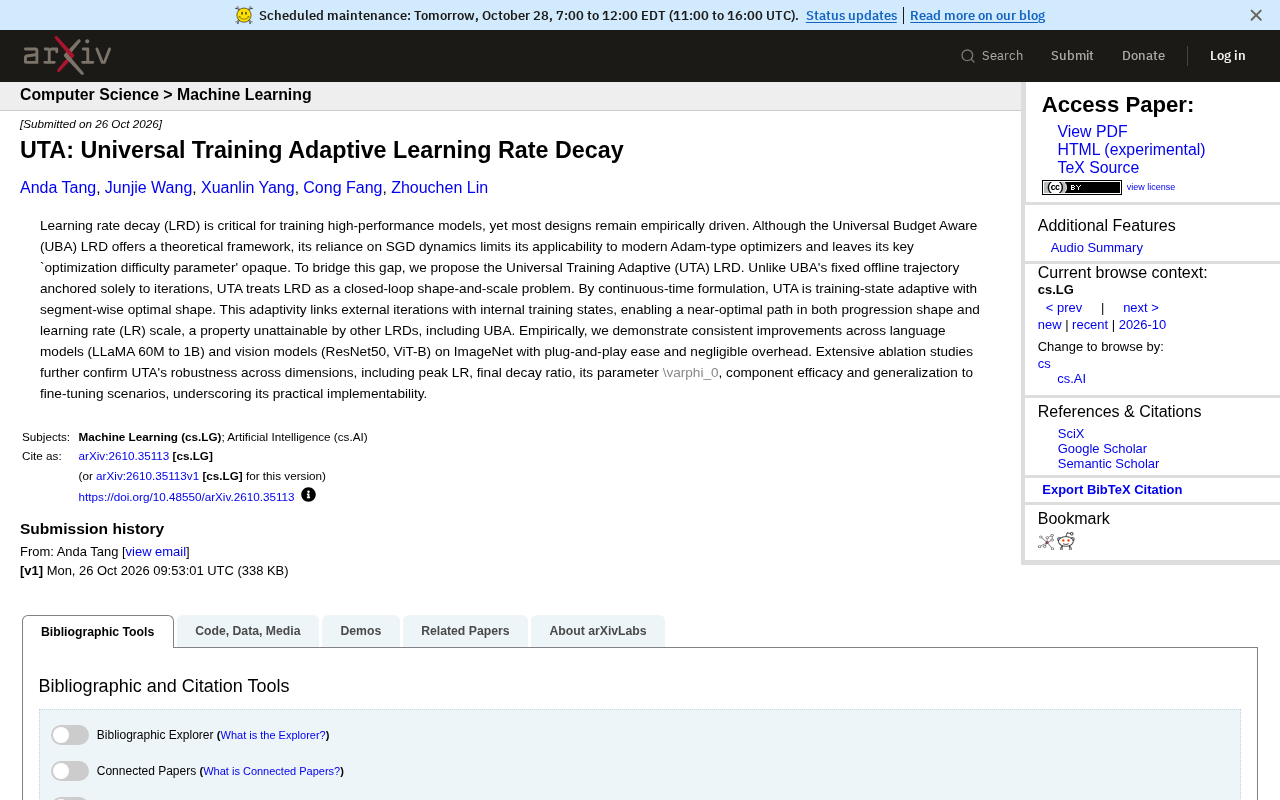
UTA's Core Mechanism: From Open Loop to Closed Loop
The essential difference between UTA and UBA lies in whether they couple with the training state. UBA relies on a fixed offline trajectory and anchors only on the iteration count, so it cannot dynamically adjust based on the model's internal state. UTA reframes LRD as a closed-loop control problem: through continuous-time modeling, the learning rate curve can adaptively select the optimal shape on each segment based on the current training state. This mechanism links external iterations with the internal training state (such as gradient statistics), enabling the learning rate to approach the optimal path in both progress shape and scale.
Another advantage of UTA is its theoretical generality. It does not depend on SGD's specific dynamics, so it can be seamlessly integrated into modern optimizers like Adam, and it is plug-and-play with negligible extra overhead. The paper validates UTA's robustness to peak learning rate, final decay ratio, the parameter φ₀, and fine-tuning scenarios through extensive ablation experiments.
Universal Budget-Aware (UBA) learning rate decay: UBA is a previously proposed framework for learning rate decay design. Its core idea is that, given a total training budget (i.e., total iteration steps), an "optimal" learning rate curve is computed offline and driven by the iteration count as the sole anchor. Since the entire curve is determined before training begins, UBA is essentially open-loop control: regardless of the model's actual state during training, the learning rate follows a preset trajectory. The framework's derivation is built on the continuous-time dynamics of stochastic gradient descent (SGD), so its optimality conclusions hold for SGD but are difficult to transfer directly to optimizers like Adam that have adaptive second-moment estimates. In addition, UBA introduces an "optimization difficulty parameter" to characterize the properties of the loss surface, but this parameter lacks intuitive physical meaning and is difficult to estimate directly from training data, which limits its practical usability.
Closed-loop control and the shape-scale decomposition of the learning rate: Closed-loop control is a concept from control theory, referring to a system that adjusts the control variable based on real-time output feedback from the controlled object, rather than merely executing a preset program. Treating learning rate scheduling as a closed-loop problem means the learning rate is no longer determined solely by the current iteration step, but also depends on internal states during training (such as gradient statistics and loss changes). UTA further decomposes the learning rate curve into two dimensions: "shape" and "scale." Shape describes the relative pattern of change in the learning rate as training progresses (e.g., the overall profile of rising then falling), while scale describes the overall magnitude level. By solving for the optimal shape segment by segment under a continuous-time framework and calibrating the scale according to the current state, UTA can approach the theoretically optimal path at different training stages. The benefit of continuous-time modeling is that it approximates discrete iterative updates as differential equations, allowing analytical characterization of the optimal learning rate using variational or optimal control methods without relying on the update rules of a specific discrete optimizer.
Experimental Validation: Consistent Improvements Across Models
For language models, UTA achieves consistent improvements on the LLaMA architecture (from 60M to 1B parameters); for vision tasks, ResNet50 and ViT-B also show improved performance on ImageNet. These results span different scales and modalities, indicating that UTA's gains are not incidental.
Interestingly, UTA's plug-and-play nature makes it easy to deploy in practical training pipelines while adding almost no computational burden. Ablation studies further confirm that UTA is insensitive to key hyperparameters, which reduces tuning costs and enhances practical value.
Adam-type optimizers and the LLaMA architecture: Adam and its variants (such as AdamW) are currently the mainstream optimizers for training large models. By maintaining first- and second-moment estimates of gradients, they adaptively scale update steps for each parameter. This per-parameter adaptivity is fundamentally different from SGD's globally uniform learning rate, and it is also why scheduling methods based on SGD dynamics, such as UBA, are difficult to apply directly. UTA does not depend on the specific update form of the optimizer, so it can be used with Adam-type optimizers. LLaMA is a family of open-source large language models released by Meta, adopting a Transformer decoder architecture with components such as rotary position embeddings, SwiGLU activation, and RMSNorm. The paper validates UTA on LLaMA-scale models from 60M to 1B parameters, covering pretraining scenarios from smaller to medium scale; this parameter range helps determine whether the method's gains stably exist as model scale varies.
Industry Implications: Learning Rate Scheduling Enters the Adaptive Era
The proposal of UTA marks a shift in learning rate scheduling from empirical rules to adaptive control. Traditional methods such as cosine annealing and step decay are widely used but often require manual tuning for specific tasks. Through a closed-loop feedback mechanism, UTA allows the learning rate curve to adjust dynamically with the training state, promising to reduce manual intervention and improve training efficiency.
For practitioners, UTA's plug-and-play nature means they can try it at low cost and potentially obtain performance gains. Especially in large-scale pretraining and fine-tuning scenarios, small improvements in learning rate scheduling may lead to significant differences in final results. UTA's generality also makes it applicable to a variety of optimizers and model architectures, giving it strong generalization potential.
Although UTA still requires choosing the parameter φ₀, experiments show that it is robust, which reduces the burden of practical deployment. In the future, as adaptive learning rate methods mature, we may see more theoretically driven and easy-to-deploy training strategies.
Cosine annealing and step decay: Cosine annealing is a widely used learning rate scheduling strategy in which the learning rate smoothly decreases from a peak to near zero according to a cosine function. Its advantages are a continuous curve and gentle decay in later stages, which help the model converge to a flatter minimum. Step decay lowers the learning rate by a fixed ratio (e.g., multiplying by 0.1) at preset iteration milestones; it is simple to implement and predictable in behavior, and is common in early convolutional network training. Both methods are open-loop, empirically driven scheduling: the curve shape and decay timing must be set manually, and once determined they do not change with the training state. Their performance is relatively sensitive to hyperparameters such as peak learning rate and decay milestones, often requiring repeated tuning for different tasks and model scales. The closed-loop adaptive approach represented by UTA attempts to replace such manual rules with training-state feedback, thereby reducing reliance on empirical tuning.
One-line Summary
UTA reframes learning rate decay as a closed-loop shape-and-scale problem, is compatible with Adam, and delivers consistent improvements across multiple models.
Paragraph Summary
The article introduces the Universal Training-Adaptive learning rate decay (UTA) method. To address the problems of the existing Universal Budget-Aware (UBA) method—reliance on SGD dynamics, difficulty adapting to Adam-type optimizers, and ambiguous core parameters—UTA reframes learning rate decay as a closed-loop control problem. Through continuous-time modeling, it enables the learning rate curve to adaptively choose the optimal shape and scale on each segment according to the current training state. The method does not depend on a specific optimizer, is plug-and-play with negligible extra overhead, and is robust to peak learning rate, final decay ratio, the parameter φ₀, and fine-tuning scenarios. Experiments achieve consistent improvements on the LLaMA architecture (60M to 1B parameters) as well as on ResNet50 and ViT-B for ImageNet tasks. The article suggests this marks a shift in learning rate scheduling from empirical rules to adaptive control, with the potential to reduce manual tuning and improve training efficiency.
Related articles

How to Build an Effective AI Code Review Agent: Prompt and Model Inversion in Practice
A practical breakdown of optimizing AI code review agents: from sandbox and PR webhooks to targeted prompts, historical PR calibration, model inversion, code knowledge bases, end-to-end QA, and cost tiering.

WorkBuddy in Action: How a Desktop Agent Automates Your Work
WorkBuddy is a desktop-level AI agent workbench that drives computers via command line, connects external tools, and automates file processing, data organization, and document generation. This article analyzes its working principles, complex task processing flow, and a practical path from getting started to taking orders.

Turning AI Intruders Against Themselves: A Hands-On Look at AgentCapture
AgentCapture is an AI countermeasure honeypot platform that integrates with existing networks and reverse proxies, using lossless deployment, AI agent identification, attacker profiling, and session replay to turn automated intruders against themselves.