Velocity Ambiguity Profiles: A New Tool for Time-Resolved Bayesian Risk Diagnostics

VAP decomposes flow matching loss into time-resolved irreducible ambiguity and reducible excess risk, guiding sampling strategies.
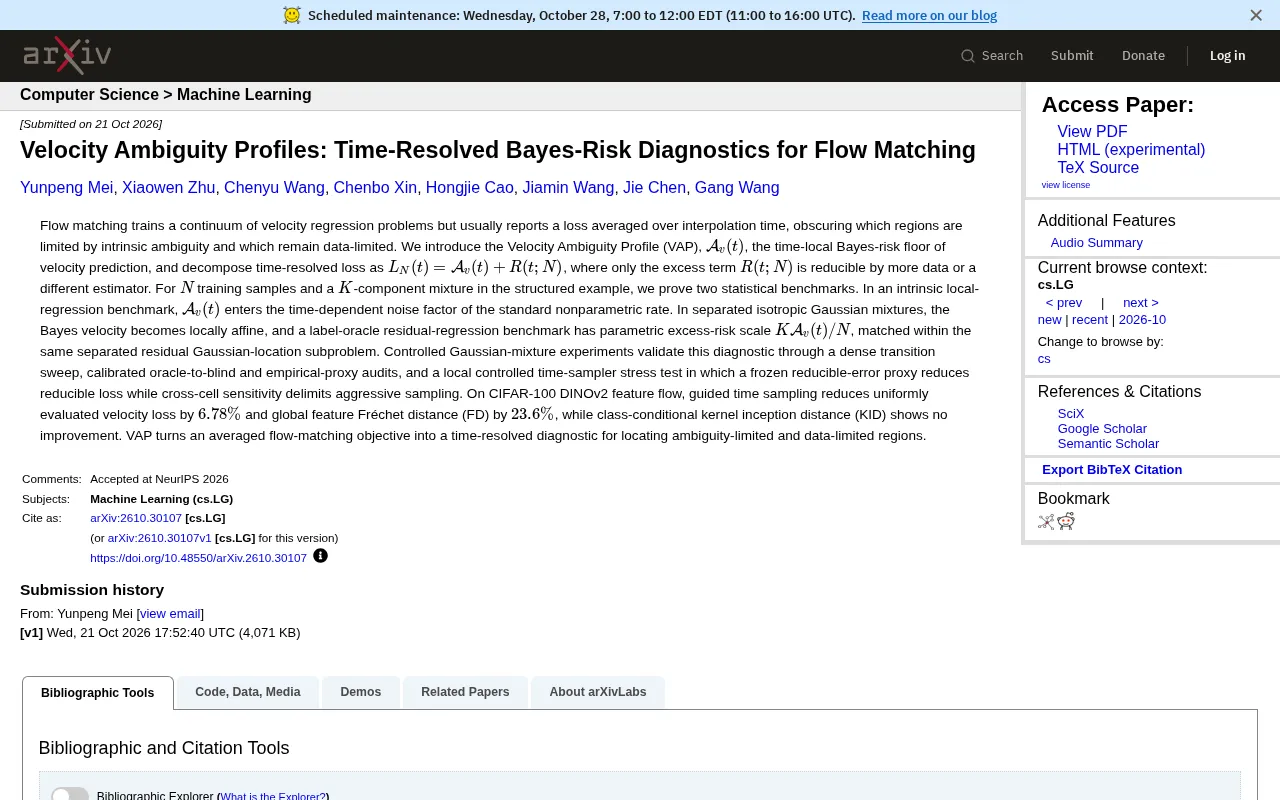
Velocity Ambiguity Profile (VAP) proposes a time-resolved Bayesian risk diagnostic method that decomposes the averaged loss in flow matching into an irreducible part $\mathcal{A}_v(t)$ caused by intrinsic ambiguity and an excess risk $R(t;N)$ that can be reduced with more data. Theoretical proofs show that in mixture models, VAP enters the nonparametric rate and the parameterized excess risk scale. Controlled Gaussian mixture experiments validate its diagnostic capability, and on CIFAR-100 DINOv2 feature flow, guided time sampling reduces velocity loss by 6.78% and FD by 23.6%, but KID does not improve. VAP provides a tool for locating ambiguity-limited and data-limited regions.
Title
Velocity Ambiguity Profiles: A New Tool for Time-Resolved Bayesian Risk Diagnostics
Meta Description
Velocity Ambiguity Profiles (VAP) is a time-resolved Bayesian risk diagnostic tool for flow matching models that distinguishes intrinsic ambiguity from data-limited loss, validated on CIFAR-100.
Article Content
Flow matching models typically report a loss value averaged over interpolation time, but this approach obscures differences in loss across different time regions: some regions are limited by intrinsic ambiguity, while others are limited by insufficient data. The recently proposed Velocity Ambiguity Profile (VAP) aims to address this issue by revealing reducible and irreducible errors in flow matching training through time-resolved Bayesian risk diagnostics.
Core Concept: VAP and Loss Decomposition
VAP is defined as the lower bound of the Bayesian risk of velocity prediction per unit time, denoted as $\mathcal{A}_v(t)$. The authors decompose the time-resolved loss as $L_N(t)=\mathcal{A}_v(t)+R(t;N)$, where $\mathcal{A}_v(t)$ is the irreducible part caused by intrinsic ambiguity, and $R(t;N)$ is the excess risk that can be reduced with more data or a better estimator. This decomposition allows us to distinguish which time regions are limited by ambiguity and which are limited by data.
Statistical Benchmarks and Theoretical Guarantees
For $N$ training samples and a $K$-component mixture model, the authors prove two statistical benchmarks: in the intrinsic local regression benchmark, $\mathcal{A}_v(t)$ enters the time-dependent noise factor of the standard nonparametric rate; in the separated isotropic Gaussian mixture, the Bayesian velocity becomes locally affine, and the label oracle residual regression benchmark has a parameterized excess risk scale $K\mathcal{A}_v(t)/N$. These theoretical results provide guarantees for the validity of VAP.
Experimental Validation and Diagnostic Capabilities
The authors validate VAP's diagnostic capabilities through controlled Gaussian mixture experiments, including dense transition sweeps, calibrated oracle-to-blind and empirical proxy audits, and local controlled time sampler stress tests. In the stress tests, the frozen reducible-error proxy reduces reducible loss, while cross-unit sensitivity bounds the limits of aggressive sampling.
Practical Application: CIFAR-100 Feature Flow
On CIFAR-100 DINOv2 feature flow, guided time sampling reduces the uniformly evaluated velocity loss by 6.78% and the global feature Fréchet distance (FD) by 23.6%, but does not improve the class-conditional kernel inception distance (KID). This indicates that VAP can guide sampling strategies, reducing reducible loss while potentially having different effects on certain metrics.
Significance and Outlook
VAP transforms the averaged flow matching objective into a time-resolved diagnostic tool, helping to locate ambiguity-limited and data-limited regions. This is not negligible for understanding the training dynamics of flow matching models and designing more effective data sampling strategies. In the future, this diagnostic method is expected to extend to more generative models and practical applications.
One-line Summary
VAP decomposes flow matching loss into time-resolved irreducible ambiguity and reducible excess risk, guiding sampling strategies.
Paragraph Summary
Velocity Ambiguity Profile (VAP) proposes a time-resolved Bayesian risk diagnostic method that decomposes the averaged loss in flow matching into an irreducible part $\mathcal{A}_v(t)$ caused by intrinsic ambiguity and an excess risk $R(t;N)$ that can be reduced with more data. Theoretical proofs show that in mixture models, VAP enters the nonparametric rate and the parameterized excess risk scale. Controlled Gaussian mixture experiments validate its diagnostic capability, and on CIFAR-100 DINOv2 feature flow, guided time sampling reduces velocity loss by 6.78% and FD by 23.6%, but KID does not improve. VAP provides a tool for locating ambiguity-limited and data-limited regions.
Related articles

Tencent WorkBuddy Hands-On: How AI Agents Crush Traditional Chat Assistants
WorkBuddy vs Doubao tested: how AI Agents directly operate computers to convert PPT to PDF, archive files and more. Analysis of WorkBuddy's low barrier, domestic ecosystem, pricing and plugin marketplace, plus AI Agent selection advice.

Azure Cross-Tenant Attack Chain: Root Cause Analysis of Five Paths
Binary Security analyzes five full cross-tenant compromise paths in Azure, trending 271 points on HN. This article interprets their shared root cause perspective and offers defense recommendations for cloud tenant isolation and reflections on responsibility boundaries.

Recreating a Real Bubble Tea Station in Isaac Sim: Script-Driven Unitree G1 Brews Tea
Developers recreated a real self-service tea station in NVIDIA Isaac Sim, using scripts to drive a Unitree G1 through a five-step tea-brewing process, exploring whether physics simulation can be a source of synthetic robot demonstration data and discussing contact stability and imitation learning.