Vercel AI SDK Adds Z.ai Support: An Analysis of @ai-sdk/zai 1.0.11

AI SDK adds the official Z.ai provider package; the patch update highlights ecosystem expansion and dependency governance.
The article interprets the significance of the @ai-sdk/zai 1.0.11 release. Although this version is a patch-level update whose core is merely synchronizing @ai-sdk/provider-utils to 3.0.45 and @ai-sdk/openai-compatible to 1.0.62, it reveals two layers of information: Z.ai has been officially included by the Vercel AI SDK as an official provider package, and because it is built on openai-compatible, its interface aligns with the OpenAI protocol, keeping integration costs very low. The author points out that this "compatibility layer + standalone provider package" is the long-standing approach of the AI SDK, allowing new model services to quickly enter the community and share the underlying toolchain. For developers, the adaptation costs for multi-model routing, fallback, and comparative evaluation continue to decline; however, the release information does not disclose model capabilities or the support list, which need to be confirmed by consulting the package documentation, and attention should be paid to dependency version synchronization to avoid version mismatches.
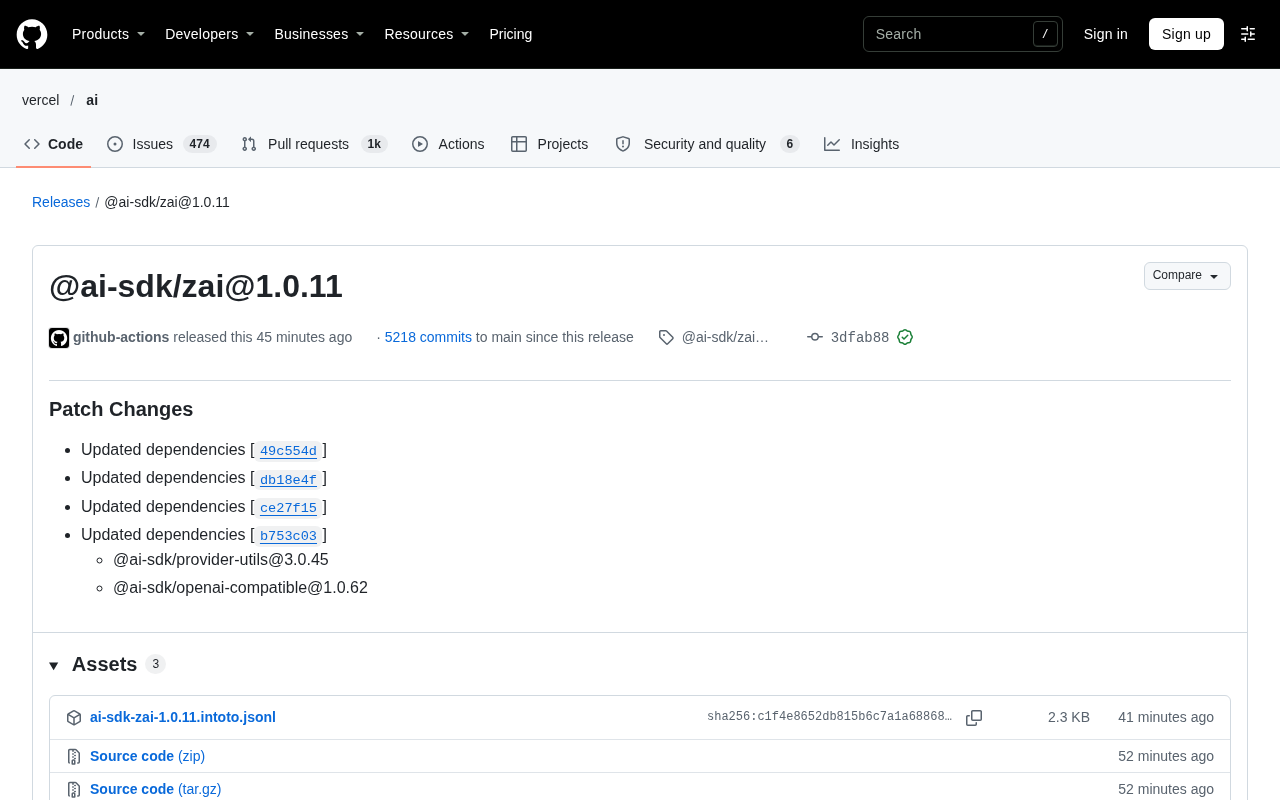
Vercel's AI SDK ecosystem has gained a new member. A package called @ai-sdk/zai has released version 1.0.11, signaling that the mainstream AI SDK is beginning to bring Z.ai into its official support scope. For frontend and full-stack developers looking for multi-model integration solutions, this is worth noting.
Why a small version number is worth paying attention to
From the release notes, @ai-sdk/zai@1.0.11 is a patch-level update whose core content is dependency synchronization: it updates @ai-sdk/provider-utils to 3.0.45 and @ai-sdk/openai-compatible to 1.0.62. On the surface it is routine maintenance, but in reality it reveals two layers of information.
First, Z.ai has been officially included by the AI SDK as a model service provider in the form of an official provider package. Developers can call it directly through @ai-sdk/zai without having to build their own compatibility layer. Second, this package is built on top of @ai-sdk/openai-compatible, indicating that Z.ai's interface aligns with the OpenAI-compatible protocol, keeping integration costs very low.
This combination of "compatibility layer + standalone provider package" is the long-standing approach of the Vercel AI SDK. It allows new model services to quickly enter the community while sharing the foundational capabilities of provider-utils.
Vercel AI SDK is an open-source TypeScript toolkit launched by Vercel for uniformly calling various large language models in web applications. It abstracts models from different vendors into a consistent API, with core functions including generateText, streamText, generateObject, and more, and supports streaming output, tool calling, and multi-step reasoning. The AI SDK adopts a "core library + provider packages" architecture: the ai package provides a unified interface, while each model service is integrated through an independent provider package (such as @ai-sdk/openai, @ai-sdk/anthropic). This design means developers only need to specify the provider at initialization, and business-layer code does not need to change when switching models, while also allowing new model services to be quickly adopted by the community.
Provider packages are the adaptation layers in the AI SDK that encapsulate individual model service providers, typically containing only a provider instance, model ID mappings, and a small amount of custom configuration. Most provider packages do not implement the protocol from scratch; instead, they are based on the general-purpose adapter @ai-sdk/openai-compatible: as long as the target service's HTTP interface matches the request/response format of OpenAI's /chat/completions, it can be integrated directly through this adapter. Z.ai's choice of this path means its interface aligns with OpenAI semantics in message structure, streaming chunks (SSE chunks), and parameter naming, so developers' existing calling experience and prompt structures can migrate smoothly.
The technical implications behind the dependency updates
This update focuses on merging the dependencies corresponding to four commits, ultimately reflected in two new versions: @ai-sdk/provider-utils@3.0.45 and @ai-sdk/openai-compatible@1.0.62.
provider-utils is the foundational module in the AI SDK that handles common logic such as streaming responses, parameter validation, and error mapping. Its version advancement means the Z.ai provider can inherit a more stable underlying toolchain. The update to openai-compatible further indicates that Z.ai's calls remain on a path consistent with OpenAI API semantics.
The practical impact for users is: if you are already using the AI SDK to call OpenAI-compatible services, switching to Z.ai mainly involves changing the provider and corresponding configuration, and the calling patterns in your business code basically do not need to be rewritten.
@ai-sdk/provider-utils is the shared foundational library of the AI SDK provider system, centralizing the underlying capabilities used by all provider packages, such as chunk-by-chunk parsing of streaming responses, schema validation of request parameters, classification and mapping of HTTP errors, and incremental assembly of tool calls. Provider packages themselves are usually thin, with most robustness logic coming from provider-utils. Therefore, a minor version bump of this package often means that fixes for error handling, streaming compatibility, or edge cases are inherited by all downstream providers. This also explains why patch-level dependency synchronization is worth paying attention to: the upgrade itself does not change the API, but it may affect runtime behavior.
The practical significance for developers
Integrating multiple models becomes lighter
The core value of the AI SDK is unifying calls to different model services into a single interface. The emergence of @ai-sdk/zai means teams that need to route, fall back, or compare and evaluate across multiple models have one less layer of adaptation code to write.
The ecosystem is still iterating rapidly
This release was completed through an automated release process triggered by GitHub Actions, and the repository has reached 5,218 commits, showing that the main AI SDK repository is highly active. Frequent patch updates also remind users to pay attention to dependency version synchronization to avoid mismatches between provider and core SDK versions.
The release mentioned in this article was automatically triggered by GitHub Actions, which is the continuous release practice adopted by the AI SDK repository: using tools such as changesets to manage version numbers and changelogs, and after a PR is merged, CI automatically calculates semantic versions, publishes to npm, and tags releases. This process results in a high frequency of patch updates and rapid version number advancement. The takeaway for users is to lock versions through lockfiles and to pay attention to the compatibility matrix between providers and the core ai package when upgrading, avoiding runtime issues caused by implicit dependency drift from automated releases.
Things to note
This release information only contains dependency changes, with no functional-level explanations and no performance or compatibility data. The actual capability boundaries of @ai-sdk/zai, the list of supported models, and details such as streaming and tool calling need to be confirmed by consulting the package's own documentation. Treating it as "an official integration point that is already available" is reasonable; treating it as a judgment that its functionality is complete lacks a basis.
Summary
@ai-sdk/zai@1.0.11 is a signal: the AI SDK is bringing more model services into its ecosystem in the form of standard providers. For developers, this means the cost of multi-model integration continues to decline; for the ecosystem, it is an ongoing process of dependency synchronization and version governance.
One-line Summary
AI SDK adds the official Z.ai provider package; the patch update highlights ecosystem expansion and dependency governance.
Paragraph Summary
The article interprets the significance of the @ai-sdk/zai 1.0.11 release. Although this version is a patch-level update whose core is merely synchronizing @ai-sdk/provider-utils to 3.0.45 and @ai-sdk/openai-compatible to 1.0.62, it reveals two layers of information: Z.ai has been officially included by the Vercel AI SDK as an official provider package, and because it is built on openai-compatible, its interface aligns with the OpenAI protocol, keeping integration costs very low. The author points out that this "compatibility layer + standalone provider package" is the long-standing approach of the AI SDK, allowing new model services to quickly enter the community and share the underlying toolchain. For developers, the adaptation costs for multi-model routing, fallback, and comparative evaluation continue to decline; however, the release information does not disclose model capabilities or the support list, which need to be confirmed by consulting the package documentation, and attention should be paid to dependency version synchronization to avoid version mismatches.
Related articles
 Tech Frontiers
Pushing the Limits of Extreme Sudoku on a 16GB GPU: Insights from Depth and Flow Matching
A researcher trained a 16.54M-parameter model on a 16GB GPU to solve extreme Sudoku, finding effective depth breaks the 60% plateau and flow matching with improved sampling pushes accuracy past 99% with ~50× lower layer-evaluation budget.
 Tech Frontiers
AI Agent Approval Workflows: Why Human Confirmations Always Get Mindlessly Clicked
Why do AI agent approval workflows always get mindlessly clicked? A Reddit discussion shows that separating rules from keys, low-frequency high-risk approvals, and GitHub Environments-style gates are the keys to effective approvals.
 Tech Frontiers
MuJoCo: An Analysis of DeepMind's Open-Source General-Purpose Physics Simulator
An in-depth analysis of Google DeepMind's open-source physics simulator MuJoCo: high-performance C++ kernel, MJCF modeling format, contact solving principles, MJX GPU acceleration, and robot reinforcement learning use cases.