Vercel AI SDK Releases @ai-sdk/svelte 3.0.258 Patch Update

Vercel AI SDK releases @ai-sdk/svelte 3.0.258, a low-risk patch update syncing with the core package.
Vercel AI SDK has released `@ai-sdk/svelte@3.0.258`, a patch-level update focused on dependency alignment and stability fixes alongside core package `ai@5.0.258`, with no breaking API changes. The SDK — a leading tool for building AI apps in frontend and full-stack development with 26.7k+ GitHub stars — provides unified abstractions for streaming, tool calling, and chat UI. The aligned patch number (258) across sub-packages reflects Vercel's monorepo Changesets strategy, reducing version mismatch risks. Developers are advised to validate in a test environment before upgrading.
Vercel AI SDK Releases @ai-sdk/svelte 3.0.258 Patch Update
Vercel's widely adopted open-source AI SDK has released @ai-sdk/svelte@3.0.258. This is a patch-level update that syncs with the core package ai@5.0.258.
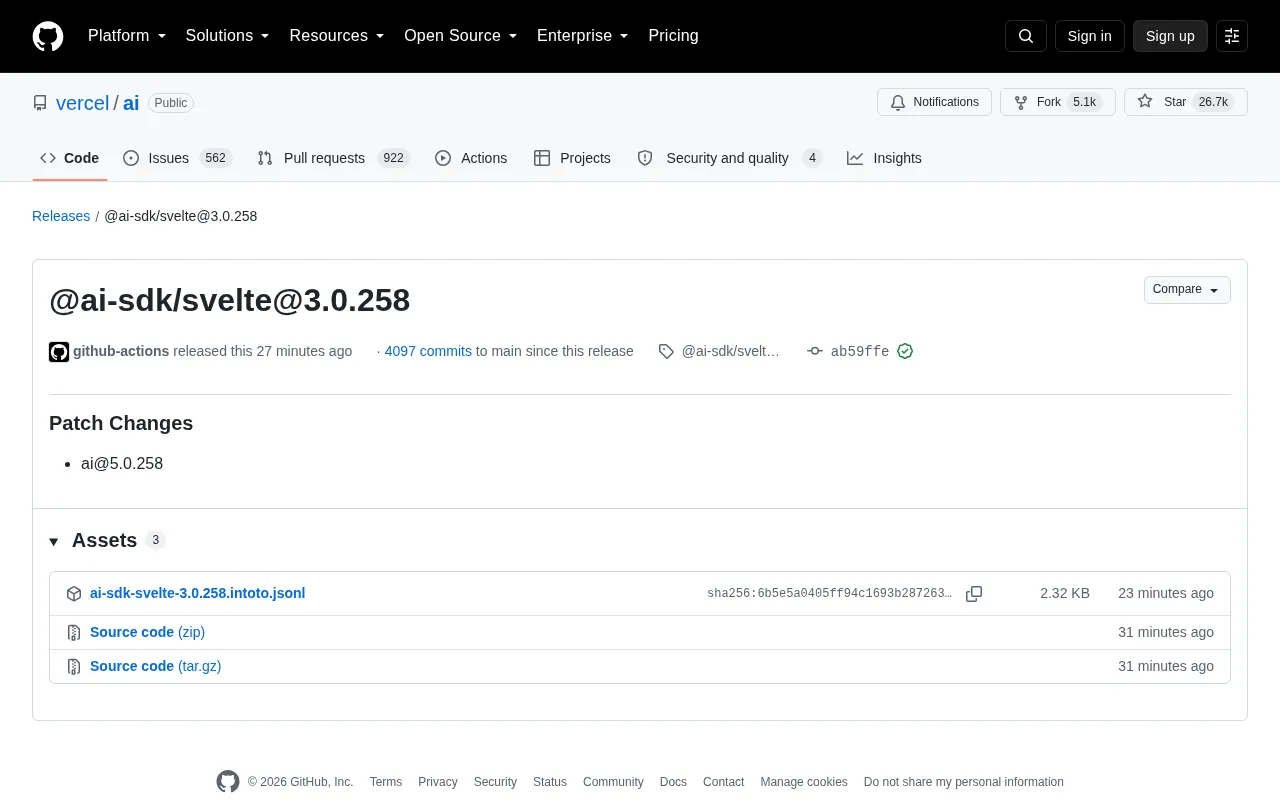
Update Overview
According to the GitHub Release page, this release was published automatically by github-actions, representing the accumulation of approximately 4,097 commits to the AI SDK monorepo since the previous version. The release notes explicitly mark this as a Patch Change, with the core change being an update to the dependency ai@5.0.258.
For developers in the Svelte ecosystem, patch releases like this typically mean bug fixes, internal dependency alignment, or minor stability improvements — not breaking API changes. The upgrade risk is low, making it straightforward to adopt.
About Vercel AI SDK
Vercel AI SDK is one of the most widely used libraries for building AI-powered applications in frontend and full-stack development. The project has accumulated over 26.7k stars and 5.1k forks on GitHub, with a highly active community. It provides a unified abstraction layer that makes it easy to integrate large language model capabilities into web applications — including streaming responses, chat interfaces, and tool calling.
@ai-sdk/svelte is the official adapter package for the Svelte / SvelteKit framework. It enables Svelte developers to tap into the core AI SDK features in a framework-idiomatic way, whether that's building conversational UIs or handling streamed model output.
Engineering Practices Behind the Version Numbers
It's worth noting that while @ai-sdk/svelte (3.0.258) and the core package ai (5.0.258) carry different major versions, their patch numbers are aligned (both at 258). This reflects Vercel's version coordination strategy within its monorepo — sub-packages are published in sync through a unified Changesets workflow, ensuring compatibility across framework adapters in the ecosystem.
This engineering approach benefits end users: developers can confidently pair the Svelte adapter with the corresponding version of the core package, avoiding runtime issues caused by version mismatches. The release is also published with a verified GPG signature via GitHub, ensuring the integrity and trustworthiness of the published artifacts.
Should Developers Upgrade?
As a patch update, 3.0.258 introduces no significant functional changes. For projects currently using @ai-sdk/svelte, it's recommended to validate the upgrade in a test environment before rolling it out, in order to pick up the latest stability fixes and dependency alignment. If your project is running smoothly without any related bugs, you can also upgrade at your own pace.
For teams tracking the evolution of AI SDK, keeping up with these frequent patch releases is a good way to stay informed about internal stability trends and potential behavioral changes within the SDK.
Related articles

Tencent WorkBuddy Hands-On: How AI Agents Crush Traditional Chat Assistants
WorkBuddy vs Doubao tested: how AI Agents directly operate computers to convert PPT to PDF, archive files and more. Analysis of WorkBuddy's low barrier, domestic ecosystem, pricing and plugin marketplace, plus AI Agent selection advice.

Azure Cross-Tenant Attack Chain: Root Cause Analysis of Five Paths
Binary Security analyzes five full cross-tenant compromise paths in Azure, trending 271 points on HN. This article interprets their shared root cause perspective and offers defense recommendations for cloud tenant isolation and reflections on responsibility boundaries.

Recreating a Real Bubble Tea Station in Isaac Sim: Script-Driven Unitree G1 Brews Tea
Developers recreated a real self-service tea station in NVIDIA Isaac Sim, using scripts to drive a Unitree G1 through a five-step tea-brewing process, exploring whether physics simulation can be a source of synthetic robot demonstration data and discussing contact stability and imitation learning.