Vercel AI SDK Releases @ai-sdk/svelte 4.0.300 Patch Update

Vercel AI SDK releases @ai-sdk/svelte 4.0.300 patch update, syncing with core library ai@6.0.300.
Vercel AI SDK has released `@ai-sdk/svelte@4.0.300`, a patch-level maintenance update that syncs with the core dependency `ai@6.0.300`, introducing no breaking API changes. One of the most popular toolkits for frontend and full-stack AI development with over 27.1k GitHub stars, its Svelte adapter provides framework-idiomatic streaming responses and chat state management. As a SemVer Patch release, the upgrade risk is low, though regression testing on critical features is still recommended.
Vercel's AI SDK has released @ai-sdk/svelte@4.0.300, a patch-level update to the Svelte framework integration package. According to the official GitHub Release notes, this release is primarily a maintenance sync that follows the upgrade of the core dependency ai@6.0.300.
What's in This Update
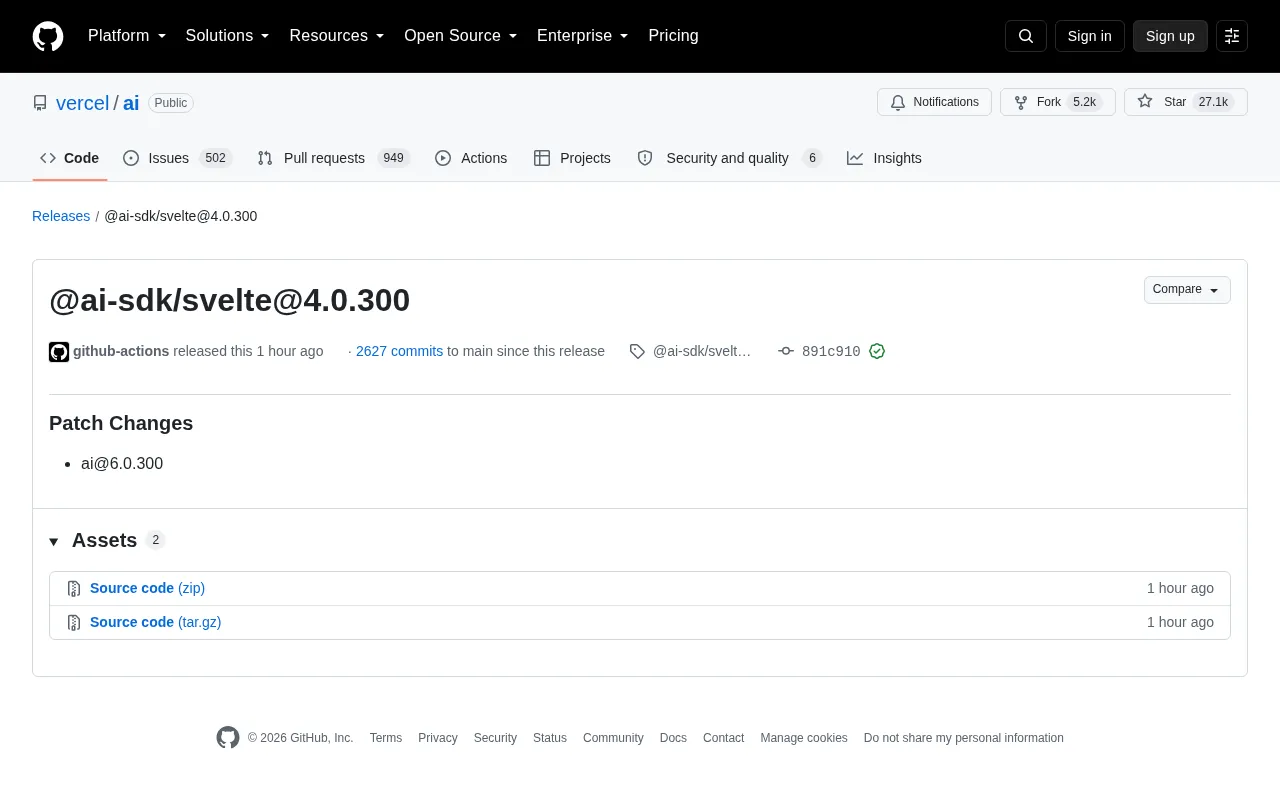
Per the GitHub Release notes, @ai-sdk/svelte@4.0.300 is classified as a Patch Change, with the changelog explicitly referencing the dependency ai@6.0.300. This means the release introduces no breaking API changes or major new features — it simply aligns the package with the latest version of the underlying core library.
For developers building AI applications with Svelte, patch releases like this are generally safe to adopt directly. They typically include bug fixes, internal dependency updates, or minor compatibility adjustments, without requiring any changes to existing business logic.
About Vercel AI SDK
Vercel AI SDK is one of the most widely used toolkits in the frontend and full-stack AI development space. Its GitHub repository (vercel/ai) has accumulated over 27.1k stars and 5.2k forks, reflecting a highly active community. The project aims to provide developers with a unified interface for integrating large language model capabilities across different frontend frameworks.
@ai-sdk/svelte is the official adapter package for the Svelte / SvelteKit ecosystem. It enables Svelte developers to use AI features — such as streaming responses and chat state management — in a framework-idiomatic way, without having to build the communication infrastructure with model services from scratch.
Vercel AI SDK supports seamless integration with major LLM providers (such as OpenAI, Anthropic, Google Gemini, etc.) through a unified Provider abstraction layer. Developers can swap out the underlying model simply by changing configuration, with no modifications needed to business code. Core capabilities include Web Streams-based streaming text generation, Structured Outputs, Tool Calling / Function Calling, and multi-turn conversation state management. @ai-sdk/svelte further wraps these capabilities with Svelte-reactive Stores and helper functions — such as Hook-style APIs like useChat and useCompletion — allowing developers to bind chat history and loading states directly in components without manually managing async data streams.
The Significance of a Patch Release
From a Semantic Versioning (SemVer) perspective, the increment in the trailing number of 4.0.300 indicates a patch release. This release was published via github-actions automation and verified with GitHub's signed commit signature, ensuring the trustworthiness of the release artifact.
Notably, @ai-sdk/svelte remains on major version 4.x, while the core ai library it depends on has already reached 6.x. This version discrepancy reflects the fact that framework adapter packages and the core library maintain independent versioning cadences — the core library iterates faster, while the framework bindings follow along while maintaining compatibility.
Semantic Versioning (SemVer) is a widely adopted versioning convention in software development, using the format MAJOR.MINOR.PATCH. A MAJOR version bump signals breaking API changes; a MINOR bump introduces new backward-compatible features; and a PATCH bump includes only backward-compatible bug fixes or internal dependency updates. This is why patch updates are generally considered "seamless upgrades" — projects depending on the package don't need to change any calling code after upgrading. The version mismatch between @ai-sdk/svelte and the core ai library (4.x vs. 6.x respectively) is quite common in monorepo multi-package projects, where each sub-package can advance its version independently based on its own rate of change, with compatibility ranges governed by explicit peer dependency declarations.
Recommendations for Developers
If you're currently using the Svelte integration of Vercel AI SDK, consider upgrading to 4.0.300 to benefit from the stability and fixes that come with alignment to the latest core library. Since this is a patch update, the upgrade risk is low — but it's still advisable to run regression tests on critical paths such as streaming chat and generation after upgrading.
For teams that haven't yet adopted the SDK, this kind of frequent and stable minor-version iteration is itself a signal of project health — it demonstrates that the official maintainers are actively responding to changes in the core library and keeping all framework adapter packages up to date.
Note: This article is based on publicly available information from the GitHub Release. Since the official release notes are relatively brief, refer to the full changelog and the
ai@6.0.300update history for specific fix details.
Related articles

Tencent WorkBuddy Hands-On: How AI Agents Crush Traditional Chat Assistants
WorkBuddy vs Doubao tested: how AI Agents directly operate computers to convert PPT to PDF, archive files and more. Analysis of WorkBuddy's low barrier, domestic ecosystem, pricing and plugin marketplace, plus AI Agent selection advice.

Azure Cross-Tenant Attack Chain: Root Cause Analysis of Five Paths
Binary Security analyzes five full cross-tenant compromise paths in Azure, trending 271 points on HN. This article interprets their shared root cause perspective and offers defense recommendations for cloud tenant isolation and reflections on responsibility boundaries.

Recreating a Real Bubble Tea Station in Isaac Sim: Script-Driven Unitree G1 Brews Tea
Developers recreated a real self-service tea station in NVIDIA Isaac Sim, using scripts to drive a Unitree G1 through a five-step tea-brewing process, exploring whether physics simulation can be a source of synthetic robot demonstration data and discussing contact stability and imitation learning.