Vercel AI SDK Releases @ai-sdk/vue@2.0.267 Patch Update

Vercel AI SDK releases @ai-sdk/vue@2.0.267 patch, syncing core dependency to ai@5.0.267 with minimal upgrade risk.
`@ai-sdk/vue@2.0.267` is a routine patch update to Vercel AI SDK's official Vue adapter, with the primary change being a dependency sync to `ai@5.0.267`. Per SemVer, a patch increment involves no breaking changes, making this a safe upgrade. The release was auto-published via GitHub Actions with GPG signature verification. With ~27k GitHub stars and a patch number of 267, the SDK reflects a rapid release cadence. Vue developers should keep `@ai-sdk/vue` and `ai` in sync and run full test suites after upgrading to verify chat streams and tool calls.
Version Overview
Vercel's open-source AI SDK project has released @ai-sdk/vue@2.0.267. This is a patch-level update, accompanied by a synchronized upgrade of the core dependency to ai@5.0.267. The release was automatically published by GitHub Actions and verified with GitHub's GPG signature (key ID: B5690EEEBB952194), ensuring the integrity and authenticity of the release artifacts.
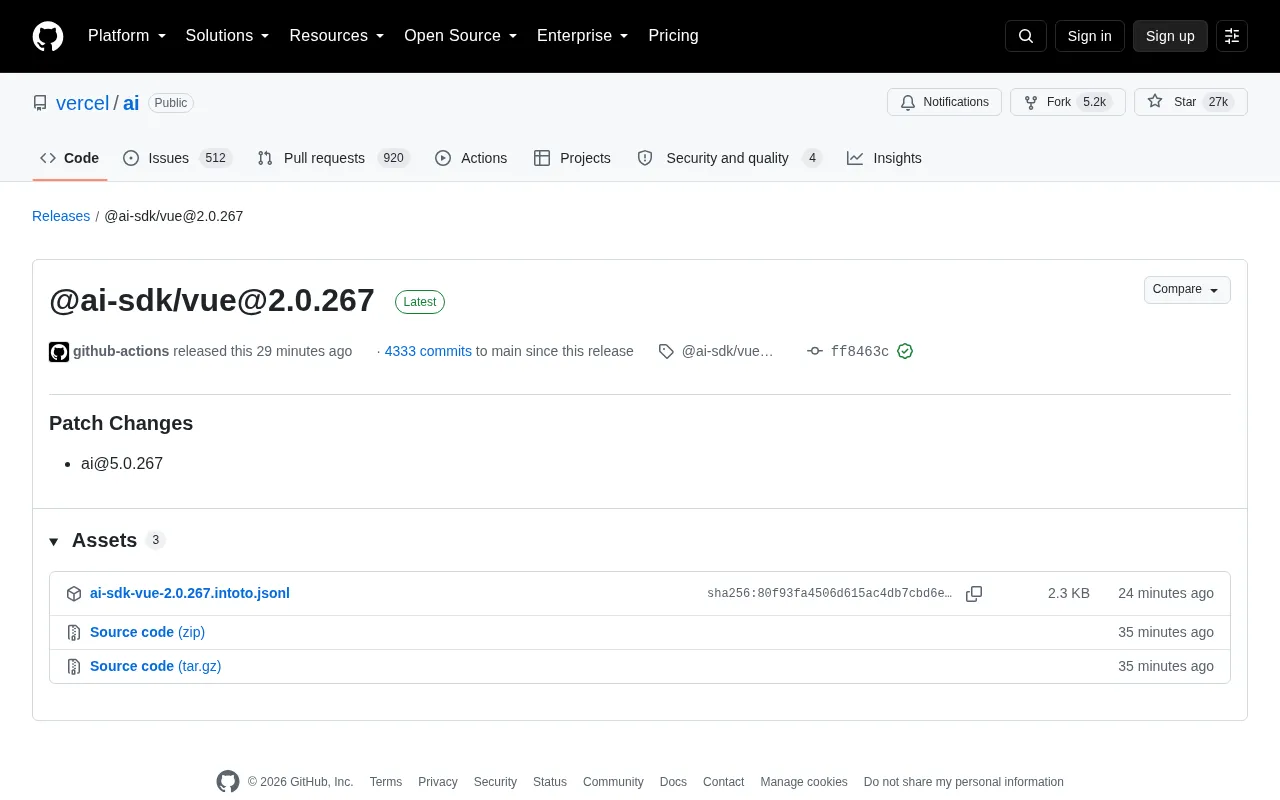
Vercel AI SDK is a widely adopted toolkit for frontend and full-stack developers building AI-powered applications. It has accumulated approximately 27k stars and 5.2k forks on GitHub, reflecting a vibrant and active community. @ai-sdk/vue is the official Vue ecosystem adapter for this SDK, enabling Vue developers to integrate large language models, streaming responses, and chat interfaces into their applications.
What's in This Update
According to the official release notes, version 2.0.267 is a typical patch release. The primary change is a dependency sync with the underlying core package ai@5.0.267. Updates of this nature generally do not introduce breaking changes — they align the Vue adapter with the latest core library behavior through continuous iteration.
For projects following Semantic Versioning (SemVer), an incremented patch number signals bug fixes and compatibility maintenance. Developers can typically upgrade with confidence and without significant changes to existing code. It's worth noting that the AI SDK follows a high-frequency release cadence — the version number has already reached 267 — reflecting the team's commitment to rapid, continuous iteration.
What is Semantic Versioning (SemVer)? SemVer is a widely adopted software versioning convention using three numeric segments: Major.Minor.Patch. A major version bump indicates breaking, incompatible changes; a minor bump adds new functionality in a backward-compatible manner; and a patch bump covers only backward-compatible bug fixes or internal maintenance. For
@ai-sdk/vue@2.0.267, the increment of the third digit (267) places this update in the lowest-risk category — no existing API call patterns need to be modified. The fact that the patch number has reached 267 reflects a highly automated CI/CD pipeline, where each change to the core library triggers an automatic release of adapter packages rather than batching multiple changes into a single release.
What This Means for Vue Developers
@ai-sdk/vue keeps the Vue ecosystem on par with the React ecosystem (@ai-sdk/react) when it comes to AI application development. Developers can use this package to quickly implement common AI interaction patterns — such as chatbots, text generation, and structured data output — while leveraging built-in streaming capabilities to enhance the user experience.
Keeping dependencies up to date is an important part of maintaining the long-term health of any AI application. As underlying model capabilities, provider APIs, and SDK abstractions continue to evolve, staying current with patch releases helps avoid potential compatibility issues and known bugs. Teams using the Vue integration are encouraged to upgrade @ai-sdk/vue and the ai core package in tandem to ensure consistent behavior.
What is Streaming? Streaming is a core UX technique in modern AI chat applications. Rather than waiting for the model to generate a complete response before returning it all at once, streaming allows the server to push text fragments (tokens) to the client as they are generated. Users see text appear word by word in a "typewriter" effect, which significantly reduces perceived latency.
@ai-sdk/vueabstracts this complexity away — developers don't need to manually handle low-level browser APIs like Server-Sent Events (SSE) orReadableStream. Instead, they can call SDK-provided Composables likeuseChatto bind streaming response state directly to Vue's reactivity system, dramatically reducing implementation complexity.
How to Upgrade
Upgrading follows the same process as any standard npm package — simply run the update command via your package manager. Since this is a patch release, the upgrade risk is low. That said, it's still recommended to run your full test suite after upgrading to confirm that critical paths such as chat streams and tool calls continue to function as expected.
Developers who want to dig into the specific changes can visit the Vercel AI SDK GitHub repository to review the full release notes and commit history. The project has accumulated over 4,300 commits since its initial branch, and its sustained maintenance provides a solid foundation for production use.
Related articles

Microsoft Fabric Database Agent in Action: From Reactive Firefighting to Intelligent Detective
A deep dive into the Microsoft Fabric Database Agent: how to enable it, supported monitoring scenarios, a blocking-issue demo, and the roadmap from reactive to autonomous operations.

Zendesk Uses ChatGPT Enterprise to Build a Sales Agent with 1,000 Daily Active Users
Zendesk opened ChatGPT Enterprise to all employees, who built about 600 apps themselves, including a sales expansion agent with about 1,000 daily active users. This article analyzes how it turns internal data into sales opportunities and its "don't wait" implementation strategy.

Google Releases Gemini 4 Carbon: Its Strongest Model Yet, Debuting with a Cybersecurity Focus
Google releases Gemini 4 Carbon, calling it its strongest model, with a cybersecurity focus. It tops the third-party composite ranking at 59 points but leads by only one or two. This article analyzes its security test results, staged rollout, token pricing, and the divergence between self-reported and third-party tests on hallucinations.