Vercel AI SDK Releases workflow-harness@1.0.122 Patch Update

Vercel AI SDK releases workflow-harness@1.0.122 patch, aligning internal dependencies in a routine maintenance update.
Vercel's high-starred open-source project `ai` (Vercel AI SDK) published `@ai-sdk/workflow-harness@1.0.122` via GitHub Actions. The sole change is a version alignment of the internal `@ai-sdk/harness` dependency. The `workflow-harness` package is an internal test scaffolding component for workflow validation, not a public-facing API. The release was auto-built with GPG signature verification, demonstrating mature open-source release practices. Most developers need not take any action, but the frequent small-step iterations reflect Vercel's sustained investment in SDK stability.
Vercel's open-source project ai (26.9k GitHub stars) recently published @ai-sdk/workflow-harness@1.0.122 via GitHub Actions. This is a patch-level update that bumps the internal dependency @ai-sdk/harness to the matching version 1.0.122.
The release is a routine maintenance iteration with no breaking changes or major new features. For developers tracking the Vercel AI SDK ecosystem, these kinds of patch updates signal ongoing refinement of the underlying components' stability and consistency.
What Changed
According to the GitHub Release page, the sole change in 1.0.122 falls under Patch Changes: a dependency version alignment that upgrades @ai-sdk/harness to 1.0.122.
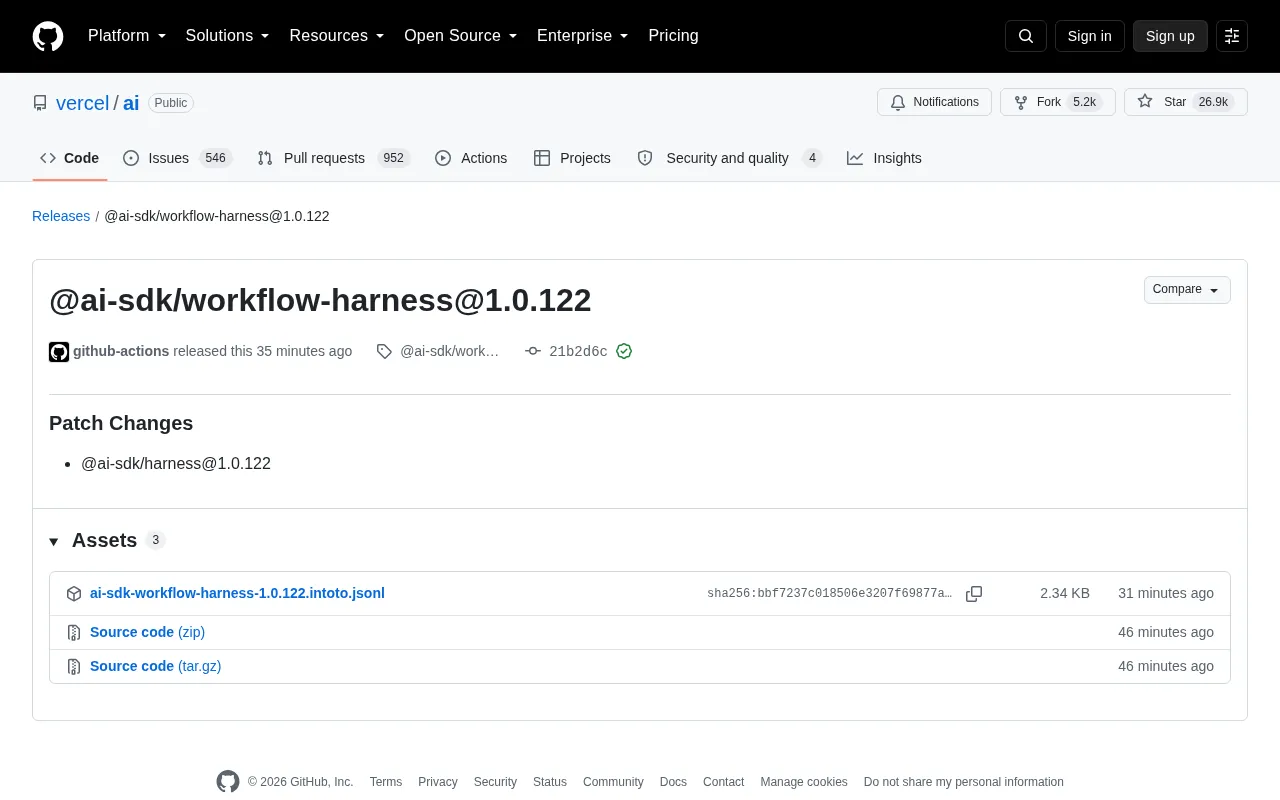
The release was built and published automatically by GitHub Actions, with commit hash 21b2d6c and a verified GPG signature (key ID: B5690EEEBB952194), ensuring the integrity and authenticity of the published artifact. This kind of automated, signature-verified release pipeline is a hallmark of mature open-source engineering practices.
What Is workflow-harness?
workflow-harness is part of Vercel AI SDK's internal toolchain. It serves as a test scaffolding component (a "harness") for workflow execution and validation — typically used for internal integration testing and workflow orchestration verification rather than as a public-facing API for end-application developers.
The version number 1.0.122 indicates the component has entered a stable semantic versioning maintenance phase, following the same incremental patch strategy as the main packages. This reflects Vercel's high-cadence, small-step iteration rhythm — continuously fixing details and aligning internal dependencies through CI.
The concept of a "test harness" comes from software testing: it refers to the infrastructure that provides a running environment, input data, and assertion verification for the component under test. In large SDK projects, a harness layer typically simulates real invocation contexts, intercepts side effects (such as network requests and streaming output), and compares expected behavior — enabling integration tests to run in a controlled, reproducible environment. Vercel AI SDK's
workflow-harnessextends this specifically for workflow orchestration scenarios — i.e., the sequencing, concurrency, and error-handling logic of multi-step AI call chains. These internal packages are decoupled from the developer-facing API packages, allowing the core test infrastructure to evolve independently without affecting the stability of public interfaces.
What This Means for Developers
Vercel AI SDK is one of the most widely used tools for building AI applications today — especially within the Next.js ecosystem — offering unified streaming responses, multi-model integration, and tool-calling capabilities. The stable evolution of its internal components directly impacts the reliability of applications built on top of it.
For most application developers, internal packages like workflow-harness require no manual attention or separate upgrades — they are pulled in automatically as part of the main SDK's version updates. However, for teams contributing to the SDK, building custom workflows, or doing deep integration work, tracking these patches helps reveal subtle changes in underlying behavior.
Developers following this project are encouraged to keep an eye on the official Release Notes for updates that include substantive new functionality.
Vercel AI SDK uses a monorepo architecture, managing dozens of sub-packages through tools like pnpm workspaces or Turborepo. In this setup, internal packages maintain compatibility through strict version number alignment — a patch release in one sub-package often triggers synchronized version bumps in packages that depend on it, creating a "version cascade." This is exactly the technical context behind
workflow-harness@1.0.122trackingharness@1.0.122. For projects using release management tools like Changesets, this kind of automated dependency alignment is standard practice — ensuring that every package published to the npm registry is in a verified, compatible state with its dependencies, eliminating potential runtime issues caused by sub-package version mismatches.
Summary
@ai-sdk/workflow-harness@1.0.122 is a typical dependency-alignment patch release, reflecting the healthy and active maintenance state of the Vercel AI SDK project. While the update itself carries limited new information, its automated publishing, signature verification, and frequent iteration cadence offer a clear window into how a high-quality open-source project operates.
Related articles

AI Weekly: Claude Code Backdoor Incident and AI Giants' Capital Game
AI security this week: Cursor marketplace seeded with a Claude Code backdoor affecting Mac and Windows developers. Meanwhile, Amazon AI capex hits $75.9B, Google AI search revenue lags traditional search, Anthropic launches Ultra subscription, and OpenAI commits to robots.txt training signals while publicly defending fair use.

Malicious Claude Code Extension Infiltrates Cursor: Version 2.1.313 Self-Check and Cleanup Guide
A malicious Claude Code build 2.1.313 appeared in the Cursor extension marketplace for about 11 hours, affecting up to 5,000 users. StepSecurity disclosed that it stole system information, git email, and environment variable names, and attempted to implant SSH keys and reverse tunnels. This article covers the incident, malicious behavior, and complete self-check and cleanup steps.

15 Essential Prompts for Vibe Coding: Keep AI from Wrecking Your Code
Vibe Coding often tempts AI to break your code. These 15 prompts—from PRD, architecture, and database to testing and debugging—chain each output as the source of truth, turning AI coding from casual chat into a controllable engineering process.