Vercel AI SDK's xAI Adapter Package Gets a Minor Version Update
@ai-sdk/xai releases 3.0.148, only syncing the underlying compatibility dependency to 2.0.89, with no functional changes.
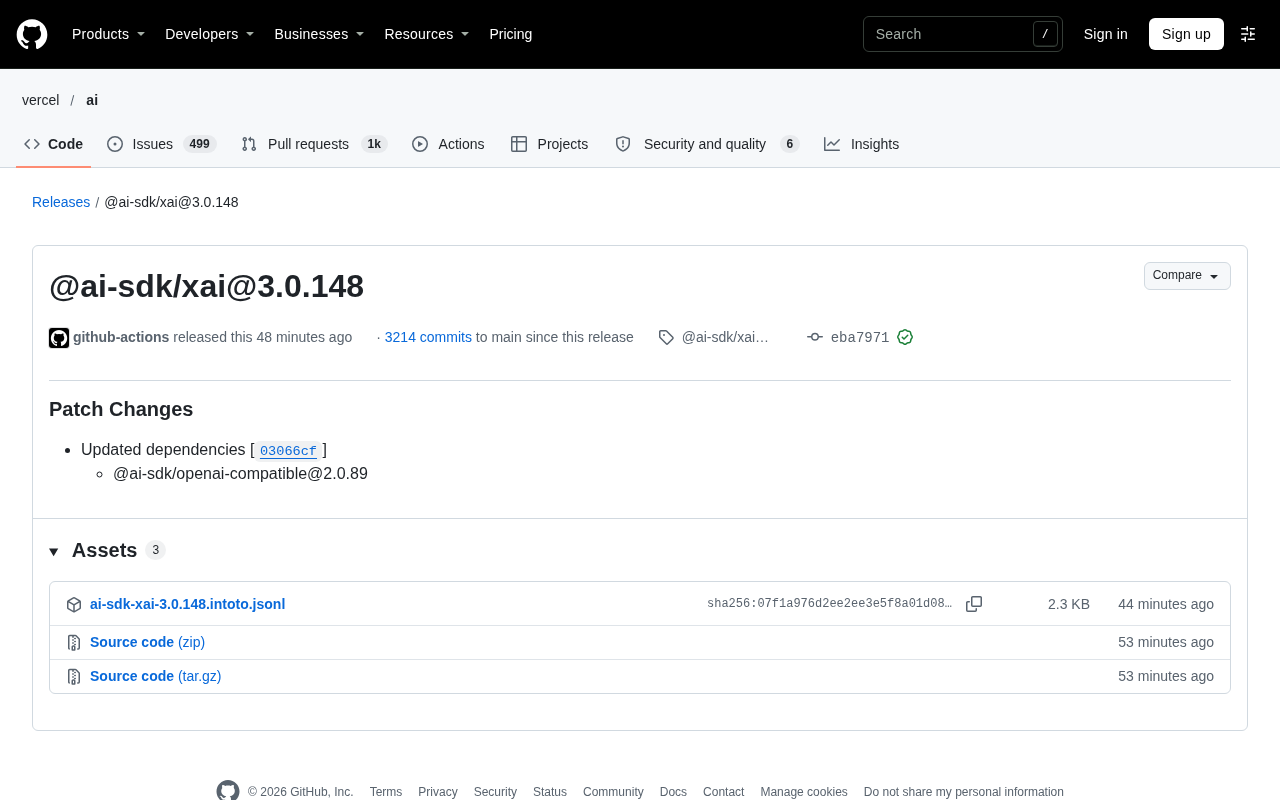
Within Vercel's AI SDK ecosystem, the xAI adapter package `@ai-sdk/xai` has released version 3.0.148, a Patch-level update. The release notes contain just one entry: upgrading the dependency `@ai-sdk/openai-compatible` to 2.0.89, with the change automatically generated by GitHub Actions and signed. The package itself adds no new methods and modifies no behavior or type definitions. The article explains why dependency syncing warrants its own release and notes that users can typically upgrade directly, though production environments should first verify streaming output and tool-calling paths.
Within Vercel's AI SDK ecosystem, the xAI adapter package @ai-sdk/xai has released version 3.0.148. Judging from the GitHub Releases page, this is a standard Patch update, with changes concentrated at the dependency level rather than in the API or functionality itself.
What This Update Actually Changed
The release notes contain only one Patch Changes entry: the dependency reference to @ai-sdk/openai-compatible was updated, bumping its version to 2.0.89. The commit message includes the commit hash for this dependency update, indicating the change was automatically generated and signed by GitHub Actions—a routine product of the release pipeline.
In other words, @ai-sdk/xai itself adds no new methods, modifies no behavior, and adjusts no type definitions. For developers already using this package, the expected behavior after upgrading remains consistent with before.
Patch Versions and Semantic Versioning (SemVer)
Version numbers in the npm ecosystem follow the semantic versioning specification, in the form major.minor.patch, corresponding respectively to incompatible API changes, backward-compatible feature additions, and backward-compatible bug fixes. In 3.0.148, the last digit 148 is the patch number, indicating this is the 148th Patch release. Under SemVer conventions, Patch versions should not contain breaking changes or new features, so dependents can typically upgrade directly and safely. Correspondingly, @ai-sdk/openai-compatible rising to 2.0.89 is likewise a patch number increment, indicating the underlying package also only made corrective changes this time, with no interface breakage. Understanding this helps gauge the risk boundary of upgrading: as long as the major version number stays the same, caller code most likely needs no adjustment.
Why a Dependency Update Warrants Its Own Release
For readers unfamiliar with the npm ecosystem, releasing a new version for a minor dependency bump may seem trivial. But in upper-layer wrapper packages like those in the AI SDK, @ai-sdk/openai-compatible handles the underlying logic for communicating with OpenAI-compatible interfaces, and xAI's API is designed to be compatible with it. Once the underlying package fixes details in request construction, streaming response parsing, or error handling, the upper-layer adapter package must follow suit for users to benefit from those fixes.
Publishing dependency changes explicitly also makes version tracing clearer: when an issue arises on the xAI call path, developers can follow the version numbers to pinpoint which dependency sync introduced it.
@ai-sdk/openai-compatible and OpenAI-Compatible Interfaces
"OpenAI-compatible" means third-party model providers mimic OpenAI's Chat Completions protocol in aspects such as request paths, message structures, streaming chunk formats (SSE's data: chunks and the [DONE] end marker), and tool calling (function calling) fields. xAI's API adopts this form, so the AI SDK doesn't need to rewrite a separate communication layer for it; instead, it reuses the general implementation provided by @ai-sdk/openai-compatible, injecting baseURL, model identifiers, and authentication headers through configuration. This package also typically handles serialization of tools/tool_choice, concatenation of streaming deltas, and normalization of slightly differing error responses from various providers into unified SDK exceptions. Because it is shared public infrastructure for multiple providers, each of its fixes affects all downstream adapter packages simultaneously—which is why its version number needs to be explicitly pinned by upstream packages.
What Users Need to Watch For
Patch updates like this can typically be upgraded directly without changing business code. If your project manages dependencies with a lock file, a routine update is all it takes; if you're working in a production environment that requires strict version locking, it's advisable to verify key paths such as streaming output and tool calling in a test environment first before rolling out to production.
It's worth noting that this release does not involve adjustments to xAI's model list, parameter mapping, or authentication logic, so you shouldn't expect this upgrade to bring capability changes. Its value lies in keeping the dependency chain in sync, not in introducing new features.
Lock Files and Dependency Resolution
Lock files such as package-lock.json, pnpm-lock.yaml, and yarn.lock pin the exact versions and integrity hashes of the entire dependency tree, ensuring that different machines and CI environments install exactly the same dependencies. Therefore, merely changing the version range in package.json may not immediately bump @ai-sdk/openai-compatible to 2.0.89; you need to run npm update, pnpm update, or delete the lock file and reinstall to have the resolver recompute. Conversely, if you want to deliberately stay on an older version, you can explicitly pin it in overrides (npm/pnpm) or resolutions (yarn). In strictly locked production environments, it's advisable to first verify streaming output and tool calling in a staging environment, then proceed by updating the lock file and committing it, so that the change is visible and rollback-able in code review.
Ecosystem Perspective: The Rhythm of Adapter Layer Iteration
The update frequency of @ai-sdk/xai is tied to the overall release cadence of the AI SDK. As this release shows, the maintenance team has incorporated dependency syncing into the formal release process rather than upgrading silently. For teams building chat, Agent, or tool-calling applications on top of this package, this transparency reduces troubleshooting costs.
If you're evaluating whether to follow this upgrade, the criterion is simple: whether your project already uses capabilities from the new version of @ai-sdk/openai-compatible, or whether you've encountered issues related to the underlying compatibility layer. If the answer is no, this update can be handled at the usual pace.
One-line Summary
@ai-sdk/xai releases 3.0.148, only syncing the underlying compatibility dependency to 2.0.89, with no functional changes.
Paragraph Summary
Within Vercel's AI SDK ecosystem, the xAI adapter package @ai-sdk/xai has released version 3.0.148, a Patch-level update. The release notes contain only one entry: upgrading the dependency @ai-sdk/openai-compatible to 2.0.89, with the change automatically generated by GitHub Actions and signed—a routine product of the release pipeline. The package itself adds no new methods and modifies no behavior or type definitions, and expected behavior after upgrading remains consistent with before. The article explains why dependency syncing warrants its own release: the underlying package handles logic for communicating with OpenAI-compatible interfaces, xAI's API is designed to be compatible with it, and underlying fixes only take effect when the upper layer follows suit—and explicit releases also make issue tracing clearer. Users can typically upgrade directly, though production environments should first verify streaming output and tool-calling paths; this upgrade does not involve adjustments to the model list, parameter mapping, or authentication logic.
Related articles

Skykea Showdown: A Hilarious Variety Show Experience of a Minecraft Airship Building Competition
Skykea Showdown is a Minecraft airship building racing variety show. This article analyzes its two-phase build + hole race format, airship mod lift physics, secret mission design, and team confrontation dynamics—ideal for game content creators.

Did the US Midterms Vote No to AI Data Centers? A Map Reveals the Truth
After the US midterms, media claimed voters rejected AI data centers, but a map shows restrictive votes are concentrated in a few Ohio townships, affecting less than 1% of US towns—the national anti-AI wave is exaggerated.
ApexW Optimizer Benchmark: Matches 8-bit AdamW in Unsloth with Lower Memory Usage
Developer shares benchmark of ApexW optimizer in Unsloth: ApexW 8bit has lower optimizer state memory (47.101 MB) and slightly better final loss than 8-bit AdamW, but similar speed. Needs independent reproduction.