Vercel AI SDK Sandbox Tool Releases 1.0.177 Patch Update
Vercel AI SDK sandbox package releases 1.0.177 patch, synced with harness, highlighting production-grade maintenance of the execution chain.
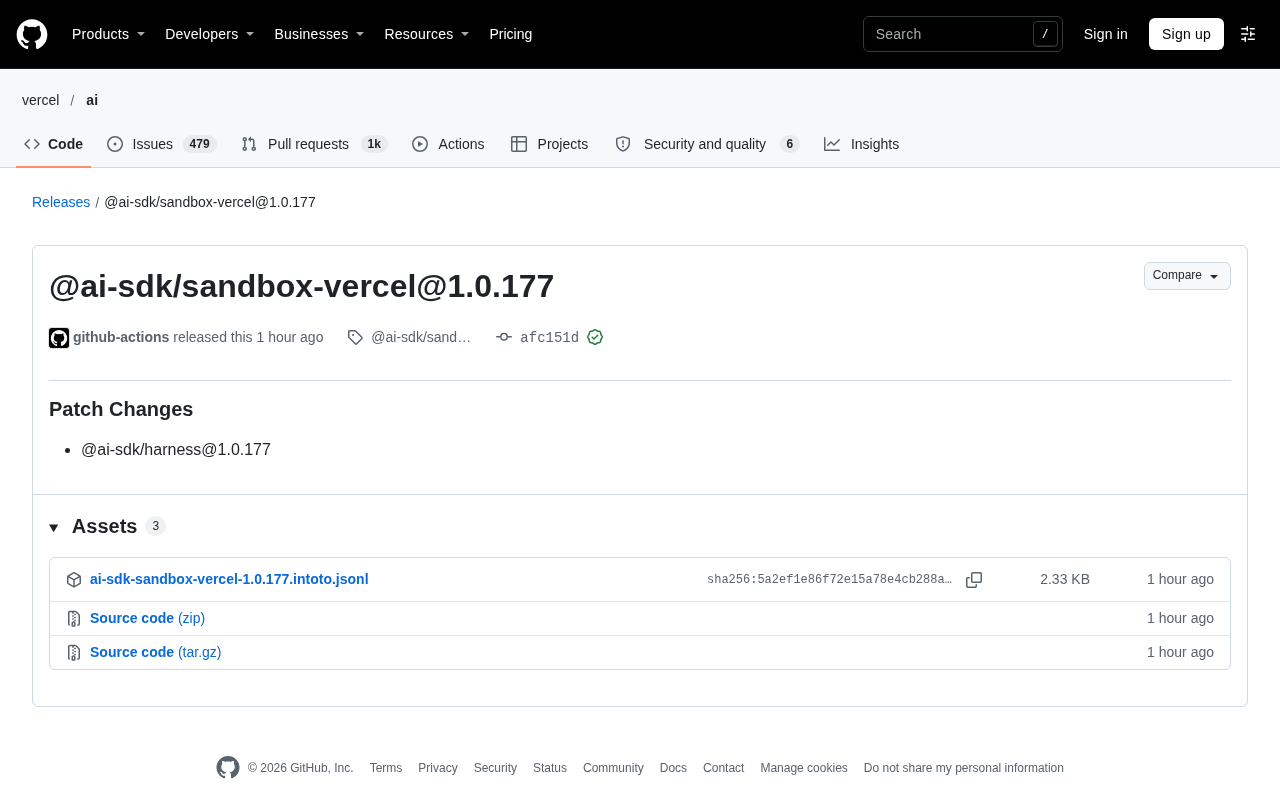
The `@ai-sdk/sandbox-vercel` package in the Vercel AI SDK ecosystem has released patch version 1.0.177, kept in sync with `@ai-sdk/harness` at the same version number. The release was completed automatically by github-actions and is a patch-level change, but the release notes do not disclose specific fixes, so the upgrade impact must be assessed independently. Sandbox capability is a key isolation layer for AI Agents executing generated code and tool calls, and its ongoing maintenance shows this chain has been brought into production-grade scope. The author recommends upgrading both packages in pairs, pinning versions at the lockfile level, and covering critical execution paths with your own tests rather than blindly following the high-frequency automated release cadence.
The Vercel AI SDK ecosystem has seen a small but noteworthy version iteration. The official repository released the @ai-sdk/sandbox-vercel@1.0.177 patch version, simultaneously updating the companion @ai-sdk/harness component. The release itself carries limited information, but against the backdrop of the AI SDK's rapid evolution, it still reveals a shift in how sandbox infrastructure is positioned within the AI application development pipeline.
What a Patch-Level Update Signals
According to the GitHub release record, the version number advanced from the 1.0.176 level to 1.0.177, falling under the Patch Changes category. The release was completed by an automated github-actions workflow at 02:56 on 09 Nov, with the commit carrying a GitHub-verified signature and a GPG key ID of B5690EEEBB952194.
From an engineering perspective, patch updates typically mean bug fixes, edge-case handling, or dependency version alignment rather than major capability expansion. @ai-sdk/sandbox-vercel and @ai-sdk/harness are released together with the same version number, indicating these two packages are managed on a tied release cadence and likely share the same build and test pipeline.
The direct value of this synchronized strategy for users is that there's no need to worry about version mismatches between the sandbox runtime and the execution framework when upgrading.
Where the Sandbox Fits in the AI SDK Architecture
The core positioning of the Vercel AI SDK is to simplify the integration and orchestration of large model capabilities. The name sandbox-vercel points to code execution sandbox capabilities—running AI-generated code or tool calls in a controlled environment.
This layer of capability is especially critical for building Agent-type applications. Model outputs need to be validated and executed, and the execution process must be isolated to avoid affecting the host environment. The ongoing maintenance of the sandbox package shows that this execution chain has been brought into production-grade maintenance scope rather than being an experimental add-on.
The synchronized update of @ai-sdk/harness suggests that the testing and evaluation framework is also evolving alongside. For developers, the testability of the sandbox directly determines debugging efficiency during integration.
Semantic Versioning (SemVer) and Patch Numbers
Semantic versioning follows the format major.minor.patch, where an increment in the patch number typically represents a backward-compatible bug fix that introduces no new features or breaking changes. In the npm ecosystem, range declarations like ^1.0.177 allow automatic pulling of patch and minor updates, so even patch-level releases can still enter production environments through dependency resolution. Understanding this helps assess the actual risk of a "small version": it may not change the API, but it can change runtime behavior—especially in infrastructure like sandboxes that are sensitive to isolation and stability, where it's still advisable to control upgrades through lockfiles and regression tests.
Code Execution Sandboxes for AI Agents
Agent-type applications often need to let large models generate and execute code and call external tools. Sandboxes constrain untrusted model outputs within controlled boundaries through process isolation, resource quotas, and file system and network access controls, preventing them from affecting the host environment or leaking sensitive data. Common implementations include containers, microVMs, and lightweight isolation based on system call filtering. For the AI SDK, the sandbox package's responsibility is to provide a unified execution abstraction so developers can safely run generated code without building their own isolation layer—which is why this capability is regarded as production-grade infrastructure rather than an experimental add-on.
How Developers Should Treat These Small Versions
When facing patch-level releases, the pragmatic approach is to fold them into your regular dependency update process. Since version numbers are tied together, @ai-sdk/sandbox-vercel and @ai-sdk/harness should be upgraded in pairs to avoid version drift caused by upgrading one package alone.
At the same time, it's important to recognize objectively that this release record does not disclose specific changes—the Patch Changes entry in the release notes only lists @ai-sdk/harness@1.0.177 without further explanation of what was fixed. This means the actual impact of the upgrade cannot be judged from the release page alone.
For teams using sandbox execution capabilities in production, it's recommended to pin versions at the lockfile level and, before upgrading, cover critical execution paths with your own test cases rather than blindly following the automated release cadence.
Lockfiles and Dependency Drift
Lockfiles (such as package-lock.json and pnpm-lock.yaml) record the exact versions and integrity hashes of the dependency tree, ensuring consistent installation results across different environments. If two packages share a release cadence but one is upgraded alone, "version drift" can occur: the interface assumptions between the sandbox runtime and the test harness become inconsistent, leading to hard-to-reproduce integration issues. Upgrading both in pairs and pinning versions at the lockfile level prevents the automated release cadence from penetrating directly into production while retaining the flexibility to upgrade in a unified way at a controlled time.
Observations on Ecosystem Maintenance Cadence
The high-frequency small releases of AI SDK-related packages reflect that this ecosystem is still in an active iteration phase. The introduction of automated release workflows lowers maintenance costs and also makes version numbers advance more densely.
The benefit of this model is that bug fixes reach users quickly; the cost is that the semantic information carried by version numbers themselves is diluted—consecutive patch number increments don't mean there's substantive change every time. Developers need to rely more on changelogs and commit records to judge upgrade value rather than the numerical magnitude of version numbers.
As the execution endpoint for AI applications in production, the stability of sandbox capabilities directly affects the reliability of Agent systems. Judging from this release, the maintainers are at least keeping this chain continuously updated, which is a positive signal for developers relying on the Vercel AI SDK to build execution-oriented AI applications.
One-line Summary
Vercel AI SDK sandbox package releases 1.0.177 patch, synchronized with harness, highlighting production-grade maintenance of the execution chain.
Paragraph Summary
The @ai-sdk/sandbox-vercel package in the Vercel AI SDK ecosystem has released patch version 1.0.177, kept in sync with @ai-sdk/harness at the same version number. The article notes that this release was completed automatically by github-actions and is a patch-level change, but the release notes do not disclose specific fixes, so the upgrade impact must be assessed independently. Sandbox capability is a key isolation layer for AI Agents executing generated code and tool calls, and its ongoing maintenance shows this chain has been brought into production-grade scope. The author recommends upgrading both packages in pairs, pinning versions at the lockfile level, and covering critical execution paths with your own tests rather than blindly following the high-frequency automated release cadence.
Related articles

Seven Years of Evolution: How Far Has the Foldable Come From the First Generation?
From the first foldable to today's latest models, what has seven years changed? Shallower creases, higher brightness, thinner bodies, and smoother software migration—has the foldable crossed the chasm from enthusiasts to ordinary users? This article discusses the question based on a video comparison.

When Did Humans Start Eating Salt? A 10,000-Year History of Salt
When did humans start eating salt? From salt use at the dawn of agriculture 11,000 years ago to ancient seawater evaporation and rock salt mining, and on to the salt trade, salt taxes, and Gandhi's Salt March, this article traces salt's key role in human civilization.
Microsoft Paza Research: How African Language Speech Recognition Breaks Through Architecture and Data Bottlenecks
Microsoft's Paza research evaluates 53 speech models across 39 African languages, revealing architecture choice matters more than pre-training coverage, 200-300 hours is the practical data threshold, and language typology deeply influences recognition performance.