Vercel AI SDK Ships Vue Patch Release: A Quiet Dependency Alignment
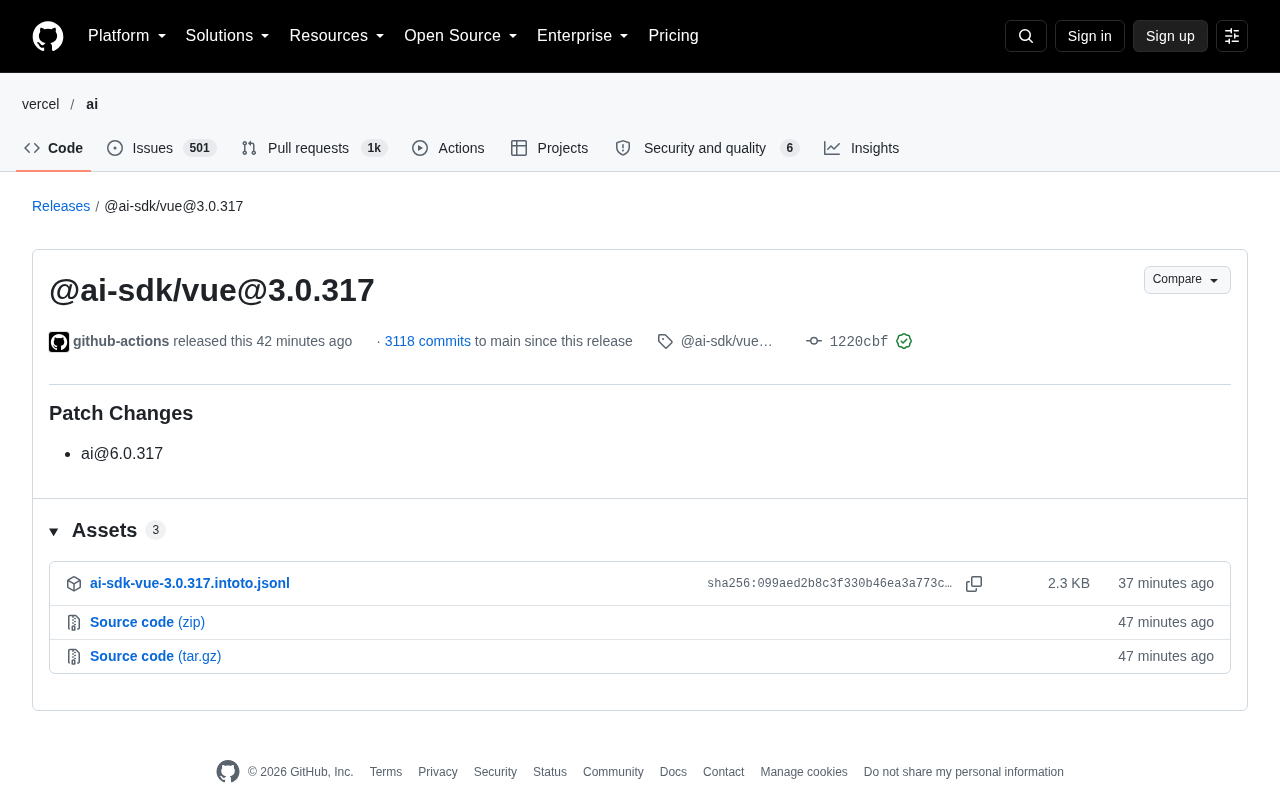
Vercel AI SDK's Vue binding layer ships a patch release that only syncs the core package version, with no API changes.
Vercel's AI SDK released @ai-sdk/vue@3.0.317 in the Vue ecosystem, with a release record containing only the line ai@6.0.317 — indicating the version merely follows the core package sync while the binding layer itself has no API changes. The release was automated by github-actions and carries a GPG signature, showing a standardized release pipeline. The article notes that this tight version alignment between adapter layer and core package reduces upgrade overhead, but also means developers must track the core ai changelog to judge real impact, and recommends locking both versions together to avoid hidden drift between patch releases.
A patch update with no explanation
Vercel's AI SDK has pushed @ai-sdk/vue@3.0.317 to the Vue ecosystem — a patch release. Judging from the release record on GitHub, the change consists of a single line: ai@6.0.317 — meaning this new version of the Vue adapter layer effectively points to a same-numbered update of the core ai package.
The release was completed automatically by the github-actions bot, carries a GitHub-verified signature, and the commit count on the main branch has reached 3,118. Releases like this are routine in open-source projects — no new feature announcements, no breaking-change notes. Yet it is precisely this "empty" update that reveals how the AI SDK is maintained on the Vue side: the adapter layer's version numbers are tightly aligned with the core package, staying in sync at the patch level.
The engineering intent behind version alignment
The synchronization mechanism between adapter layer and core package
@ai-sdk/vue is the Vue binding layer of the Vercel AI SDK, responsible for exposing capabilities such as streaming chat and generation state inside Vue components. Its release record references only ai@6.0.317, meaning this patch version does not change the Vue binding layer's own API — it simply follows along with fixes in the core package. For developers building AI chat interfaces with Vue, this pattern reduces the mental overhead of upgrading: when the core package fixes a bug, the Vue binding layer syncs via a patch version, and there is no need to separately investigate whether the adapter layer has independent changes.
The Vercel AI SDK uses a monorepo structure. The core ai package provides the underlying capabilities — unified language model invocation, streaming text generation, tool calling, and structured output — while framework binding layers such as @ai-sdk/vue and @ai-sdk/react are only responsible for wrapping those capabilities into reactive interfaces for the corresponding framework. In Vue's case, the binding layer typically exposes composables like useChat and useCompletion, internally converting the ReadableStream returned by the core package into Vue's ref / computed state. The binding layer itself does not implement model invocation logic, so when the core package only ships bug fixes, the binding layer needs no code changes — it only needs to bump its dependency version to the same number. That is why its release records often contain just a single line, ai@x.y.z — the version alignment is itself the change.
A reliability signal from automated releases
The release was triggered by the github-actions bot and marked with a verified GPG signature. Together, these two points indicate that the repository's release pipeline has been standardized: version numbers, changelogs, and signatures all come from CI rather than manual operations. For downstream dependents, automated releases combined with signature verification can theoretically reduce supply-chain risk and make the provenance of patch versions more traceable.
GPG signature verification corresponds to the provenance mechanism in the npm ecosystem. When enabled, a package built and published in CI generates a verifiable attestation recording the source commit, build environment, and release pipeline that produced it. Downstream developers or tools can use this to confirm that the tarball in hand was indeed built by the repository's GitHub Actions from a specified commit, rather than being tampered with locally and uploaded. Together with bot-account publishing and auto-generated changelogs, this forms a common supply-chain security practice. However, a signature only proves that the "source is trustworthy" — it does not mean the code has been human-reviewed. So for patch versions, it is still advisable to consult the core package's changelog to judge the actual impact.
The practical impact on AI developers in the Vue ecosystem
Judging from the patch number 3.0.317 alone, the Vue binding layer has iterated through quite a few patches on this major version. Continuous patch releases usually correspond to continuous fixes in the core package rather than architectural changes. If you are building an AI application with Vue that needs streaming output, upgrading to this version is a low-risk operation — but the release notes do not list specific fixes, so whether to upgrade depends on whether you have already been tracking changes in the core ai package.
It is worth noting that this release involves only a version reference, with no feature description whatsoever. For developers hoping the adapter layer would add new Vue composables or state-management improvements, this version brings no changes. It is more of a maintenance-oriented "sync update" than a capability expansion.
In semantic versioning (SemVer), 3.0.317 means major version 3, minor version 0, patch number 317. Under SemVer, the patch number should contain only backward-compatible bug fixes and should not introduce new APIs or breaking changes. A patch number that has accumulated into the three hundreds usually indicates either a very high release frequency or that every core-package release also triggers a synchronized release of the binding layer. This also means the size of the patch number alone cannot be used to infer the scale of changes — it reflects release count more than code change volume. To determine whether a given patch version is worth upgrading, the reliable approach is to compare the commit differences in the core ai package between adjacent versions, not to guess based on the version number.
How to interpret low-information releases like this
Against the backdrop of rapidly iterating AI toolchains, patch releases tend to be more frequent than feature releases. The release record for @ai-sdk/vue@3.0.317 has almost nothing to read, because the change details are all consolidated into the core ai package's updates. This carries a reminder for dependency management: if you use the AI SDK through the Vue binding layer, the actual functional changes should be found in the ai package's changelog — the Vue package's release notes are merely a sync marker.
From an engineering perspective, this "minimal change description" approach has both pros and cons. The upside is a clean release record that is hard to misread; the cost is that developers must follow updates across multiple packages to judge the real impact when upgrading. For long-term projects, it is advisable to lock the versions of the Vue binding layer and the core package together, to avoid hidden drift between patch versions.
One-line Summary
Vercel AI SDK's Vue binding layer ships a patch release that only syncs the core package version, with no API changes.
Related articles

Microsoft Fabric Database Agent in Action: From Reactive Firefighting to Intelligent Detective
A deep dive into the Microsoft Fabric Database Agent: how to enable it, supported monitoring scenarios, a blocking-issue demo, and the roadmap from reactive to autonomous operations.

Zendesk Uses ChatGPT Enterprise to Build a Sales Agent with 1,000 Daily Active Users
Zendesk opened ChatGPT Enterprise to all employees, who built about 600 apps themselves, including a sales expansion agent with about 1,000 daily active users. This article analyzes how it turns internal data into sales opportunities and its "don't wait" implementation strategy.

Google Releases Gemini 4 Carbon: Its Strongest Model Yet, Debuting with a Cybersecurity Focus
Google releases Gemini 4 Carbon, calling it its strongest model, with a cybersecurity focus. It tops the third-party composite ranking at 59 points but leads by only one or two. This article analyzes its security test results, staged rollout, token pricing, and the divergence between self-reported and third-party tests on hallucinations.