Vercel AI SDK Svelte 3.0.254 Update: What's New

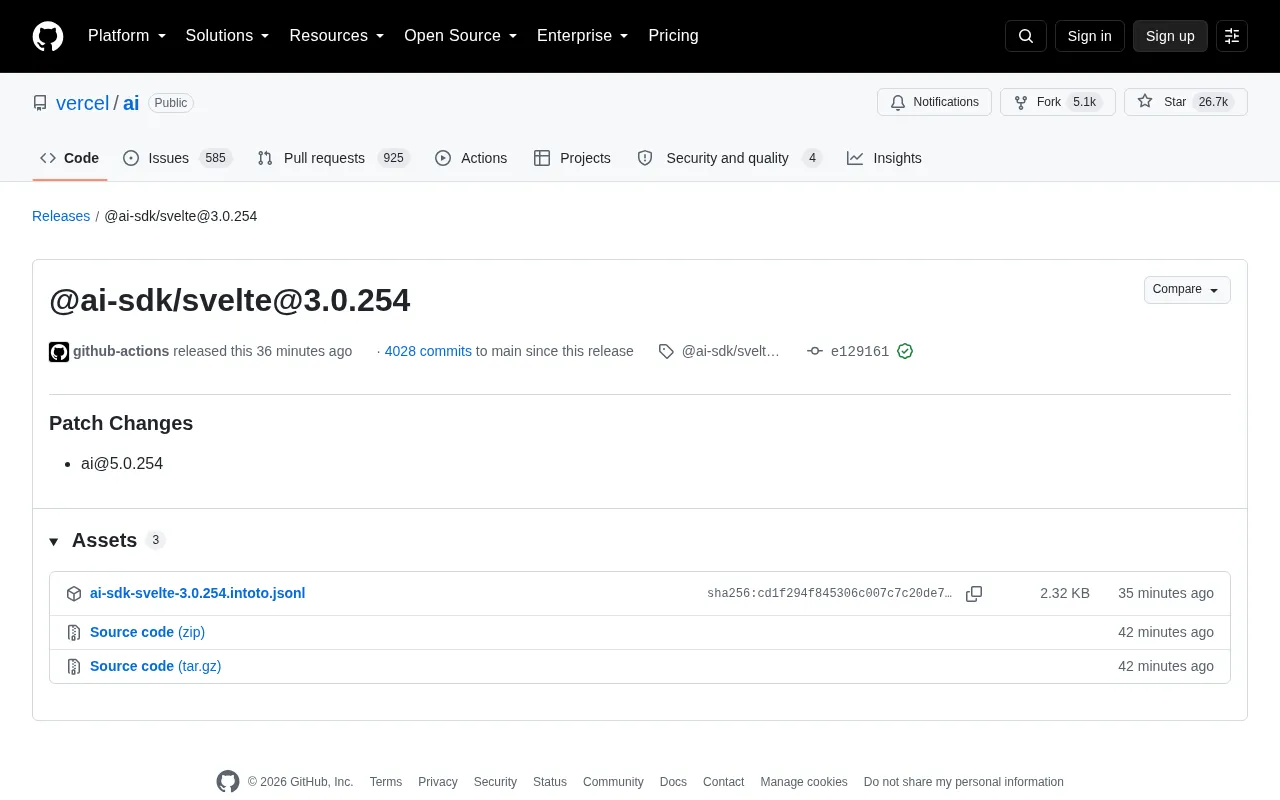
@ai-sdk/svelte 3.0.254 patch release syncs the underlying AI SDK to 5.0.254 — seamless upgrade, no breaking changes.
Vercel AI SDK's Svelte adapter, `@ai-sdk/svelte`, has released patch version 3.0.254. The core change is syncing the underlying dependency to `ai-sdk` 5.0.254, maintaining compatibility between the adapter layer and core functionality. As a patch-level update, it introduces no breaking changes — projects can upgrade directly via npm or pnpm without modifying existing code. The Vercel AI SDK is an open-source project with over 26.7k GitHub stars, offering a unified AI integration solution for React, Vue, Svelte, and other frameworks, supporting chat, streaming text generation, and multi-model access.
Overview
Vercel AI SDK has released version 3.0.254 for the Svelte framework. As a core component of the Vercel AI SDK ecosystem, @ai-sdk/svelte provides Svelte developers with a complete toolchain for building AI-powered applications.
What's Changed
This is a patch release that includes the following changes:
Core Dependency Sync
The primary change in this update is syncing the underlying AI SDK dependency to version 5.0.254. This version alignment strategy ensures compatibility between the Svelte adapter layer and the core AI functionality, allowing developers to benefit from the latest optimizations and fixes in the underlying SDK.
Technical Significance
As a patch-level update, this release focuses on stability improvements and bug fixes — with no breaking changes. Existing projects can upgrade safely without worrying about API compatibility issues. Developers currently using Vercel AI SDK to build Svelte applications are encouraged to update promptly for the best stability.
The Vercel AI SDK Ecosystem
Vercel AI SDK is an open-source project with over 26.7k stars and 5.1k forks on GitHub, reflecting a highly active community. The project provides a unified AI integration solution for multiple mainstream frontend frameworks — including React, Vue, and Svelte — significantly lowering the barrier for developers to integrate AI capabilities into their applications.
Use Cases
@ai-sdk/svelte is particularly well-suited for the following scenarios:
- Building Svelte applications with chat interaction features
- Web apps that integrate streaming text generation
- Projects that need rapid access to multiple AI models
- Frontend AI solutions that prioritize lightweight performance
Upgrade Guide
For projects currently using an older version of @ai-sdk/svelte, you can update via your package manager:
npm install @ai-sdk/svelte@3.0.254
# or
pnpm update @ai-sdk/svelte
Since this is a patch release, the upgrade process is seamless and requires no code changes. That said, it's still recommended to test thoroughly in your development environment before deploying to production, to confirm compatibility with your project's other dependencies.
Looking Ahead
As AI technology becomes more deeply integrated into frontend development, tools like Vercel AI SDK will continue to play a critical role. For Svelte developers, staying up to date with @ai-sdk/svelte releases helps keep your tech stack both cutting-edge and stable.
Related articles

LLM Application Development: A High-Paying Career Guide for Ordinary People
LLM application development offers fresh graduates up to 35K/month, with SP offers reaching 600K. This article explains the core skills, how to break in, and how ordinary people can seize AI opportunities through learning by doing.

Say Goodbye to AI Influencer Faces: A Complete Guide to Creating Visual Assets for AI Comic Dramas from Scratch
Bilibili creator shares a full workflow for zero-basics AI comic drama visual assets: use Doubao Work skills with script-first, visual references, and real-person texture to escape AI influencer faces, then lock character and scene consistency with asset sheet layouts, weapon detail images, scene nine-grids, and cinematic color palettes.

The AI Production Pipeline Behind Great Videos: From Research to Agent Validation
AI video production isn't just a model race. This article breaks down a transferable four-step pipeline: researching professional workflows, organizing a skill checklist, configuring agents, and experimental validation—and explains how general-purpose LLMs like DeepSeek can replace paid tools to run the entire process.