Vercel's New Defense Line: Blocking Malicious npm Packages Before and During Installation
Vercel launches an npm malicious package interception mechanism that automatically blocks known malicious dependencies before and during installation.
Vercel has recently introduced a proactive defense mechanism for the npm ecosystem that automatically checks for and blocks malicious npm packages before and during dependency installation. Based on a blocklist, the mechanism covers lockfile checks and public npm download interception, and is automatically applied to new builds on all plans without extra configuration. When a blocked dependency is detected, deployment fails with the package name and version indicated, and build caches are attempted to be invalidated. The remediation is to update dependencies to safe versions, update the lockfile, and redeploy. This reflects the shift-left security trend, but it mainly guards against known malicious package versions and should be combined with other security practices.
Amid increasingly frequent software supply chain attacks, Vercel has recently introduced a proactive defense mechanism for the npm ecosystem: automatically checking for and blocking malicious npm packages before and during dependency installation, thereby preventing malicious install scripts from executing in the build environment. This capability aims to move the security perimeter earlier, intercepting known malicious dependencies already at the deployment stage.
Checking Mechanism: Dual Interception Before and During Installation
According to Vercel's official documentation, the check is based on a blocklist that lists specific package versions flagged for malware or security vulnerabilities. These rules typically sync to new builds within minutes, ensuring newly emerging threats are quickly covered.
Specifically, the check occurs at two key points:
- Before installation: Vercel checks supported lockfiles, and the check is performed even when dependencies are restored from the build cache.
- During installation: Vercel blocks the download of affected public npm packages, preventing malicious packages from entering the build process.
This dual-stage design makes it difficult for attackers to bypass security policies through cache restoration or the download step. Before deployment, Vercel's existing checks on installed dependencies and function outputs continue to run, forming multiple layers of protection.
Lockfiles (such as package-lock.json, yarn.lock, pnpm-lock.yaml) record the exact versions and sources of a project's dependency tree, ensuring consistent installation results across different environments. Vercel checking the lockfile before installation means that even if dependencies have not yet been downloaded, it can compare the locked version numbers against the blocklist and detect risks in advance. Meanwhile, the build cache may retain previously downloaded dependency packages; if a cached package is later flagged as malicious, the pre-installation check prevents it from being restored and used.
Automatic Enforcement, No Extra Configuration Required
For teams using Vercel, a notable feature of this protection is zero configuration. These safeguards are automatically applied to new builds on all plans, and developers do not need to modify project settings or add extra scripts. For detected blocked dependencies, Vercel directly fails the deployment and clearly identifies the blocked package name and version in the error message. At the same time, the system attempts to invalidate affected build caches to prevent problematic dependencies from continuing to spread through the cache.
Response and Remediation Process
Once a deployment fails due to a blocked dependency, the official remediation path is: update the dependency to a safe version, update the lockfile, and redeploy. Although this process is simple, it requires teams to promptly follow security updates for dependencies. For projects with deep dependency trees or many transitive dependencies, tools may be needed to analyze which upstream package introduced the blocked version.
The Industry Trend of Shifting Security Left
Vercel's capability reflects an important trend in software supply chain security in 2026: shifting security checks as far left as possible, completing interception before code enters the build pipeline. Traditional security scanning often occurs after dependency installation and before deployment, by which point malicious install scripts may have already finished executing. By moving checks earlier—before and during installation—Vercel directly cuts off the window for malicious scripts to run, which is especially critical for defending against attacks launched via scripts such as postinstall.
However, this blocklist-based mechanism also has its limits: it primarily guards against known malicious package versions, and new attacks not yet listed or risks from private packages still require other security measures. Developers should treat such platform-level protection as one layer of defense in depth, not a replacement for foundational practices such as dependency auditing and source verification.
Software supply chain attacks refer to attackers compromising links in the software development lifecycle (such as dependency packages, build tools, and distribution channels) to implant malicious code, thereby affecting large numbers of downstream users. The npm ecosystem, due to its openness and vast dependency network, is a high-incidence area for such attacks. Common techniques include dependency confusion (uploading malicious public packages with the same names as internal packages), name squatting attacks (exploiting abandoned package names), and executing arbitrary commands at install time through postinstall scripts. Vercel's blocklist mechanism targets these known attack patterns and intercepts them at the installation stage.
Key Takeaways
- Vercel checks a blocklist before and during dependency installation to prevent malicious npm packages from executing install scripts
- The check covers lockfiles and public npm downloads, and is automatically applied to new builds on all plans
- When a blocked dependency is detected, the deployment fails with the package version indicated, and affected caches are attempted to be purged
- The remediation is to update dependencies to safe versions, update the lockfile, and redeploy
Related articles

Skykea Showdown: A Hilarious Variety Show Experience of a Minecraft Airship Building Competition
Skykea Showdown is a Minecraft airship building racing variety show. This article analyzes its two-phase build + hole race format, airship mod lift physics, secret mission design, and team confrontation dynamics—ideal for game content creators.

Did the US Midterms Vote No to AI Data Centers? A Map Reveals the Truth
After the US midterms, media claimed voters rejected AI data centers, but a map shows restrictive votes are concentrated in a few Ohio townships, affecting less than 1% of US towns—the national anti-AI wave is exaggerated.
ApexW Optimizer Benchmark: Matches 8-bit AdamW in Unsloth with Lower Memory Usage
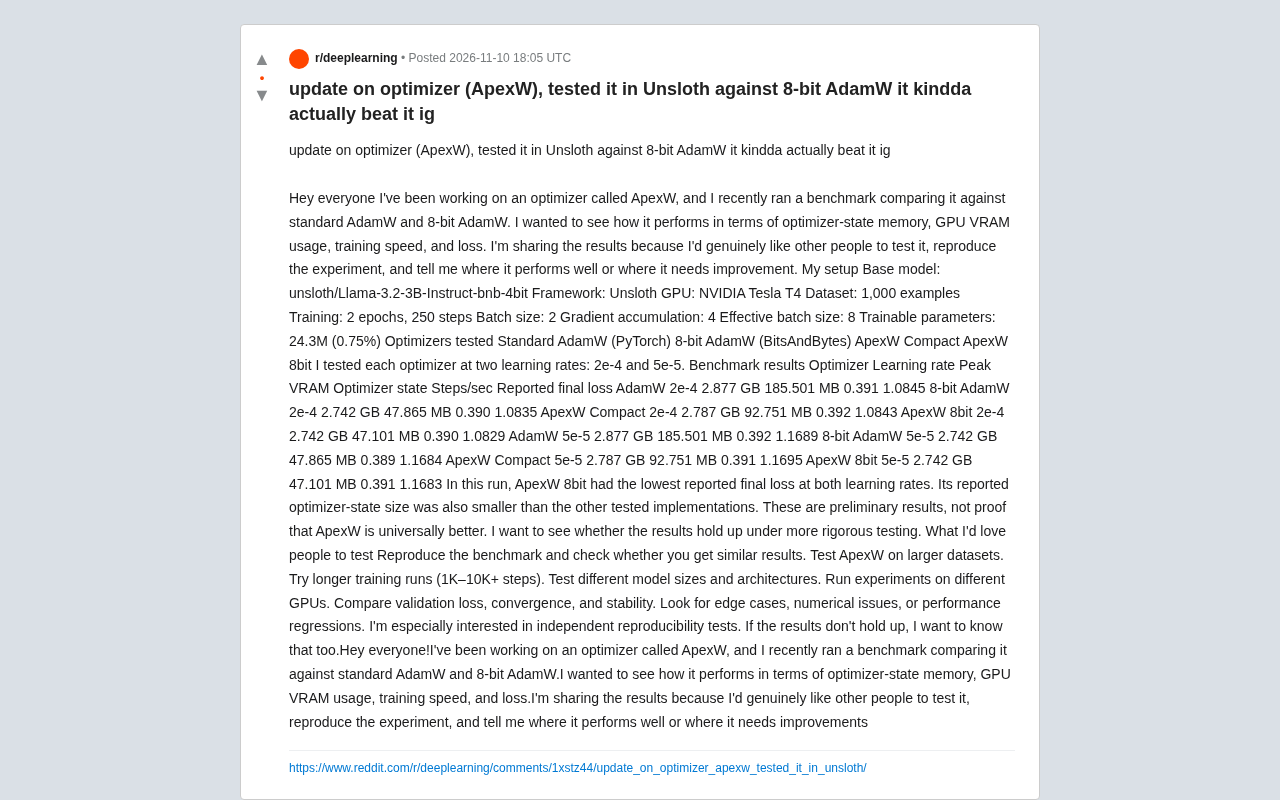
Developer shares benchmark of ApexW optimizer in Unsloth: ApexW 8bit has lower optimizer state memory (47.101 MB) and slightly better final loss than 8-bit AdamW, but similar speed. Needs independent reproduction.