Vercel Token Pass Upgrade: $150 in Token Credits for $30/Month
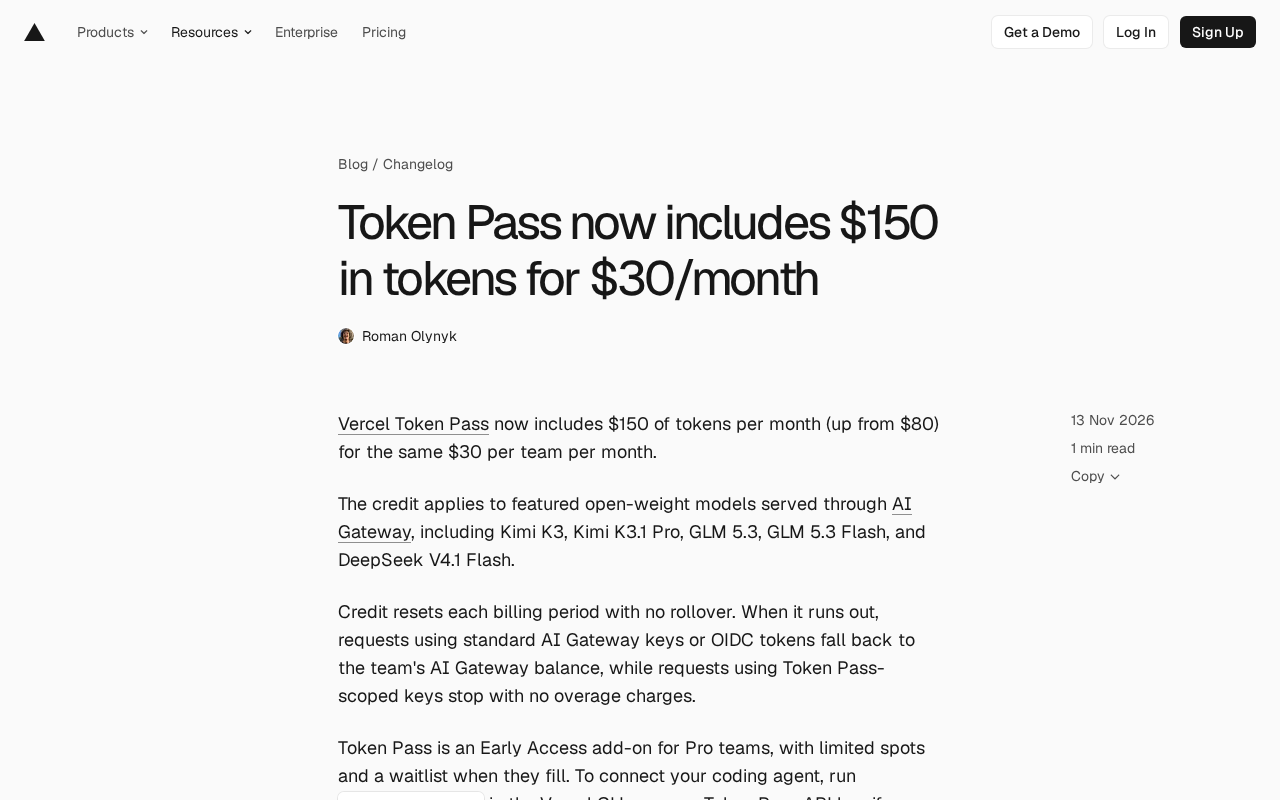
Vercel Token Pass keeps its monthly fee but raises token credits from $80 to $150, covering multiple open-weight models.
Vercel announced a credit upgrade for its Token Pass add-on: the subscription price stays at $30 per team per month, while monthly token credits rise from $80 to $150—nearly double. The credit applies to featured open-weight models offered through the AI Gateway, including Kimi K3, Kimi K3.1 Pro, GLM 5.3, GLM 5.3 Flash, and DeepSeek V4.1 Flash. Credits reset per billing cycle and do not accumulate; once exhausted, requests using a standard AI Gateway key or OIDC token fall back to the team's Gateway balance for continued billing, while requests using a Token Pass–scoped key stop directly with no overage charges, effectively providing a hard budget ceiling. The feature is currently an Early Access add-on for Pro teams with limited spots, accessible to coding agents via the vercel token-pass command in the Vercel CLI or a Token Pass API key.
Vercel's Token Pass service has received a significant credit increase. According to the official RSS announcement, Token Pass now provides each team with $150 in token credits per month, up from the previous $80, while the subscription price remains unchanged at $30 per team per month.
The Model Lineup Behind the Doubled Credits
The core appeal of this upgrade lies in the available model list. The $150 credit applies to featured open-weight models offered through the AI Gateway, specifically including Kimi K3, Kimi K3.1 Pro, GLM 5.3, GLM 5.3 Flash, and DeepSeekAd V4.1 Flash.
For development teams that frequently call open-weight models, raising the credit from $80 to $150 means nearly double the usable call volume. Vercel's choice of these models for the credit coverage also reflects its bet on the open-source model ecosystem—these models often offer strong cost-effectiveness in coding agent scenarios.
AI Gateway is a model routing and unified access layer provided by Vercel: developers make requests against a single API specification in their code, and the Gateway forwards them to models from different vendors while handling authentication, usage metering, rate limiting, and fallback in a unified way. Its value lies in freeing teams from maintaining separate SDKs, keys, and billing accounts for each model provider, and in making it easy to compare and switch between multiple models. The reason Token Pass credits can cover models from multiple vendors is precisely this layer of abstraction—the credit is essentially an available balance under the Gateway account, rather than a quota for any specific model service.
Open-weight models refer to models whose parameter weights can be publicly downloaded and that allow self-deployment or third-party hosting, as opposed to black-box closed-source models that only offer an API. The Kimi, GLM, and DeepSeek series mentioned in the article all fall into this category. For development teams, open-weight models are typically cheaper and offer more hosting options, giving them a clear cost-effectiveness advantage in high-frequency, long-context, trial-and-error scenarios like coding agents. This is one of the reasons Vercel chose these models to fill out the credit coverage.
Credit Usage Rules and Fallback Mechanism
The announcement clearly explains the boundary conditions for credit consumption. Credits reset per billing cycle and do not accumulate, meaning unused portions are not carried over to the next month.
When credits are exhausted, behavior differs by key type: requests using a standard AI Gateway key or OIDC token fall back to the team's AI Gateway balance for continued billing, while requests using a Token Pass–scoped key stop directly and incur no overage charges. This design effectively gives teams a hard budget ceiling—if you want strict cost control, using a Token Pass–scoped key avoids unexpected bills.
OIDC token (OpenID Connect token) is an identity credential issued based on an open standard, commonly used to establish keyless trust between services. In Vercel's scenario, functions or build tasks deployed on the platform can automatically obtain a short-lived OIDC token and use it to prove their identity and team ownership to the AI Gateway, eliminating the need to store static API keys long-term in environment variables. Compared with hardcoded keys, OIDC tokens rotate automatically and have limited scope, reducing the risk of leakage. This also explains the distinction in the announcement: OIDC tokens are team-level identities, so after credits are exhausted they naturally fall back to the team's AI Gateway balance; whereas Token Pass–scoped keys are confined to that add-on, and become invalid once credits run out.
Access Methods and Eligibility
Token Pass is currently an Early Access add-on for Pro teams, with limited spots available; once full, teams enter a waitlist.
There are two ways to connect coding agents: run the vercel token-pass command in the Vercel CLI, or use a Token Pass API key if the agent supports AI Gateway. The subscription entry point is located in the AI Gateway dashboard.
From a product strategy perspective, Token Pass is positioned to reduce the friction for teams trying multiple open-source models—covering calls to several popular models with a fixed monthly fee, while providing a cost guardrail through scoped keys. With the credit raised to $150, this add-on has become more attractive to small and medium-sized development teams.
Early Access is a common release format for SaaS products: the feature is usable but not fully open, typically accompanied by limited spots, terms that may change, and a lack of full SLA and documentation. For users, the benefit is early access to new capabilities and often more favorable pricing; the cost is no guarantee of stability or long-term availability, and the feature may change shape or pricing at general availability. The article notes that Token Pass enters a waitlist once full, meaning this add-on currently resembles a limited-capacity gray release, through which Vercel validates its billing model and usage distribution under controlled load.
Scoped key refers to an API key whose permissions are explicitly limited to a certain resource or feature scope, as opposed to a key with full account-level permissions. Scoped keys follow the principle of least privilege, so even if leaked, the impact is confined to the corresponding feature. In Token Pass's design, scoped keys serve both as permission isolation and as a hard budget ceiling.
Editor's Observations
This adjustment did not change the subscription price but instead improved cost-effectiveness by raising the credit. At a time when coding agents consume large amounts of tokens, teams have become more sensitive to model call costs, and Vercel responded to this demand with a credit expansion. However, the Early Access limited-spot mechanism means that not all Pro teams can use it immediately in the short term.
The announcement was co-signed by Caleb Boyd, Krish, Rohan Taneja, and Jonathan Simcoe.
Related articles

Why Microsoft CEO Nadella Still Backs Nvidia After Jensen Huang's Departure
Microsoft CEO Nadella publicly expresses confidence in Nvidia interim CEO Colette Kress. This article analyzes Nvidia's power transition after Jensen Huang's departure, Microsoft's compute dependency, and the trust logic of the AI supply chain.

Nadella: Critical Infrastructure Is 'Unpatchable' as AI Cybersecurity Arms Race Escalates
Microsoft CEO Nadella addresses AI cyberattack fears, saying much critical infrastructure is unpatchable, downplaying the Outlook outage, and analyzing AI's dual role in cybersecurity.

Musk Backs Jensen Huang: Firing Him Is Like Cutting Jordan
Musk says Jensen Huang is loyal to the U.S. and likens firing him to cutting Michael Jordan—highlighting politicization anxieties in the AI chip industry and defending talent value.