VHDL Standard Float Package Miscalculates sqrt(2), Sparks Debate in Hardware Design Community

VHDL standard float package miscalculates sqrt(2), exposing reliability risks in hardware standard libraries.
The Hacker News community disclosed that the VHDL standard float package produces an incorrect result when computing sqrt(2), raising concerns about hardware design standard library reliability. The article analyzes that the error may stem from a typo in the standard specification or a defect in the reference implementation, and notes that because VHDL is widely used in FPGA/ASIC design, such errors may lead to simulation-synthesis mismatch, cross-toolchain behavior differences, and weakened trust in the standard. It also emphasizes the importance of community oversight and independent verification, recommending engineers verify critical computation paths themselves and monitor IEEE standard updates and tool vendor patches. Finally, it reminds readers that the report is based on a single community source, and the specific manifestation and scope of impact still require confirmation from official documentation and actual testing.
An Error That Shouldn't Exist: sqrt(2) in the VHDL Standard Float Package
In hardware design, VHDL (VHSIC Hardware Description Language) is an IEEE standard language whose standard library accuracy directly affects the correctness of countless chip design projects. However, a discussion on Hacker News revealed an unsettling fact: the VHDL standard's float package produces an incorrect result when computing sqrt(2).
This discovery was disclosed by community members on a technical forum and quickly drew attention with 7 comments. Although the discussion wasn't particularly heated, the issue itself touches on the sensitive topic of standard library reliability—when developers rely on standard libraries for mathematical operations, they assume these implementations have been rigorously verified.
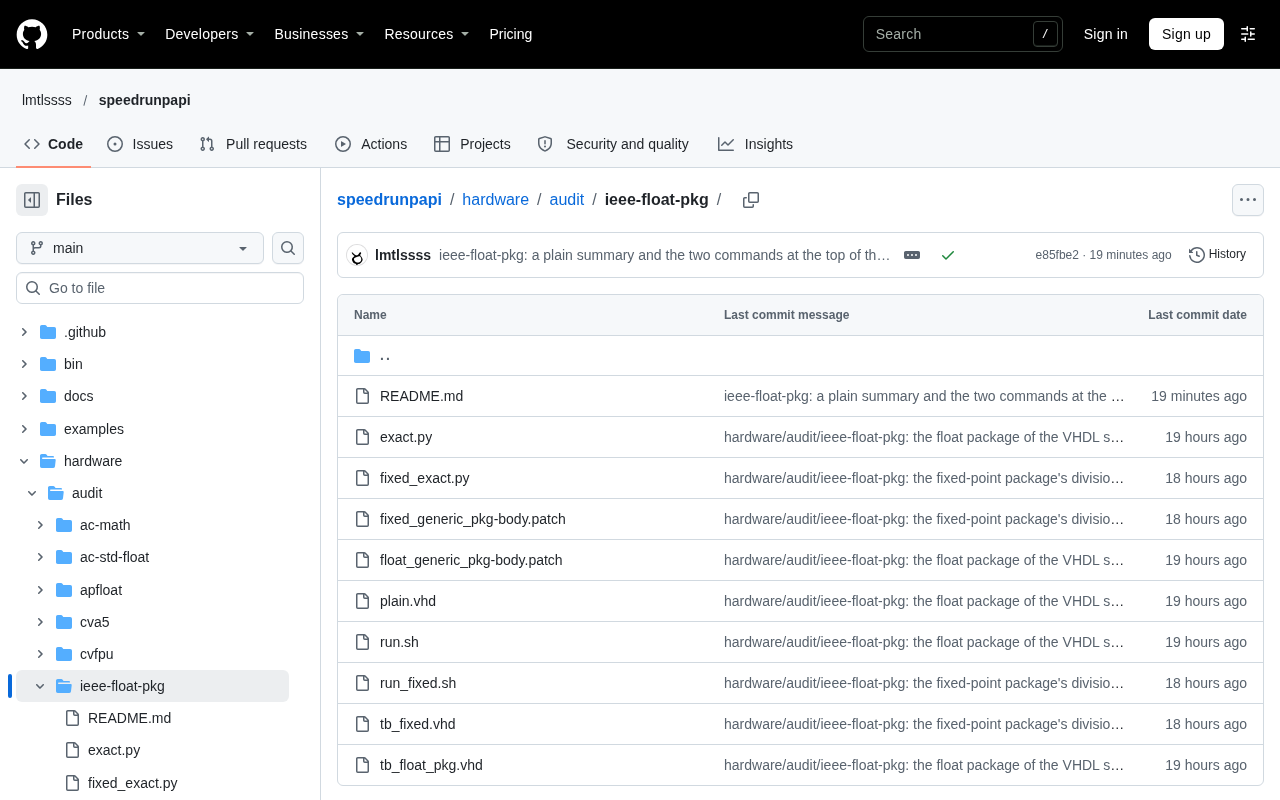
Technical Details Behind the Error
According to the Hacker News discussion, the problem lies in the float arithmetic package defined by the VHDL standard. sqrt(2) is an irrational number whose correct value is approximately 1.41421356..., but in the implementation or specification of this standard package, the computed result deviates from this.
To be clear, this is not a simple rounding error. In floating-point arithmetic, rounding is expected behavior, but a standard library should provide the closest approximation to the correct value at a given precision. If the result of sqrt(2) deviates beyond a reasonable range, it means the implementation logic or specification itself has a flaw.
In the discussion, some commenters pointed out that such problems may stem from typos in the standard document when defining algorithms, or code errors in the reference implementation. Since the VHDL standard is maintained by IEEE, any specification-level error affects all toolchains and projects that follow the standard.
VHDL's float package (float_pkg) is part of the IEEE 1076.2 standard, which defines a general package for implementing IEEE 754 floating-point operations in VHDL. This package is not a built-in language feature but a reference implementation provided by the standard document, typically distributed as source code and integrated into their own libraries by various EDA tool vendors. Since VHDL was originally oriented toward synthesizable hardware design, floating-point operations were only widely supported later; float_pkg's design goal is to provide consistent mathematical behavior in simulation and synthesis. However, unlike standard libraries of software languages, VHDL standard package implementations often lack large-scale automated testing and fuzz testing like glibc or musl; their reference implementations exist more as appendages to specification text, with limited verification intensity.
IEEE 754 Floating Point and Rounding
IEEE 754 is the floating-point arithmetic standard followed by almost all computer systems today, defining representations, rounding rules, and special values (such as NaN and infinity) for formats like single precision (binary32) and double precision (binary64). In IEEE 754, sqrt is listed as one of the correctly rounded basic operations: for a given input and precision, the result should be the closest floating-point number to the exact square root after correct rounding. That is, sqrt(2) has a uniquely determined correct result in double precision (approximately 1.4142135623730951), and any implementation deviating by more than half a ULP constitutes an error, not an acceptable precision difference. The VHDL float package claims to follow IEEE 754, so if its sqrt(2) error exceeds the rounding range, it is a defect at the implementation or specification level, not inherent uncertainty of floating-point arithmetic.
Potential Impact on the Hardware Design Community
VHDL is widely used in FPGA and ASIC design, especially in fields with extremely high reliability requirements such as aerospace, communications, and defense. Errors in the standard float package can have cascading effects:
- Simulation-synthesis mismatch: If a simulator uses the standard package to compute sqrt(2) while the synthesis tool uses a different implementation, functional verification may pass but actual hardware behavior may deviate.
- Cross-toolchain differences: VHDL tools from different vendors may implement the standard package differently; errors may be masked in some tools and exposed in others.
- Crisis of trust: Errors in standard libraries undermine developers' trust in the standard itself, pushing teams toward custom math libraries and increasing project complexity and verification burden.
Comments on Hacker News also noted that similar problems are not unprecedented in standard libraries of other languages, but as a hardware description language, VHDL's errors have more fundamental and insidious effects—software bugs can be patched, but hardware errors after tape-out are extremely costly.
VHDL Simulation and Synthesis Toolchain
The VHDL toolchain is generally divided into two categories: simulators and synthesis tools. Simulators (such as ModelSim, GHDL, Vivado Simulator) directly execute VHDL code and call functions in the standard package to compute floating-point results; synthesis tools (such as Synopsys Design Compiler, Vivado Synthesis) need to map floating-point operations to hardware logic or IP cores. Since float_pkg's reference implementation is pure VHDL code, simulators generally reference it directly, while synthesis tools may use their own optimized implementations or call vendor floating-point IP. This "same standard, multiple implementations" pattern means that errors in the standard package manifest inconsistently across tools: a simulator may faithfully reproduce the error while a synthesis tool may give the correct result due to a different algorithm, or vice versa. This is precisely the root of simulation-synthesis mismatch risk and the reason standard library errors are harder to locate in hardware design than in software.
Lessons from Standard Maintenance and Community Response
This incident once again highlights the value of the open-source community in standard maintenance. Although the discussion on Hacker News was small in scale, it played a whistleblower role, bringing a potentially long-latent problem into public view.
For engineers using the VHDL float package, it is recommended to perform independent verification on critical computation paths, especially in scenarios involving irrational number operations. At the same time, pay attention to IEEE standard updates and tool vendor patch announcements. At the community level, disclosure of such issues helps push standards organizations to establish stricter testing mechanisms for reference implementations.
In hardware design, every numerical value in a standard library carries expectations from the physical world. The sqrt(2) error reminds us: trust in standards must be built on continuous verification, not default assumptions.
IEEE Standards Maintenance Process and Reference Implementation Testing
The IEEE 1076 series of standards is maintained by working groups under the Design Automation Standards Committee (DASC) of the IEEE Computer Society. The revision cycle of standard documents is usually measured in years and relies mainly on volunteers and a few corporate representatives. Reference implementations (such as the VHDL source code of float_pkg) are often released together with standard documents, but their test suites are not as open and transparent as open-source software projects, and they lack continuous integration and regression testing mechanisms. If the sqrt(2) error disclosed by the community is confirmed, possible remediation paths include: correcting the specification text in the next version of the standard, having tool vendors patch their respective libraries, or fixing it first in open-source VHDL implementations (such as GHDL's library). This incident contrasts with how similar problems in software standard libraries are handled—the latter usually have CVE numbers, security advisories, and rapid patch channels, while errors in hardware standard libraries lack response infrastructure of the same level. This itself is a structural gap that the hardware design community needs to confront.
Multi-Source Cross-Verification
This report is based on discussion content from a single source, Hacker News, and no official IEEE response or independent reporting from other technical media has been obtained. Therefore, the specific manifestation, scope of impact, and root cause analysis of the error described in this article all come from community discussion, and readers should make judgments in conjunction with official documentation and actual toolchain testing.
One-line Summary
VHDL standard float package miscalculates sqrt(2), exposing reliability risks in hardware standard libraries.
Paragraph Summary
The Hacker News community disclosed that the VHDL standard float package produces an incorrect result when computing sqrt(2), raising concerns about the reliability of hardware design standard libraries. The article analyzes that the error may stem from a typo in the standard specification or a defect in the reference implementation, and points out that because VHDL is widely used in FPGA/ASIC design, such errors may lead to simulation-synthesis mismatch, cross-toolchain behavior differences, and weakened developer trust in the standard. The article also emphasizes the importance of community oversight and independent verification, recommending that engineers verify critical computation paths themselves and pay attention to IEEE standard updates and tool vendor patches. Finally, it reminds readers that this report is based on a single community source, and the specific manifestation and scope of impact still need to be confirmed by official documentation and actual testing.
Related articles

Gemini 4 Neon Hands-On: Value King or Confident Catastrophe?
Gemini 4 Neon review: 1M-token context, four thinking levels, 201 files in one KingBench4 pass at one-tenth Fable 5.2's cost—but it hallucinates fake data, leaves 7 symlink escapes, and bricks keyboards.

Google Gemini 4 Neon Hands-On: 6 3D Works That Impress and Fail
Hands-on with Google Gemini 4 Neon on a 3060 laptop: 6 3D works tested. Sunshower Fishing Harbor and mechanical keyboard impress; soft-body physics and faces fall short.

Gemini 4 Neo Web Novel Writing Test: Faint AI Flavor, Textured Dialogue
Bilibili creator's first-look review of Gemini 4 Neo for Chinese web novel writing: testing a Three Kingdoms transmigration opening with faint AI flavor, emotionally textured dialogue, and strong crisis building, plus comparison of 4A/4H/4C models and full workflow demos.