vLLM Delivers Day-0 Support for MiniMax M3.1 Flash: Engineering Optimizations for Automation and Visual Reasoning

MiniMax M3.1 Flash gets Day-0 vLLM support, targeting multi-step automation and code engineering.
MiniMax launches M3.1 Flash, positioned not as a general chatbot but for multi-step automation, real-codebase engineering, and visual reasoning. vLLM provides Day-0 support on release day, enabling immediate deployment in a production-grade inference framework. The serving stack includes three key optimizations: native NVFP4 KV cache and NVFP4 MoE weights to compress memory for long contexts and high concurrency, plus DSpark speculative decoding to boost throughput without changing output distribution—dedicated tuning for this model. Day-0 support reflects pre-release engineering collaboration and shows inference framework competition shifting from model coverage to per-model optimization depth. The article notes that parameter scale, context window, and benchmarks are not yet public, so actual performance should be judged by the official model card and independent evaluations.
Model Positioning: Targeting Multi-Step Automation and Real-Codebase Engineering
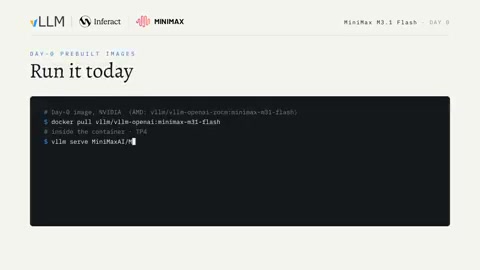
MiniMax's M3.1 Flash is not a general-purpose chat model; it explicitly targets three high-difficulty scenarios: multi-step automation tasks, real-codebase engineering, and visual reasoning. According to vLLM's official announcement on X, the model received Day-0 support from vLLM on its release day, meaning developers can deploy it immediately in a production-grade inference framework without waiting for community adaptation.
Multi-step automation and codebase-level engineering place far higher demands on a model than single-turn Q&A: it needs to maintain consistency over long contexts, preserve state across multiple tool calls, and make reasonable inferences about cross-file code dependencies. The addition of visual reasoning further broadens the use cases—for example, extracting information from UI screenshots or architecture diagrams and converting it into executable steps.
Three Key Engineering Optimizations in the Serving Stack
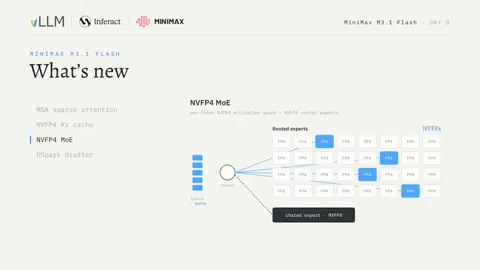
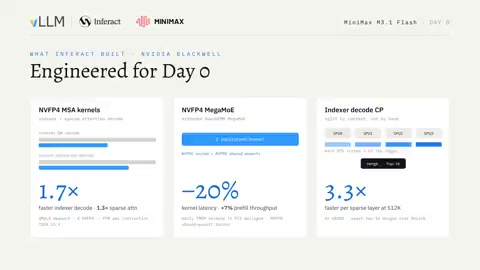
vLLM's announcement highlights three technical configurations in the serving stack: native NVFP4 KV cache, NVFP4 MoE weights, and DSpark speculative decoding. Together, these determine whether the model can "run at all and run fast" under real workloads.
NVFP4 KV Cache and MoE Weights
The KV cache is one of the main GPU memory bottlenecks in long-context inference. Storing the KV cache in NVFP4 precision can significantly compress memory usage while maintaining usable accuracy, thereby supporting longer conversation histories and more complex multi-step tasks. MoE weights are likewise loaded in NVFP4 format, indicating that the model uses a mixture-of-experts architecture and that vLLM has adapted low-precision handling at the weight-loading layer.
The impact of low-precision quantization on deployment cost is direct: lower memory requirements mean a single GPU can host a larger model or higher concurrency, which is especially critical for scenarios that require running automation tasks over long periods.
NVFP4 is a 4-bit floating-point data format introduced by NVIDIA on the Blackwell architecture. It is a variant in the FP4 family that uses scaling factors, positioned similarly to formats such as MXFP4 but with different details. Its numerical representation consists of an extremely narrow mantissa and exponent, combined with block-wise shared scaling factors to extend the representable dynamic range. As a result, in scenarios where weight and activation distributions are relatively concentrated, it can maintain acceptable accuracy at bit widths significantly below FP8/FP16. For inference, the practical value of NVFP4 is not only memory savings but also that hardware such as Blackwell has native support for FP4 matrix operations and dequantization, so the low-precision path does not incur an additional compute penalty. It is worth noting that FP4's accuracy loss is more severe for data sensitive to long-range dependencies, such as the KV cache. It usually requires per-channel or per-token scaling strategies, as well as possibly keeping sensitive layers at higher precision, to avoid quality degradation in long-context tasks.
Mixture-of-Experts (MoE) architecture refers to a model composed of multiple feed-forward "expert" subnetworks plus a routing gate, where each token activates only a few experts. This keeps the computation of a single forward pass relatively small even when the total parameter count is large. This structure affects deployment in two ways: first, memory usage is determined by the total parameter count—the more experts and the larger the total weights, the more pronounced the memory pressure, which is the direct reason MoE weights need NVFP4 compression; second, load imbalance—routing may cause popular experts to receive too many tokens, creating compute and bandwidth bottlenecks, so inference frameworks typically need mechanisms such as expert parallelism, capacity factor control, and token reordering. For this reason, inference optimization for MoE models depends heavily on framework-level specialized adaptation; generic loading paths often fail to deliver their due performance.
DSpark Speculative Decoding
Speculative decoding uses a small model to quickly generate candidate tokens, which are then verified in parallel by the large model, improving throughput without changing the output distribution. vLLM has integrated DSpark speculative decoding for M3.1 Flash, indicating that the official team performed dedicated performance tuning for this model's decoding path rather than only generic adaptation.
The core of speculative decoding is a two-stage "guess—verify" process: a draft model or draft head first rapidly generates several candidate tokens autoregressively, and the target large model then performs a single parallel forward pass over this candidate segment, validating position by position and keeping the prefix consistent with its own distribution. Once a position is rejected, all subsequent candidates are discarded. Because the verification stage can be completed in parallel, and the number of accepted tokens determines the actual speedup, the benefit depends heavily on draft quality and task predictability—repetitive scenarios such as code completion and structured text usually have higher acceptance rates, while open-ended creation is lower. Engineering-wise, it is also necessary to handle KV cache rollback and reuse, as well as scheduling waste caused by inconsistent accepted lengths across sequences in batched requests. These details determine whether speculative decoding can realize its theoretical throughput gains under real concurrent workloads.
What Day-0 Support Means
Day-0 support is a notable signal in the open-source inference ecosystem. It usually means that the model team and the inference framework team have already collaborated engineering-wise before release, with the model architecture, weight formats, and decoding characteristics incorporated into the framework's optimization path in advance. For users, the most direct benefit is saving the time cost of self-porting and tuning, allowing evaluation and prototype validation immediately after the model is released.
From an ecosystem perspective, vLLM's rapid follow-up on MiniMax's new model also reflects that competition among inference frameworks has shifted from "how many models are supported" to "how deeply a specific model is optimized."
The difference between Day-0 support and Day-1 support is worth distinguishing: Day-0 usually means the framework can load and correctly run inference on the day the model is released, often accompanied by architecture documentation, weight format conventions, and even joint debugging provided by the model team before release; Day-1 generally refers to the community completing initial adaptation on its own after the model is made public. The former is closer to "usable and tuned," while the latter focuses on "getting it to run." In frameworks like vLLM, Day-0 support generally means the model architecture has been registered in the framework's model implementation, quantization formats and parallelism strategies have been aligned, and there may be kernels or scheduling optimizations specific to the model. This also explains why frameworks promote Day-0 as a selling point—it is both proof of engineering collaboration depth and a means of attracting developers to choose their framework during the model's initial release period.
Applicable Scenarios and Deployment Recommendations
Based on the official description, typical uses of M3.1 Flash include automated refactoring and bug fixing with the codebase as context, multi-step operation agents that require visual input, and long-chain tool-calling tasks. During deployment, priority should be given to confirming whether the runtime environment supports NVFP4 precision, and to evaluating the gains of DSpark speculative decoding under actual workloads.
It should be noted that the currently public information comes only from vLLM's release post. The model's benchmark results, context window size, and specific parameter scale have not yet been disclosed in the source material, and actual performance should still be based on the official model card and independent evaluations.
Related articles

The Truth Behind Titanic's Sinking: Key Decisions and Communication Failures in the National Geographic Documentary
National Geographic's The Unsinkable Ship uses survivor testimony to reconstruct Titanic's fatal decisions—from the missing MSG telegram prefix and the broken boiler-room-to-bridge link to how 'unsinkable' thinking delayed damage control and evacuation.

74M-Parameter Open-Source Model Partially Outperforms Jev AI in Testing
Fastino AI's Glider 2.5 models, with just 74M–300M parameters, reportedly outperform Jev AI in some guardrail benchmarks per YouTube testing, run on consumer hardware, and even play Doom. We analyze small models' competitiveness and deployment value on specific tasks.

Gemini 4 Argon Hands-On: Aggressive Pricing, 3D Capabilities Need Coaching
Gemini 4 Argon hands-on: limited-time $2/$10 pricing, million-token output, strong 3D and reverse-engineering work, but weak front-end aesthetics and zero-shot ability need coaching.